Peter Campbell

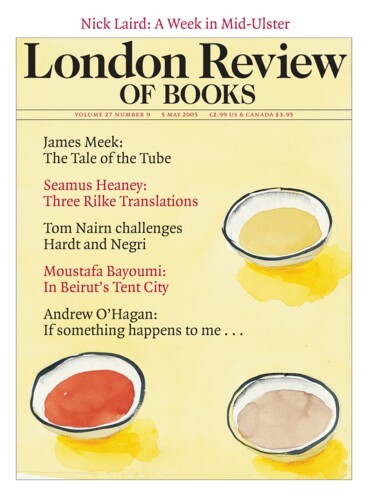
Peter Campbell, who was born in Wellington in New Zealand in 1937 and died in London in 2011, designed the LRB and wrote more than three hundred pieces for the paper, including, from 2000, a regular gallery piece. He also did the cover illustrations from 1993 until his death: his last, a fox in the street outside his house, was painted only a few weeks earlier. Many of these covers, as well as some of his other illustrations and book designs, can be seen in the collection Artwork and at petercampbell.org.uk.

Mary-Kay Wilmers, who first worked with him on the Listener in the late 1960s, when he designed the books for such BBC series as Kenneth Clark’s Civilisation and Jacob Bronowski’s The Ascent of Man, wrote about his capacious interests. When there wasn’t an exhibition he liked, he described what he saw around him: gasometers, plane trees, beaches (and untucked shirts), funfairs, the squares of Bloomsbury (where the LRB offices are), the timber-framed houses of Wellington. He was also interested in how things work, writing memorably about escalators. There were, as Wilmers wrote, ‘few aspects of the world that Peter didn’t wish to honour’.

At the V&A: Penguin’s 70th birthday

Peter Campbell, 2 June 2005

When Hans Schmoller​ first saw a copy of John Berger’s Ways of Seeing – the book was published in 1972 – he hurled it across the room. Schmoller, who had succeeded Jan Tschichold as designer at Penguin in 1949, was a subtle practitioner of traditional book design. His pages were balanced, proper and elegant. He hated the pages of black sans serif type, punctuated with...
Aphotograph from a 35 mm film, shot with a normal 50 mm lens, matches up pretty well to what you think you see when you glance at a place or a room. An image printed from a bigger piece of film holds more information: you may, for example, be able to take a magnifying glass and read titles on the spines of books which would be too far away were you standing where the camera stood. Records of...

Oil paint, the most powerful of mediums, can also be nasty-looking stuff. Watercolour can be feeble or messy, tempera can lack verve, distemper can look flat, but none of them has oil paint’s potential for unpleasantness. Its physical qualities – its brilliance, the way impasto can give weight to a brush stroke, the way one colour can merge with another on the canvas, the way it...

At Kew: The New Alpine House

Peter Campbell, 21 April 2005

Anew Alpine House​ is due to open later this year in the Royal Botanic Gardens at Kew. But you can already get a good idea of how it will look. Its footprint is small but the curved profile of its glass walls stands surprisingly high on the garden horizon. Think of it as a miniature version of the Wembley arch, the Gherkin, the London Eye – other landmarks which have bubbled up on the...

The total area of sky in Caravaggio’s paintings covers, by my count, no more than a few square inches tucked away in the corners of two quite early pictures. Otherwise his subjects are set up on crowded, enclosed stages. As time goes by general illumination is replaced by angled shafts of light. If the action takes place outdoors it is at night by lantern light. The even light of the...

Read anywhere with the London Review of Books app, available now from the App Store for Apple devices, Google Play for Android devices and Amazon for your Kindle Fire.

Sign up to our newsletter

For highlights from the latest issue, our archive and the blog, as well as news, events and exclusive promotions.

Newsletter Preferences