Peter Campbell

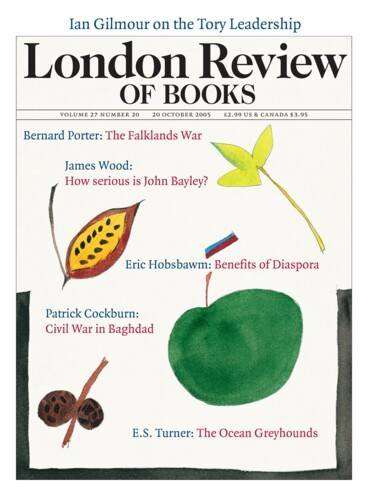
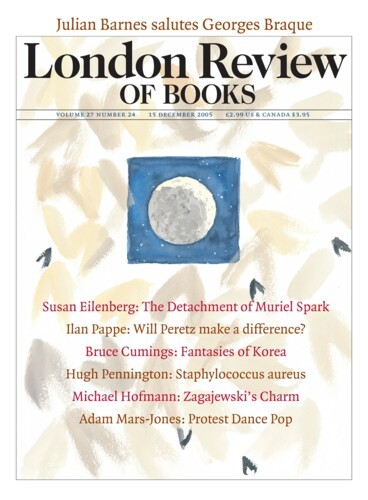
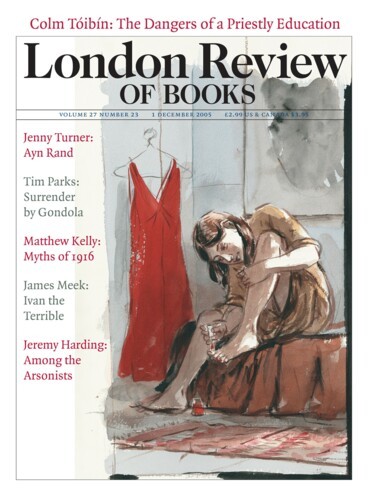
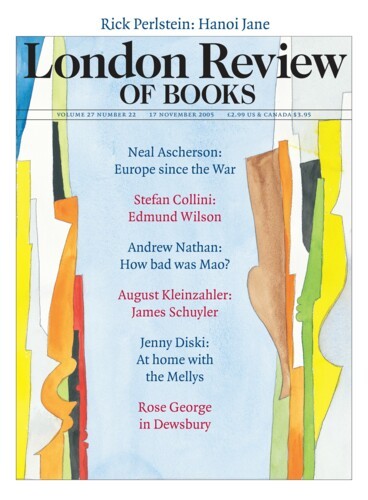
Peter Campbell, who was born in Wellington in New Zealand in 1937 and died in London in 2011, designed the LRB and wrote more than three hundred pieces for the paper, including, from 2000, a regular gallery piece. He also did the cover illustrations from 1993 until his death: his last, a fox in the street outside his house, was painted only a few weeks earlier. Many of these covers, as well as some of his other illustrations and book designs, can be seen in the collection Artwork and at petercampbell.org.uk.

Mary-Kay Wilmers, who first worked with him on the Listener in the late 1960s, when he designed the books for such BBC series as Kenneth Clark’s Civilisation and Jacob Bronowski’s The Ascent of Man, wrote about his capacious interests. When there wasn’t an exhibition he liked, he described what he saw around him: gasometers, plane trees, beaches (and untucked shirts), funfairs, the squares of Bloomsbury (where the LRB offices are), the timber-framed houses of Wellington. He was also interested in how things work, writing memorably about escalators. There were, as Wilmers wrote, ‘few aspects of the world that Peter didn’t wish to honour’.

Short Cuts: the Regent Street lights

Peter Campbell, 15 December 2005

It’s the time of year when the kinds of thing that are done with light are very like those which, if done with a spray-can, would have boys up in front of the magistrates. Above Regent Street there is a parade of panels peppered with blue lights. Large snowflakes flick on and off. Cut-outs of a cartoon sabre-tooth tiger, mammoth and sloth advertise the cartoon Ice Age 2: The Meltdown...
Get planting: Why Trees Matter

Peter Campbell, 1 December 2005

They are pollarding the plane trees in our street. They do it every few years: left to themselves, branches would overtop the houses by many metres and form a summer tunnel of green. In other places and at other times the lopped branches would have been a resource. In Trees and Woodland in the British Landscape (1976), Oliver Rackham makes a distinction between wood and timber. Wood, the...

‘Cornfield by Moonlight, with the Evening Star’, c.1830.

Samuel Palmer​ had one pocket in his coat for a sketchbook and one for Milton. He recalled the years he was living in Shoreham, the decade from 1825 to 1835, as spent ‘cultivating, among good books, a fastidious and unpopular taste’. During that time he made the pictures for which he is now famous: shepherds...

Edvard Munch’s art was made from his troubles. When, in middle age, he retreated to the estate he had bought on the outskirts of Oslo (then still called Kristiania), love affairs, drink, a nervous breakdown and illness had already supplied the subject-matter his peculiarly subjective art required. The ideas he developed early he went on using. Late in his career he wrote: ‘The...

Early evenings are upon us, bringing the concomitant pleasure of looking at dusk into the lit rooms of strangers. To assuage the curiosity partial views of private places elicit we have London Open House, the scheme which allows you to get inside quite a number of the buildings that these glimpsed rooms make you wonder about. This year it fell on 17 and 18 September. Walking the streets of...

Read anywhere with the London Review of Books app, available now from the App Store for Apple devices, Google Play for Android devices and Amazon for your Kindle Fire.

Sign up to our newsletter

For highlights from the latest issue, our archive and the blog, as well as news, events and exclusive promotions.

Newsletter Preferences