Peter Campbell

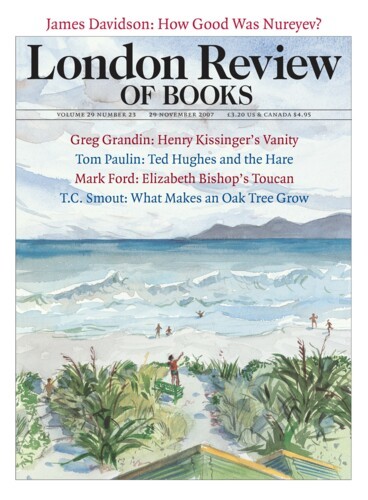
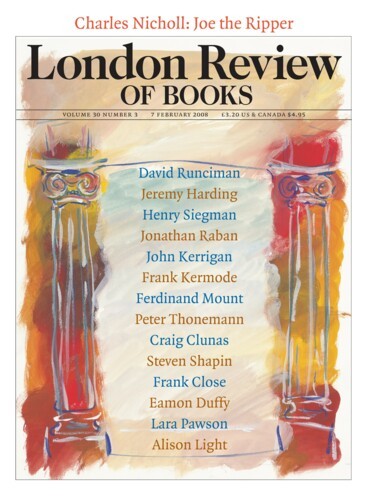
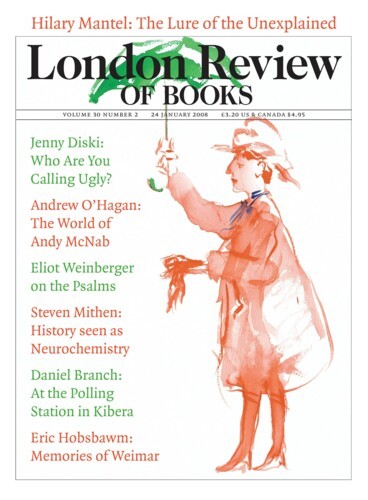
Peter Campbell, who was born in Wellington in New Zealand in 1937 and died in London in 2011, designed the LRB and wrote more than three hundred pieces for the paper, including, from 2000, a regular gallery piece. He also did the cover illustrations from 1993 until his death: his last, a fox in the street outside his house, was painted only a few weeks earlier. Many of these covers, as well as some of his other illustrations and book designs, can be seen in the collection Artwork and at petercampbell.org.uk.

Mary-Kay Wilmers, who first worked with him on the Listener in the late 1960s, when he designed the books for such BBC series as Kenneth Clark’s Civilisation and Jacob Bronowski’s The Ascent of Man, wrote about his capacious interests. When there wasn’t an exhibition he liked, he described what he saw around him: gasometers, plane trees, beaches (and untucked shirts), funfairs, the squares of Bloomsbury (where the LRB offices are), the timber-framed houses of Wellington. He was also interested in how things work, writing memorably about escalators. There were, as Wilmers wrote, ‘few aspects of the world that Peter didn’t wish to honour’.

At the Royal Academy: From Russia

Peter Campbell, 7 February 2008

The pictures, Russian and French in about equal numbers, lent for the exhibition From Russia – at the Royal Academy until 18 April – were made in the last quarter of the 19th century and the first quarter of the 20th. Early publicity for the show concentrated on the French paintings. This was not, I think, because we are familiar with the work of Cézanne, Matisse, Picasso...
At the National Gallery: Good Enough to Eat

Peter Campbell, 24 January 2008

Tortured saints and dead children can be made beautiful; dead animals can too

Joan Eardley was only 42 when she died in 1963. She was born in England but her life was in Scotland. Two Scottish subjects dominate the current exhibition of her work (at the National Gallery of Scotland until 13 January): paintings of children from the tenements near her Glasgow studio, and of the land and sea around Catterline, a village on the east coast, south of Aberdeen, which she...

Global Moods: Art, Past and Present

Peter Campbell, 29 November 2007

Julian Bell has written a tremendous history of world art, one that will inevitably be compared with Gombrich’s The Story of Art, published nearly sixty years ago. Since then image-making technologies that seemed mature have changed and expanded their reach. In 1950 we lived in an image flood. We are now, as Bell puts it, in an image jam. As you turn the pages of Mirror of the World and skip from illustration to illustration you feel the jostle of hundreds of other images that could equally well have been chosen as landing places, while thousands more that make no claim to be works of art still demand attention. The very persistence of art objects can seem a burden. Of a New Ireland mask Bell writes: ‘the mask, like the malanggans, New Ireland’s giant funerary complexes of carving, would probably on principle have been consigned to the fire. That is, until European collectors created a market for “primitive” exotica.’ The plate of available art is piled higher and higher. Will appetite fail?

At Tate Modern: Louise Bourgeois

Peter Campbell, 29 November 2007

Full recognition came late to Louise Bourgeois. Born in France in 1911, she married the American art historian Robert Goldwater in 1938 and moved to New York, where she worked first as a painter and then, after 1940, mainly as a sculptor and assembler of installations. The catalogue of the exhibition of her work at Tate Modern (until 20 January) consists mainly of handsomely illustrated,...

Read anywhere with the London Review of Books app, available now from the App Store for Apple devices, Google Play for Android devices and Amazon for your Kindle Fire.

Sign up to our newsletter

For highlights from the latest issue, our archive and the blog, as well as news, events and exclusive promotions.

Newsletter Preferences