Perry Anderson

Perry Anderson’s books include Lineages of the Absolutist State, The Origins of Postmodernity, Passages from Antiquity to Feudalism and Ever Closer Union? Europe in the West. He is a professor of history and sociology at UCLA and sits on the editorial board of New Left Review. He has written more than fifty pieces for the LRB, on subjects including his father’s career in the Chinese Customs Service, Lula’s Brazil, Michael Oakeshott, Anthony Powell, Dmitri Furman, the modern political histories of Italy, Turkey, France, and India and the failings of the EU.

Of all postwar institutions in the public eye, the United Nations has probably yielded the poorest literature. With the exception of two lucid studies of its foundation, Robert Hildebrand’s Dumbarton Oaks (1990) and Stephen Schlesinger’s Act of Creation (2003), each the work of a serious diplomatic historian, little or nothing of analytic interest exists about the organisation,...
Russia’s Managed Democracy: Why Putin?

Perry Anderson, 25 January 2007

Under lowering skies, a thin line of mourners stretched silently outside the funeral hall. Barring the entrance, hulking riot police kept them waiting until assorted dignitaries – Anatoly Chubais, Nato envoys, an impotent ombudsman – had paid their respects. Eventually they were let in to view the corpse of the murdered woman, her forehead wrapped in the white ribbon of the Orthodox rite, her body, slight enough anyway, diminished by the flower-encrusted bier. Around the edges of the mortuary chamber, garlands from the media that attacked her while she was alive stood thick alongside wreaths from her children and friends, the satisfied leaf to leaf with the bereaved. Filing past them and out into the cemetery beyond, virtually no one spoke. Some were in tears. People dispersed in the drizzle as quietly as they came.

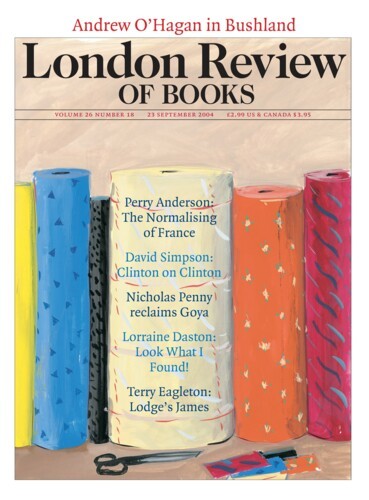
Union Sucrée: The Normalising of France

Perry Anderson, 23 September 2004

“The wider puzzle remains: what explains the strange contrast between a unique literary cosmopolitanism and so much intellectual parochialism in France? It is tempting to wonder whether the answer lies simply in the relative self-confidence of each sector: the continuing native vitality of French history and theory inducing indifference to foreign output, and the declining prestige of French letters prompting compensation in the role of a universal dragoman. There may be something in this, but it cannot be the whole story.”

Dégringolade: The Fall of France

Perry Anderson, 2 September 2004

“The French National Assembly is the weakest parliament in the Western world, with more than one resemblance to the echo chambers of the First Empire. The current ruler of the country would be in the dock for malversation had a constitutional court not hastened to grant him immunity from prosecution: a trampling of equality before the law that not even his Italian counterpart, in what is usually imagined to be a still more cynical political culture, has been able to secure. Foreign policy is a mottled parody of Gaullism: vocal opposition to the pretext for war in the Middle East, followed by practical provision of airspace and prompt wishes for victory once the attack was under way. At home the prestige of public works, as late as the 1990s still a touchstone of national pride, lies in the mortuary dust and rubble of Roissy.”

“Whatever the short-term eventualities, the long-term prospects of China ever accepting a breakaway of Taiwan seem small. From the standpoint of the nation-state, for a former province without ethnic difference from the majority population to attempt independence is secession. So far, no nation-state has ever permitted this. Freely to accept the independence of Taiwan would, in the eyes of the central government, be to invite a dynamic of disintegration along Yugoslav lines.”

The Murmur of Engines: A Historian's Historians

Christopher Clark, 5 December 2024

Perry Anderson brings a peculiar gift to the work of criticism: he can step into a book and inspect it closely, even sympathetically, scrutinising its structures, immersing himself in its style and atmosphere;...

Read more reviews

You need a gun: The A-Word

Wolfgang Streeck, 14 December 2017

What​ is the relationship between coercion and consent? Under what circumstances does power turn into authority, brute force into legitimate leadership? Can coercion work without consent? Can...

Read more reviews

‘It is a sign​ of true political power when a great people can determine, of its own will, the vocabulary, the terminology and the words, the very way of speaking, even the way of...

Read more reviews

What We Have: Tarantinisation

David Bromwich, 4 February 1999

Post-Modernism entered the public mind as a fast-value currency in the late Seventies and early Eighties, in the field of architecture, where its association with gimmicky tropes of visual play...

Read more reviews

Post-Nationalism

Geoffrey Hawthorn, 3 December 1992

For the past thirty years, New Left Review has been the most consistently interesting political journal in the country. And Perry Anderson, who used to edit it and still helps direct it, has been...

Read more reviews

What would socialism be like?

Geoffrey Hawthorn, 1 March 1984

Joseph Schumpeter had a refreshing sense of socialism. For him, it had almost no fixed sense at all. ‘A society may be fully and truly socialist and yet be led by an absolute ruler or be...

Read more reviews

English Marxists in dispute

Roy Porter, 17 July 1980

The Englishness of English historians lies in their eclecticism. Few would admit to being unswerving Marxists, Freudians, Structuralists, Cliometricians, Namierites, or even Whigs. Most believe...

Read more reviews

Read anywhere with the London Review of Books app, available now from the App Store for Apple devices, Google Play for Android devices and Amazon for your Kindle Fire.

Sign up to our newsletter

For highlights from the latest issue, our archive and the blog, as well as news, events and exclusive promotions.

Newsletter Preferences