Perry Anderson

Perry Anderson’s books include Lineages of the Absolutist State, The Origins of Postmodernity, Passages from Antiquity to Feudalism and Ever Closer Union? Europe in the West. He is a professor of history and sociology at UCLA and sits on the editorial board of New Left Review. He has written more than fifty pieces for the LRB, on subjects including his father’s career in the Chinese Customs Service, Lula’s Brazil, Michael Oakeshott, Anthony Powell, Dmitri Furman, the modern political histories of Italy, Turkey, France, and India and the failings of the EU.

“If the movement is to have staying power, it will have to develop beyond the fixations of the fan club, the politics of the spectacle, the ethics of fright. For war, if it comes, will not be like Vietnam. It will be short and sharp; and there is no guarantee that poetic justice will follow. A merely prudential opposition to the war will not survive a triumph, any more than handwringing about its legality a UN figleaf.”
The Cardoso Legacy: Lula’s Inheritance

Perry Anderson, 12 December 2002

For two decades – more or less since the Falklands War, and the end of the military dictatorships that had become an international byword for counter-revolutionary ferocity – South America has been largely forgotten by world politics. Recycled democratisation, debt and dependency offered few conflicts and yielded no consequences to compare with dramas in Eastern Europe or Russia,...

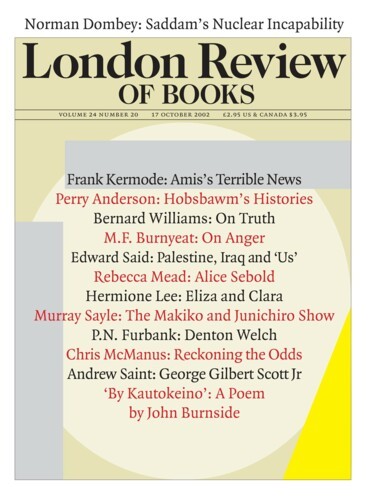
Confronting Defeat: Hobsbawm’s Histories

Perry Anderson, 17 October 2002

Historically, in truth, ‘representative democracy is rarely a convincing way of running states.’ Amid the reigning gabble of non-stop ñ bureaucratic, academic, journalistic ñ democratese, such astringency is a bracing corrective. If any testimony were needed of just how unassimilable Hobsbawm’s work is to any comfortable consensus, these acrid verdicts would be enough.

The Age of EJH: Eric Hobsbawm’s Memoirs

Perry Anderson, 3 October 2002

Hobsbawm calls this combination of loyalty and ambition a form of egoism, which he does not defend. Most people would see in it evidence of an exceptional integrity and strength of character: a courage to take unpopular positions all the more striking in one for whom success has plainly mattered so much.

Italy has long occupied a peculiar position within the concert of Europe. By wealth and population it belongs alongside France, Britain and Germany as one of the four leading states of the Union. But it has never played a comparable role in the affairs of the continent, and has rarely been regarded as a diplomatic partner or rival of much significance. Its image lacks any association with...

The Murmur of Engines: A Historian's Historians

Christopher Clark, 5 December 2024

Perry Anderson brings a peculiar gift to the work of criticism: he can step into a book and inspect it closely, even sympathetically, scrutinising its structures, immersing himself in its style and atmosphere;...

Read more reviews

You need a gun: The A-Word

Wolfgang Streeck, 14 December 2017

What​ is the relationship between coercion and consent? Under what circumstances does power turn into authority, brute force into legitimate leadership? Can coercion work without consent? Can...

Read more reviews

‘It is a sign​ of true political power when a great people can determine, of its own will, the vocabulary, the terminology and the words, the very way of speaking, even the way of...

Read more reviews

What We Have: Tarantinisation

David Bromwich, 4 February 1999

Post-Modernism entered the public mind as a fast-value currency in the late Seventies and early Eighties, in the field of architecture, where its association with gimmicky tropes of visual play...

Read more reviews

Post-Nationalism

Geoffrey Hawthorn, 3 December 1992

For the past thirty years, New Left Review has been the most consistently interesting political journal in the country. And Perry Anderson, who used to edit it and still helps direct it, has been...

Read more reviews

What would socialism be like?

Geoffrey Hawthorn, 1 March 1984

Joseph Schumpeter had a refreshing sense of socialism. For him, it had almost no fixed sense at all. ‘A society may be fully and truly socialist and yet be led by an absolute ruler or be...

Read more reviews

English Marxists in dispute

Roy Porter, 17 July 1980

The Englishness of English historians lies in their eclecticism. Few would admit to being unswerving Marxists, Freudians, Structuralists, Cliometricians, Namierites, or even Whigs. Most believe...

Read more reviews

Read anywhere with the London Review of Books app, available now from the App Store for Apple devices, Google Play for Android devices and Amazon for your Kindle Fire.

Sign up to our newsletter

For highlights from the latest issue, our archive and the blog, as well as news, events and exclusive promotions.

Newsletter Preferences