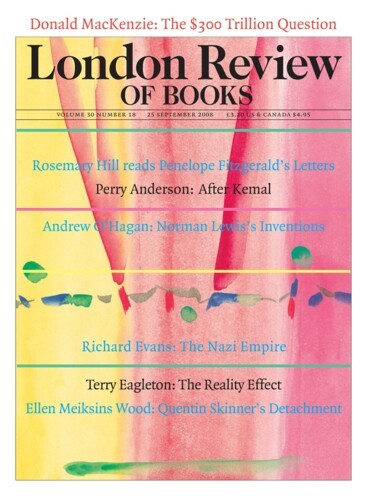
After Kemal
Perry Anderson, 25 September 2008
In a famous essay, one of the most acute self-critical reflections to emerge out of any of the youthful revolts of the 1960s, Murat Belge – a writer unrivalled in his intelligence of the political sensibility of his generation – told his contemporaries on the Turkish left, as yet another military intervention came thudding down over more than a decade of ardent hopes, that they had misunderstood their own country in a quite fundamental way.1 They had thought it a Third World society among others, ready for liberation by guerrilla uprisings, in the towns or in the mountains. The paradox they had failed to grasp was that although the Turkey of the time was indeed ‘a relatively backward country economically . . . and socially’ – with a per capita GNP similar to that of Algeria and Mexico, and adult literacy at a mere 60 per cent – it was ‘relatively advanced politically’, having known ‘a two-party system in which opposing leaders have changed office a number of times after a popular mandate, something which has never happened in Japan for example’. In short, Turkey was unusual in being a poor and ill-educated society that had yet remained a democracy as generally understood, if with violent intermissions – Belge was writing in the aftermath of the military putsch of 1980.