Perry Anderson

Perry Anderson’s books include Lineages of the Absolutist State, The Origins of Postmodernity, Passages from Antiquity to Feudalism and Ever Closer Union? Europe in the West. He is a professor of history and sociology at UCLA and sits on the editorial board of New Left Review. He has written more than fifty pieces for the LRB, on subjects including his father’s career in the Chinese Customs Service, Lula’s Brazil, Michael Oakeshott, Anthony Powell, Dmitri Furman, the modern political histories of Italy, Turkey, France, and India and the failings of the EU.

Within the huge multiverse of prose fiction the historical novel has, almost by definition, been the most consistently political. It is no surprise that it should have occasioned what is still probably the best-known of all works of Marxist literary theory, Lukács’s The Historical Novel, written in Russian exile in the 1930s. Any reflection on the strange career of this form has to begin there, however far it may then wander from him.
Lula’s Brazil

Perry Anderson, 31 March 2011

Contrary to a well-known English dictum, stoical if self-exonerating, all political lives do not end in failure. In postwar Europe, it is enough to think of Adenauer or De Gasperi, or perhaps even more impressively, Franco. But it is true that, in democratic conditions, to be more popular at the close than at the outset of a prolonged period in office is rare. Rarer still – indeed, virtually unheard of – is for such popularity to reflect, not appeasement or moderation, but a radicalisation in government. Today, there is only one ruler in the world who can claim this achievement, the former worker who in January stepped down as president of Brazil, enjoying the approval of 80 per cent of its citizens. By any criterion, Luiz Inácio da Silva is the most successful politician of his time.

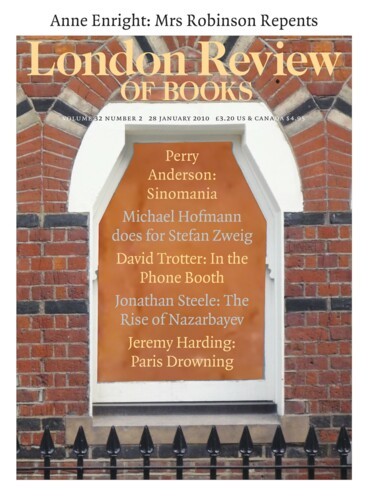
Sinomania

Perry Anderson, 28 January 2010

After 1948, Red China became the focus of still greater fear and anxiety, a totalitarian nightmare more sinister even than Russia. Today, the high-speed growth of the People’s Republic is transforming Western attitudes once again, attracting excitement and enthusiasm in business and media alike, with a wave of fashion and fascination recalling the chinoiserie of rococo Europe. Sinophobia has by no means disappeared. But another round of Sinomania is in the making.

An Invertebrate Left

Perry Anderson, 12 March 2009

The Italian left was once the largest and most impressive popular movement for social change in Western Europe. Comprising two mass parties, each with its own history and culture, and each committed not to ameliorating but to overcoming capitalism, the postwar alliance between Socialists and Communists, the PSI and PCI, did not survive the boom of the 1950s.

Berlusconi embodies perhaps the deepest irony in the postwar history of any Western society. The First Republic collapsed amid public outrage at the exposure of stratospheric levels of political corruption, only to give birth to a Second Republic dominated by a yet more flamboyant monument of illegality and corruption.

The Murmur of Engines: A Historian's Historians

Christopher Clark, 5 December 2024

Perry Anderson brings a peculiar gift to the work of criticism: he can step into a book and inspect it closely, even sympathetically, scrutinising its structures, immersing himself in its style and atmosphere;...

Read more reviews

You need a gun: The A-Word

Wolfgang Streeck, 14 December 2017

What​ is the relationship between coercion and consent? Under what circumstances does power turn into authority, brute force into legitimate leadership? Can coercion work without consent? Can...

Read more reviews

‘It is a sign​ of true political power when a great people can determine, of its own will, the vocabulary, the terminology and the words, the very way of speaking, even the way of...

Read more reviews

What We Have: Tarantinisation

David Bromwich, 4 February 1999

Post-Modernism entered the public mind as a fast-value currency in the late Seventies and early Eighties, in the field of architecture, where its association with gimmicky tropes of visual play...

Read more reviews

Post-Nationalism

Geoffrey Hawthorn, 3 December 1992

For the past thirty years, New Left Review has been the most consistently interesting political journal in the country. And Perry Anderson, who used to edit it and still helps direct it, has been...

Read more reviews

What would socialism be like?

Geoffrey Hawthorn, 1 March 1984

Joseph Schumpeter had a refreshing sense of socialism. For him, it had almost no fixed sense at all. ‘A society may be fully and truly socialist and yet be led by an absolute ruler or be...

Read more reviews

English Marxists in dispute

Roy Porter, 17 July 1980

The Englishness of English historians lies in their eclecticism. Few would admit to being unswerving Marxists, Freudians, Structuralists, Cliometricians, Namierites, or even Whigs. Most believe...

Read more reviews

Read anywhere with the London Review of Books app, available now from the App Store for Apple devices, Google Play for Android devices and Amazon for your Kindle Fire.

Sign up to our newsletter

For highlights from the latest issue, our archive and the blog, as well as news, events and exclusive promotions.

Newsletter Preferences