Michael Wood

Michael Wood is an emeritus professor at Princeton. He has written books on Yeats, Nabokov, Stendhal, Hitchcock and Empson, among other things.

Living in the Enemy’s Dream

Michael Wood, 27 November 1997

‘Maybe this is a detective story,’ a character thinks in John Edgar Wideman’s novel Philadelphia Fire (1990). It’s a reasonable suspicion, and would be for anyone in any of Wideman’s books that I’ve read. But they are not detective stories. Often structured around a quest, for a missing child, a vanished woman, a former self, a meaning, an answer, they finally take the form of a flight, as if from a horror too great to bear or name, a shock one can only circle again and again, and at last abandon. ‘Do I write to escape, to make a fiction of my life?’ Wideman asks in his memoir Brothers and Keepers (1984). ‘Wasn’t there something fundamental in my writing, in my capacity to function, that depended on flight, escape?’ But Wideman is not avoiding the shocks and horrors, he is allowing himself to be haunted by them, evoking their aftermath in a series of deft and ingenious pictures, taken from all kinds of angles by a restless imagination. The aftermath, though, is as close as he gets, and the need to flee even from that is a measure of the force of the original blast.‘
Sounds like hell to me

Michael Wood, 13 November 1997

You step up to the wooden door, a heavy, rustic affair set in a brick arch, and you peer through two small holes conveniently set at around head height. You do this not because you are a snoop, but because this is an installation at the Philadelphia Museum of Art. Even so, you feel like a snoop, and worse. As Calvin Tomkins says, no amount of practice or mental preparation will diminish the complicated shock of what you see on the other side of the door. This has to do partly with the meticulous realism of what is in the foreground, partly with the tacky artificiality of the background; and has everything to do with the failed combination of the two, with your inability to get them to go together or even cancel each other out. The moment you reach for an overall interpretation, you feel you are losing the stubborn individuality of the bits of the scene, their separate stories. If you decide the stubborn bits are all there is, you feel you are missing a larger message, and trying to make yourself comfortable when you are not.

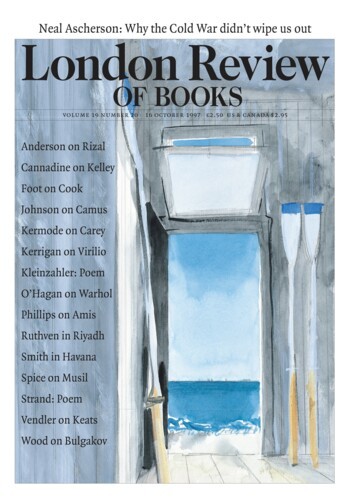
Sympathy for the Devil

Michael Wood, 16 October 1997

In an early chapter of Mikhail Bulgakov’s funny and frightening novel, The Master and Margarita, written between 1928 and 1940 and now available in four different English translations, a character loses his head – literally. He slips on a Moscow street and is hit by a tram. His last thought is ‘Can this be?’ and his severed head then bounces away across the cobblestones. The question and the grisly performance of an answer are characteristic of this remarkable book, which Bulgakov described as his ‘sunset novel’. He was writing it, without any hope or thought of publication, in a time and place where arbitrary arrests and disappearances were a common occurrence, and yet where people managed to devise for themselves, as they had to, a fable of normality. Bulgakov confronts this fable with a further fable, registers the fantastic nature of his historical world by conflating it with inventive variants on more traditional forms of fantasy, of the kind we may associate with Hoffmann or Gogol. The man who loses his head has also met the devil an hour or so earlier – a busy day for a man described as being ‘unaccustomed to unusual happenings’. When one of the devil’s assistants says to a young woman that he has been sent to see her ‘regarding a certain small matter’, she understands him immediately, albeit wrongly. Obviously he has come to arrest her. What a relief when she learns that he hasn’t; better the devil than the secret police.’

When the Balloon Goes up

Michael Wood, 4 September 1997

A young woman is shaken in her understanding of who she is and what she wants. The walking holiday she and her husband have planned now seems, Ian McEwan says, ‘a pointless detour from her uncertainty’. The phrase is full of trouble, of precise and elusive implications. Uncertainty is a path, a destination, a need. Of course we may not like the thought, and many of us will prefer to see our detours as chosen directions, uncertainty as something to be shaken off rather than returned to. But truths can often be measured by the urgency of our desire to avoid them, and sometimes only by that.

You see stars

Michael Wood, 19 June 1997

In the early Eighties, British novelists worried a lot about history. Where had it gone, why had it left so few traces, why did it still hurt? How could it simultaneously seem so irrelevant and so inescapable? ‘The past is a receding shoreline,’ the narrator says in Flaubert’s Parrot (1984), but he was busy replaying a story a hundred years old. In Graham Swift’s Waterland (1983), history is being ‘cut back’ as a school subject at the same time as it invades all the lives in the book. But behind these worries was still another one, not yet focused but beginning to loom pretty large. Something was taking the place of history, some hefty compound of nostalgia, propaganda, heritage, sheer imagination, which made it look as if we had always been, until recently, just what we wished we had been – or what some of us wished we had been. History was becoming an Edwardian calendar, the long afternoon of empire, when children obeyed their parents, everyone could spell, there were no drugs, and socialism was something intellectuals played at in the evenings. Free enterprise was sufficient, and entirely amiable – and when it wasn’t amiable, it was still all right, because it knew what was good for us, it didn’t tolerate slackers. Whatever was wrong with the present could be seen as a betrayal of these golden days, a failure to hang onto our glory.’

Pirouette on a Sixpence: Untranslatables

Christopher Prendergast, 10 September 2015

O n​ the face of it a Dictionary of Untranslatables looks like a contradiction in terms, either self-imploding from the word go, or, if pursued, headed fast down a cul-de-sac in which it is...

Read more reviews

It took a very special kind of invention to get an awareness of the ‘erratic truth of death’s timing’ into a medium of mass entertainment.

Read more reviews

I told you so! oracles

James Davidson, 2 December 2004

I don’t believe in astrology, but I also know that not believing in astrology is a typically Taurean trait. When I first caught a bright young friend browsing in the astrology section of a...

Read more reviews

And That Rug! images of Shakespeare

Michael Dobson, 6 November 2003

Above the entrance to the saloon bar there is a picture of Shakespeare on the swinging sign. It is the same picture of Shakespeare that I remember from my schooldays, when I frowned over Timon of...

Read more reviews

Unspeakability

John Lanchester, 6 October 1994

Musing over Don Juan, Byron asked his banker and agent Douglas Kinnaird a rhetorical question: ‘Could any man have written it – who has not lived in the world? – and tooled in a...

Read more reviews

Read anywhere with the London Review of Books app, available now from the App Store for Apple devices, Google Play for Android devices and Amazon for your Kindle Fire.

Sign up to our newsletters

For highlights from the latest issue, our archive and the blog, as well as news, events and exclusive promotions.

Newsletter Preferences