
What Kind of Guy? W.H. Auden
Michael Wood, 10 June 1999
That is the way things happen,’ Auden writes in ‘Memorial for the City’, a poem Edward Mendelson dates from June 1949,‘
Michael Wood is an emeritus professor at Princeton. He has written books on Yeats, Nabokov, Stendhal, Hitchcock and Empson, among other things.
That is the way things happen,’ Auden writes in ‘Memorial for the City’, a poem Edward Mendelson dates from June 1949,‘

Writers in the early part of our century fell in love with the interminable work, the book that seemed infinite. The Cantos, Remembrance of Things Past, The Man without Qualities were all tasks designed to last the writer’s lifetime, and they did. But there are degrees and differences among these projects. The Cantos were a ragbag, as Pound once half-mockingly called them, into which he could throw the contents of his mind in the form of poetry, but they were a ragbag that dreamed of a secret ordering. Remembrance of Things Past was in one sense finished as soon as it was started, the circle of its story complete. Proust spent all the time that remained to him filling out the middle. The Man without Qualities, however, turned gradually into a work that was genuinely, irremediably endless. Somewhere in his forties, Musil developed an incomparable talent for beginnings, and after that he wrote very little else. The results were lengthy and wonderful, whole novels in themselves, but they were, as Musil himself kept saying, only a start.
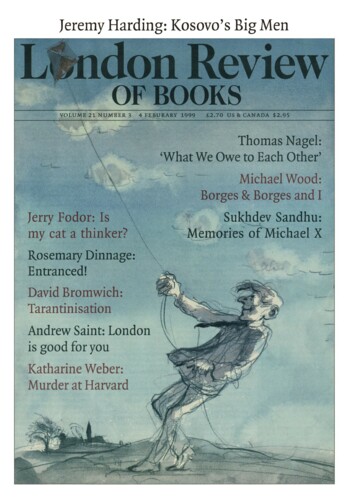
‘Not everyone can be Whitman,’ Borges said in an interview in London long ago. He paused, pretending to reflect. ‘Not even Whitman could be Whitman.’ We knew Borges was only pretending to reflect because we recognised the joke and the timing as belonging so perfectly to him, a Borges short story in miniature, a shortest story. And also because, if we were still sceptical, we could find the joke in his writings. In ‘The Simulacrum’, which Andrew Hurley translates as ‘The Mountebank’, a man arrives in a small village in northern Argentina and exhibits a blonde doll in a cardboard box which serves as her coffin. People file by, offering their condolences, addressing the man as ‘General’. He shakes their hands, murmurs a platitude, and they drop their two pesos in a collection box. The time is July 1952. But this ‘funereal farce’, as Borges puts it, is of course not the real thing. ‘The man in mourning was not Perón and the blonde doll was not the woman Eva Duarte, but then Perón was not Perón either, nor was Eva Eva.’‘

There are all kinds of things to do with books apart from reading them, and one of the most pleasurable is to dream of reading them. Many of us keep scribbled or notional lists of such dreams, and happily speak of rereading works we haven’t read even once. In If On a Winter’s Night a Traveller, Calvino steers his reader and chief character through a bookstore, past heaps of dangerous objects identified as, among other things, Books You Haven’t Read, Books You’ve Been Planning to Read for Ages, Books You Want to Own so They’ll Be Handy just in Case, Books You Mean to Read but There Are Others You Must Read First, and Books You’ve Always Pretended to Have Read and Now It’s Time to Sit Down and Really Read Them. Even great readers can fall into this mode, and even books we have read can be dreamed. At one point in his inaugural lecture at the Collège de France, Roland Barthes casually said: ‘The other day, I reread ‘The Magic Mountain.’ I’m sure Barthes had read The Magic Mountain, probably many times, but I’m equally sure he didn’t reread it ‘the other day’. That day he just remembered reading it, or perhaps skimmed a few pages. He joined the club of dreamers.‘
Myriam Anissimov’s biography of Primo Levi, first published in French two years ago, begins with a kind of stutter surrounding the writer’s end. The book’s Introduction, prologue and opening chapter all invoke his death, as if it were a threshold that had to be crossed but couldn’t be crossed without returning. ‘On 11 April 1987 Primo Levi plunged down the stairwell of the house where he was born and had always lived’; ‘It was this man who on an April morning, after a period of dreadful depression, suddenly “exited life by the window”, in the words of the Italian critic Cesare Cases’; ‘One Saturday morning in April 1987, a tragedy disrupted the peace and quiet of the Corso Re Umberto. Primo Levi had taken his own life.’‘
Michael Wood talks to Malin Hay about the recent list from Sight and Sound of the ‘greatest films of all time’ (in which he voted), and what considerations could, or should, go into...
Michael Wood talks to Adam Shatz about critical theory, its origins, developments and various diversions, and where it stands today.
Michael Wood looks at how Fritz Lang uses sound in his first two sound films, M (1931) and The Testament of Dr Mabuse (1933).
Michael Wood reads his take on Joseph L. Mankiewicz’s Cleopatra.
O n the face of it a Dictionary of Untranslatables looks like a contradiction in terms, either self-imploding from the word go, or, if pursued, headed fast down a cul-de-sac in which it is...
It took a very special kind of invention to get an awareness of the ‘erratic truth of death’s timing’ into a medium of mass entertainment.
I don’t believe in astrology, but I also know that not believing in astrology is a typically Taurean trait. When I first caught a bright young friend browsing in the astrology section of a...
Above the entrance to the saloon bar there is a picture of Shakespeare on the swinging sign. It is the same picture of Shakespeare that I remember from my schooldays, when I frowned over Timon of...
Musing over Don Juan, Byron asked his banker and agent Douglas Kinnaird a rhetorical question: ‘Could any man have written it – who has not lived in the world? – and tooled in a...

Read anywhere with the London Review of Books app, available now from the App Store for Apple devices, Google Play for Android devices and Amazon for your Kindle Fire.
For highlights from the latest issue, our archive and the blog, as well as news, events and exclusive promotions.