Michael Wood

Michael Wood is an emeritus professor at Princeton. He has written books on Yeats, Nabokov, Stendhal, Hitchcock and Empson, among other things.

Six Scotches More: Anthony Powell

Michael Wood, 8 February 2001

Anthony Powell, suave in his interwar Morris Minor.

Reviewers are always sternly instructed to check page proofs against finished copies of books, and I do, I will. But the proofs of Anthony Powell’s A Writer’s Notebook provide, along with numerous unimportant oddities of phrase and spelling which seem to be errors of transcription from script to voice to type to print...

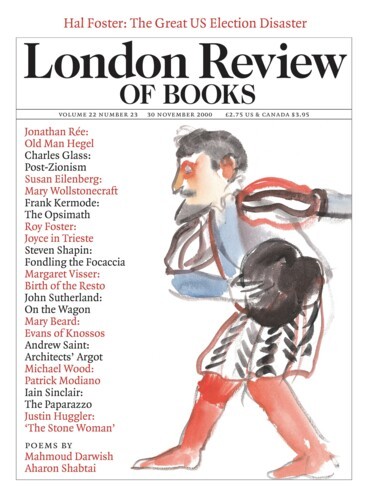
J. xx Drancy. 13/8/42: Patrick Modiano

Michael Wood, 30 November 2000

Patrick Modiano’s fiction is intricately caught up in time, as he himself says. ‘The great, the inevitable subject of the novel, is always . . . time.’ And more interestingly, less portentously: ‘I had the mania of looking back, always that feeling of something lost, not like paradise, but certainly lost.’ In fact, time is less his subject than his...

‘Studio Vingt-Huit – high up a winding street of Montmartre, in the full blasphemy of a freezing Sunday; taxis arriving, friends greeting each other, an excitable afternoon audience’. The description is Cyril Connolly’s, the occasion a showing of Luis Buñuel’s first film, Un Chien andalou. The audience seemed baffled at the end, and some of its members were...

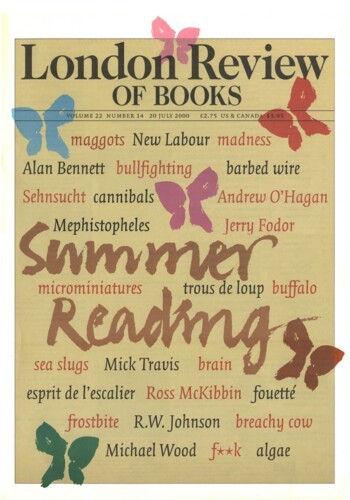
The Man without Predicates: Goethe

Michael Wood, 20 July 2000

The story so far is this. Johann Wolfgang (not yet von) Goethe, the prodigiously talented son of a prosperous Frankfurt citizen, startles his compatriots with a furious and rambling play, Götz von Berlichingen (1771), which effectively inaugurates modern drama in Germany. He then writes The Sorrows of Young Werther (1774), a melancholy novel in letters, and becomes an immensely influential European figure, a provoker of fashions in dress and suicide, a sort of Byron before Byron. He is 25. Troubled by this success in print – Götz was published to great acclaim but not staged for some time – Goethe seeks a different public and a different relation to the world. He moves to Weimar in 1775, where he becomes confidential adviser and then minister and privy councillor to the Duke. He is made a baron in 1782. Weimar at this time is a city of 6000 inhabitants, compared with Frankfurt’s 36,000. But Weimar is also the centre of a duchy, which includes the territories of Jena, Eisenach and Ilmenau. It is a little world but it is a world. Goethe occupies himself with mines, politics, the development of the University of Jena. He starts several lengthy writing projects but finishes few, although at this time as at all times he writes remarkable poems in many genres. He becomes frustrated, both by the burdens of office and by the stranglement of what appears to have been a long Platonic affair with a married court lady, Frau von Stein. He longs to travel in Italy, a journey he has often imagined, and which he postponed when he came to Weimar. Finally, in 1786, he asks for and is given a leave of absence and takes off for the better part of two years, visiting Verona, Padua, Venice and Naples, and staying for some time in Sicily and (twice) in Rome. He finds a new life among German artists in Italy – ‘artists’ here means painters and sculptors, but Goethe, and Schiller soon after him, convert the word to something like its modern meaning, where it includes writers and film-makers, for example. ‘I have found myself again,’ Goethe writes to the Duke, ‘but as what? – As an artist!’ This is a declaration of independence of sorts, but Goethe knows he can’t stay in Italy. He returns to Weimar, works again on his Faust, finishes other plays (Iphigenia in Tauris, Egmont, Tasso), elaborates an early version of his novel Wilhelm Meister, and publishes his Collected Works in eight volumes. He also grieves extensively for the warm, permissive South and his lost artist colony in Rome, but realises, on a brief return trip to Venice, that his future lies in Germany. Italy had been paradise, or rather a proof that paradise exists and can be abandoned. Goethe is happy with the sterner North, or says he is. ‘The Duchess is well and contented,’ he writes of his employer’s mother’s homecoming from her Italian trip, ‘as one is when one returns from paradise. I am now used to it, and this time I was quite happy to leave Italy.’ Used to his return, he means, and used to the absence from paradise. The words I have just quoted are the last words of the first volume of Nicholas Boyle’s biography of Goethe. The date is June 1790, and other things have been happening in Europe, to which Boyle immediately turns in his new book.’‘
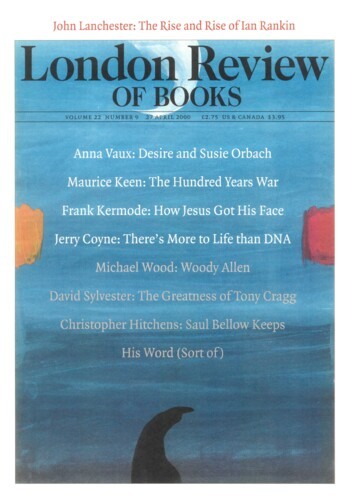
A Kind of Slither: Woody Allen

Michael Wood, 27 April 2000

The films of Woody Allen are dedicated to the proposition that life is both alarming and boring. Is this possible? Surely alarms are at least interesting? Nothing is interesting in Allen’s imagined world except the nervousness of the mind observing the banality, the sheer invention with which the imagination pictures its cage. The comedy arises constantly from the gap between where we might have been and where we ended up. In the film Love and Death (1975), the hero’s idea of a miracle is that his Uncle Sasha should pick up a check. In one of Allen’s stories, the lack of a sense of humour is defined as believing that Zeppo was the most amusing of the Marx Brothers. When a man tries to rob a bank in Take the Money and Run (1969), he is foiled because he gets into an argument about the handwriting of his stick-up note. In Manhattan Murder Mystery (1993) the Diane Keaton character has a wild idea and is advised to save some of her craziness for the menopause.

Pirouette on a Sixpence: Untranslatables

Christopher Prendergast, 10 September 2015

O n​ the face of it a Dictionary of Untranslatables looks like a contradiction in terms, either self-imploding from the word go, or, if pursued, headed fast down a cul-de-sac in which it is...

Read more reviews

It took a very special kind of invention to get an awareness of the ‘erratic truth of death’s timing’ into a medium of mass entertainment.

Read more reviews

I told you so! oracles

James Davidson, 2 December 2004

I don’t believe in astrology, but I also know that not believing in astrology is a typically Taurean trait. When I first caught a bright young friend browsing in the astrology section of a...

Read more reviews

And That Rug! images of Shakespeare

Michael Dobson, 6 November 2003

Above the entrance to the saloon bar there is a picture of Shakespeare on the swinging sign. It is the same picture of Shakespeare that I remember from my schooldays, when I frowned over Timon of...

Read more reviews

Unspeakability

John Lanchester, 6 October 1994

Musing over Don Juan, Byron asked his banker and agent Douglas Kinnaird a rhetorical question: ‘Could any man have written it – who has not lived in the world? – and tooled in a...

Read more reviews

Read anywhere with the London Review of Books app, available now from the App Store for Apple devices, Google Play for Android devices and Amazon for your Kindle Fire.

Sign up to our newsletters

For highlights from the latest issue, our archive and the blog, as well as news, events and exclusive promotions.

Newsletter Preferences