Michael Wood

Michael Wood is an emeritus professor at Princeton. He has written books on Yeats, Nabokov, Stendhal, Hitchcock and Empson, among other things.

The story opens on a picture of a very large young lady, ‘a truly massive young person’, crossing from one house to another in Newport, Rhode Island, site of ‘florid’ villas and other structures ‘smothered in senseless architectural ornament’. On the verandah of the second house she finds her father, an inordinately rich man, sourly awaiting the death of...
‘It is, and is not,’ Ezra Pound wrote in a short poem called ‘Sub Mare’, ‘I am sane enough.’ What ‘is, and is not’ is the eerie landscape of the piece, a shifting underwater place; ‘sane enough’ is designed to allay but not entirely disperse our suspicions. It means the speaker is sane enough for the job in hand, which is the...

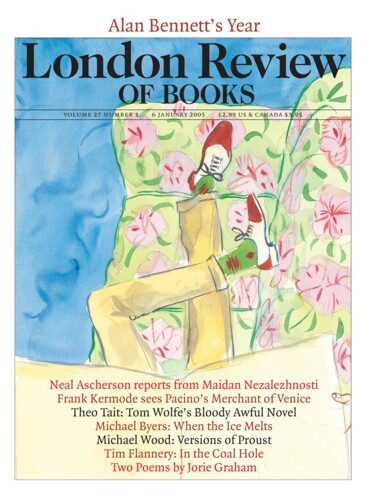
The Thing: Versions of Proust

Michael Wood, 6 January 2005

What was it Proust said about paradise? That all paradises are lost paradises? That the only true paradise is a lost paradise? That it isn’t paradise until it’s lost? That paradise is a name for a favourite form of loss? He can plausibly be read as saying any of these things, and perhaps more than one at once. But the propositions are not identical, and it’s not easy to...

“But what’s astonishing is still the quiet domesticity of the story and its telling. The small scale of these lives almost allows us to miss – and this is the point – the large scale of the threat. History is not only what happens to everybody, and not only the narrative of fear; it is also, seen from another angle, the way we tame our surprises. America is bowled over by Lindbergh’s landslide victory, but ‘by the day after . . . everybody seemed to understand everything.’ And what is studied in schools, Roth says, is ‘harmless history, where everything unexpected in its own time is chronicled on the page as inevitable. The terror of the unforeseen is what the science of history hides, turning a disaster into an epic.’ For this very reason, The Plot Against America refuses the epic note and proportion.”

Ilya Ehrenburg had a complaint about his friend Pablo Neruda’s work. ‘Too much root,’ he said. ‘Too many roots in your poems. Why so many?’ Neruda, reporting this remark in his memoirs, took it as a joke, which it probably was, and as a compliment, which it probably wasn’t. Isla Negra has a whole section, originally a separate volume, called ‘The...

Pirouette on a Sixpence: Untranslatables

Christopher Prendergast, 10 September 2015

O n​ the face of it a Dictionary of Untranslatables looks like a contradiction in terms, either self-imploding from the word go, or, if pursued, headed fast down a cul-de-sac in which it is...

Read more reviews

It took a very special kind of invention to get an awareness of the ‘erratic truth of death’s timing’ into a medium of mass entertainment.

Read more reviews

I told you so! oracles

James Davidson, 2 December 2004

I don’t believe in astrology, but I also know that not believing in astrology is a typically Taurean trait. When I first caught a bright young friend browsing in the astrology section of a...

Read more reviews

And That Rug! images of Shakespeare

Michael Dobson, 6 November 2003

Above the entrance to the saloon bar there is a picture of Shakespeare on the swinging sign. It is the same picture of Shakespeare that I remember from my schooldays, when I frowned over Timon of...

Read more reviews

Unspeakability

John Lanchester, 6 October 1994

Musing over Don Juan, Byron asked his banker and agent Douglas Kinnaird a rhetorical question: ‘Could any man have written it – who has not lived in the world? – and tooled in a...

Read more reviews

Read anywhere with the London Review of Books app, available now from the App Store for Apple devices, Google Play for Android devices and Amazon for your Kindle Fire.

Sign up to our newsletters

For highlights from the latest issue, our archive and the blog, as well as news, events and exclusive promotions.

Newsletter Preferences