Michael Wood

Michael Wood is an emeritus professor at Princeton. He has written books on Yeats, Nabokov, Stendhal, Hitchcock and Empson, among other things.

At the Movies: ‘The Conformist’

Michael Wood, 20 March 2008

There is a fine, far-reaching moment in Stanley Kubrick’s Lolita, handsomely set up by the director and beautifully spun out by the actor. Peter Sellers, as the creepy and protean Clare Quilty, has struck up a conversation with James Mason, as Humbert Humbert. The latter is in no mood for any kind of conversation, since he is just marking time before he returns to his hotel room to have...

At the Movies: ‘No Country for Old Men’

Michael Wood, 21 February 2008

Joel and Ethan Coen often look like moviemakers in search of a movie; as if their perfect film were waiting for them out there and they had to do something while they were looking for it. What else could have driven them to their 2004 remake of the Ealing comedy The Ladykillers? Even if Tom Hanks is funnier in that film than our idea of Tom Hanks ought to allow, he’s not Alec Guinness....

At the Movies: ‘Lust, Caution’

Michael Wood, 24 January 2008

In the film moderately scrutable orientals play inscrutable orientals pretending to be inscrutable orientals

Marvellous Money: Eça de Queirós

Michael Wood, 3 January 2008

Balzac is named several times in The Maias. Two characters are said to have a ‘Balzacian eye’, and Balzac is elsewhere called a ‘prodigy of observational powers’. A love nest is called the Villa Balzac, an intricate, critical irony because the owner of the house is a ‘great fantasist’ far from fully aware of what he is doing when he adopts the great realist as his ‘patron saint’. The book itself, I should say, is subtitled ‘Episodes from Romantic Life’, so these touches are important. ‘Romantic’ in this context has all kinds of associations, and its near-synonyms could include ‘poetic’, ‘stylish’, ‘idealistic’, ‘liberal’, ‘deluded’. As in ‘all English songs were alike, they always struck the same sorrowful romantic tone,’ or (spoken of a poem that has just been recited) ‘such romantic outpourings’. ‘Literature,’ we are told, ‘used to be all about the imagination, fantasy, ideas. Nowadays, it’s all about reality, experience, facts, documentation.’ And about money, which is this character’s main translation of ‘facts’. But then he calls it ‘marvellous money’, slipping unconsciously back into the romantic mode, in spite of his attempt at irony. Eça de Queirós’s chief question, perhaps, is whether realism is possible in Portugal, in literature or anything else, and his mischievous suggestion is that ‘Portugal’ may just mean ‘romantic’ – there couldn’t be episodes of any other sort of life there. He is doing this, however, with sly intelligence, in an undeniably realist Portuguese novel.

At the Movies: the gangster movie

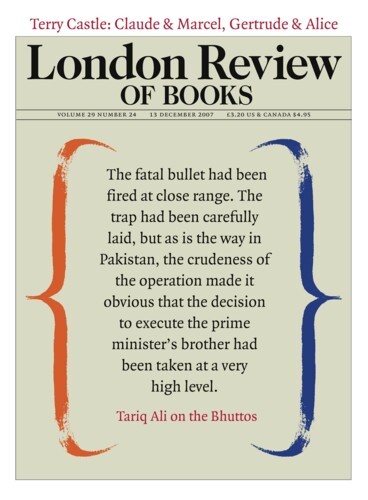
Michael Wood, 13 December 2007

Ridley Scott is always a director to watch. This proposition includes watching for things to avoid, especially when he goes for history and costume, as in 1492 and The Kingdom of Heaven. But there were also The Duellists and Thelma and Louise; and Blade Runner, it seems, is always showing up in a new version. A ‘final cut’, following on the studio cut and the director’s cut,...

Pirouette on a Sixpence: Untranslatables

Christopher Prendergast, 10 September 2015

O n​ the face of it a Dictionary of Untranslatables looks like a contradiction in terms, either self-imploding from the word go, or, if pursued, headed fast down a cul-de-sac in which it is...

Read more reviews

It took a very special kind of invention to get an awareness of the ‘erratic truth of death’s timing’ into a medium of mass entertainment.

Read more reviews

I told you so! oracles

James Davidson, 2 December 2004

I don’t believe in astrology, but I also know that not believing in astrology is a typically Taurean trait. When I first caught a bright young friend browsing in the astrology section of a...

Read more reviews

And That Rug! images of Shakespeare

Michael Dobson, 6 November 2003

Above the entrance to the saloon bar there is a picture of Shakespeare on the swinging sign. It is the same picture of Shakespeare that I remember from my schooldays, when I frowned over Timon of...

Read more reviews

Unspeakability

John Lanchester, 6 October 1994

Musing over Don Juan, Byron asked his banker and agent Douglas Kinnaird a rhetorical question: ‘Could any man have written it – who has not lived in the world? – and tooled in a...

Read more reviews

Read anywhere with the London Review of Books app, available now from the App Store for Apple devices, Google Play for Android devices and Amazon for your Kindle Fire.

Sign up to our newsletters

For highlights from the latest issue, our archive and the blog, as well as news, events and exclusive promotions.

Newsletter Preferences