Michael Wood

Michael Wood is an emeritus professor at Princeton. He has written books on Yeats, Nabokov, Stendhal, Hitchcock and Empson, among other things.

At the Movies: ‘Avatar’

Michael Wood, 28 January 2010

The first time the name appeared in the movie I thought I had misheard it. The second time also. It was only when I read a few reviews and plot summaries that I could confirm that I wasn’t dreaming, inserting an unlikely joke where there couldn’t be one. The precious mineral found only on the planet Pandora which would, if mined and transported, cure the wrecked energy system of...
One of the attractions of Nabokov’s view of literature is that although (or because) he scoffed at any idea of readerly independence he scarcely ever wanted to separate the writer’s interests from the reader’s. He was prepared to indulge in a kind of crazed fusion of the two in his commentary on Eugene Onegin, and to parody that madness in Pale Fire. When in his afterword to...

The Subtleties of Frank Kermode

Michael Wood, 17 December 2009

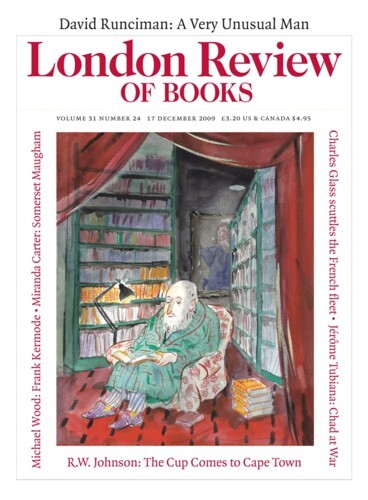
Frank Kermode is too multifarious a writer to have anything as dogged as a theme for his critical work; too sane and stealthy to boast of anything as limiting as an obsession. But there are persistences, continuities, as he calls them in the title of one of his books. There is an interest in difficulty, for example, and especially the difficulty of understanding – either oneself or...

At the Movies: ‘A Serious Man’

Michael Wood, 17 December 2009

There is a certain kind of Jewish joke that doesn’t end, but peters out in a shoulder-shrugging way, as if to say: ‘You thought this was going to be a joke?’ I’ll spare you the details of the one about what is green, hangs on the wall, and plays the violin. These jokes are not funny, just mildly desperate. Except that of course desperation is funny too, if you tell it...

A Lot of Travail: T.S. Eliot’s Letters

Michael Wood, 3 December 2009

Eliot was working full-time at Lloyds Bank, where he stayed until 1925, and editing the Criterion in the spare moments he didn’t have. This tale of time swallowed up, what Eliot calls ‘the prison-like limitation of my time’, is one of the two chief themes of the second volume of the Letters. The other is the competitive invalidism the Eliots have instead of a marriage.

Pirouette on a Sixpence: Untranslatables

Christopher Prendergast, 10 September 2015

O n​ the face of it a Dictionary of Untranslatables looks like a contradiction in terms, either self-imploding from the word go, or, if pursued, headed fast down a cul-de-sac in which it is...

Read more reviews

It took a very special kind of invention to get an awareness of the ‘erratic truth of death’s timing’ into a medium of mass entertainment.

Read more reviews

I told you so! oracles

James Davidson, 2 December 2004

I don’t believe in astrology, but I also know that not believing in astrology is a typically Taurean trait. When I first caught a bright young friend browsing in the astrology section of a...

Read more reviews

And That Rug! images of Shakespeare

Michael Dobson, 6 November 2003

Above the entrance to the saloon bar there is a picture of Shakespeare on the swinging sign. It is the same picture of Shakespeare that I remember from my schooldays, when I frowned over Timon of...

Read more reviews

Unspeakability

John Lanchester, 6 October 1994

Musing over Don Juan, Byron asked his banker and agent Douglas Kinnaird a rhetorical question: ‘Could any man have written it – who has not lived in the world? – and tooled in a...

Read more reviews

Read anywhere with the London Review of Books app, available now from the App Store for Apple devices, Google Play for Android devices and Amazon for your Kindle Fire.

Sign up to our newsletters

For highlights from the latest issue, our archive and the blog, as well as news, events and exclusive promotions.

Newsletter Preferences