Michael Wood

Michael Wood is an emeritus professor at Princeton. He has written books on Yeats, Nabokov, Stendhal, Hitchcock and Empson, among other things.

At the Movies: ‘The Tree of Life’

Michael Wood, 28 July 2011

There is a mystery about Terrence Malick’s new movie, but it has nothing to do with life, death and the wonders wrought by the maker of the universe, which are the film’s modest ostensible subjects. The mystery about The Tree of Life is how a work that is truly terrible in so many respects can remain so weirdly interesting. Interesting only to some, certainly; and maybe not...
At the Movies: ‘Senna’

Michael Wood, 14 July 2011

You might think one big difference between the biopic and the documentary life is that in the latter all the characters are allowed to play themselves, and that when they die, we see their actual friends and parents weeping. You wouldn’t be wrong to think this, and after the title-figure of Asif Kapadia’s Senna has failed to survive a high-speed crash into a barrier at Imola in...

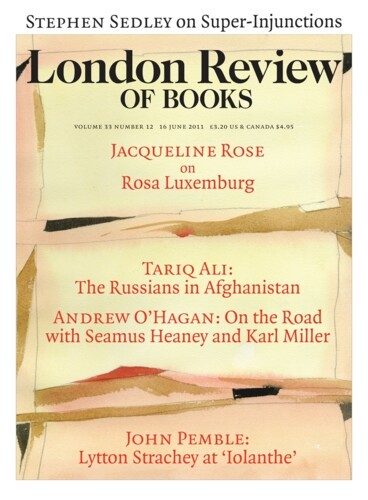
At the Movies: Carlos Saura

Michael Wood, 16 June 2011

In Carlos Saura’s film Tango (1998), the chief character is making a musical about making a musical. The film is shot (by Vittorio Storaro, cameraman on The Conformist, Last Tango in Paris, Apocalypse Now and many other movies) as a sort of designer’s dream, full of bright, shifting colours, ubiquitous mirrors, many set-pieces. It’s hard to tell whether any particular...

In a poem from the early 1960s, ‘On the Circuit’, W.H. Auden describes himself as ‘a sulky fifty-six’, who finds ‘A change of meal-time utter hell’, and has ‘Grown far too crotchety to like/A luxury hotel’. There is plenty of self-parody in this picture – a little later in the poem he identifies his worry about where the next drink is coming from as ‘grahamgreeneish’ – but this was a time when Auden was rearranging his sense of himself and of his world. Comedy was one sort of arrangement, and an important feature of his view of life; but he was seriously ‘unsettled’, as Edward Mendelson says, and had acquired ‘a profound new sense of menace and dread’.

I’m not much given to feeling that images make words look poor – often they make them look rich and friendly – but that was certainly my response to two recent viewings of Eisenstein’s Battleship Potemkin (1925), to be screened again at the BFI Southbank from 29 April. Of course the words that look poor here are quite particular: the weakly loaded phrases of the...

Pirouette on a Sixpence: Untranslatables

Christopher Prendergast, 10 September 2015

O n​ the face of it a Dictionary of Untranslatables looks like a contradiction in terms, either self-imploding from the word go, or, if pursued, headed fast down a cul-de-sac in which it is...

Read more reviews

It took a very special kind of invention to get an awareness of the ‘erratic truth of death’s timing’ into a medium of mass entertainment.

Read more reviews

I told you so! oracles

James Davidson, 2 December 2004

I don’t believe in astrology, but I also know that not believing in astrology is a typically Taurean trait. When I first caught a bright young friend browsing in the astrology section of a...

Read more reviews

And That Rug! images of Shakespeare

Michael Dobson, 6 November 2003

Above the entrance to the saloon bar there is a picture of Shakespeare on the swinging sign. It is the same picture of Shakespeare that I remember from my schooldays, when I frowned over Timon of...

Read more reviews

Unspeakability

John Lanchester, 6 October 1994

Musing over Don Juan, Byron asked his banker and agent Douglas Kinnaird a rhetorical question: ‘Could any man have written it – who has not lived in the world? – and tooled in a...

Read more reviews

Read anywhere with the London Review of Books app, available now from the App Store for Apple devices, Google Play for Android devices and Amazon for your Kindle Fire.

Sign up to our newsletters

For highlights from the latest issue, our archive and the blog, as well as news, events and exclusive promotions.

Newsletter Preferences