Michael Wood

Michael Wood is an emeritus professor at Princeton. He has written books on Yeats, Nabokov, Stendhal, Hitchcock and Empson, among other things.

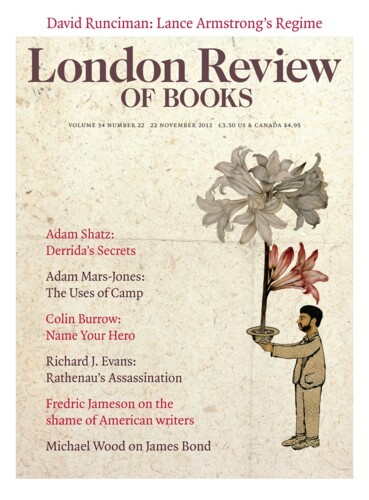
At the Movies: ‘Skyfall’

Michael Wood, 22 November 2012

When Daniel Craig took on the role of James Bond in Casino Royale (2006), there was much talk of the real thing. Here at last was the mean, lethal, almost banter-free figure we thought Ian Fleming had invented, the ruthless, funless fellow we imagined we had always wanted. He had a licence to kill but his real licence was his angry work ethic. He was going to get the job done and nothing...
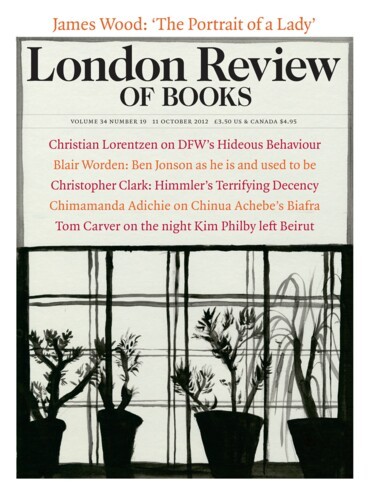
At the Movies: ‘The Master’

Michael Wood, 11 October 2012

People weren’t walking out in droves from the suburban cinema in which we saw Paul Thomas Anderson’s new film The Master because there weren’t droves there: just perhaps eight or nine people. But they did all walk out, in a slow trickle that started about halfway through the film. Staying there made us feel like loyalists in a lost cause – the future of film perhaps...

Not What Anybody Says: James Fenton

Michael Wood, 13 September 2012

One of the great attractions of James Fenton’s verse is the way it manages so often to be both plain and cryptic at once. It urges us to think about what we can’t quite know, and it favours certain strategies for doing this. ‘It is not the houses,’ Fenton writes in ‘A German Requiem’. ‘It is the spaces between the houses.’ He repeats this...

At the Movies: ‘The Lodger’

Michael Wood, 30 August 2012

The Lodger (1926) was Alfred Hitchcock’s third film, following The Pleasure Garden (1925) and the lost Mountain Eagle (also 1926). He made six more silent films before turning to sound. He told Truffaut that The Lodger was his first exercise in his own style, adding: ‘In truth, you might almost say that The Lodger was my first picture.’ The film certainly has all kinds of...

If we leave aside some notes and references at the back, Zona seems to close, appropriately, with a description of the end of a film: ‘her eyes, her watching eyes, and her face and head, resting on the table, watching us watching her, fading to black’. The film we have been seeing through these two hundred pages of Dyer’s memory and prose is Andrei Tarkovsky’s Stalker...

Pirouette on a Sixpence: Untranslatables

Christopher Prendergast, 10 September 2015

O n​ the face of it a Dictionary of Untranslatables looks like a contradiction in terms, either self-imploding from the word go, or, if pursued, headed fast down a cul-de-sac in which it is...

Read more reviews

It took a very special kind of invention to get an awareness of the ‘erratic truth of death’s timing’ into a medium of mass entertainment.

Read more reviews

I told you so! oracles

James Davidson, 2 December 2004

I don’t believe in astrology, but I also know that not believing in astrology is a typically Taurean trait. When I first caught a bright young friend browsing in the astrology section of a...

Read more reviews

And That Rug! images of Shakespeare

Michael Dobson, 6 November 2003

Above the entrance to the saloon bar there is a picture of Shakespeare on the swinging sign. It is the same picture of Shakespeare that I remember from my schooldays, when I frowned over Timon of...

Read more reviews

Unspeakability

John Lanchester, 6 October 1994

Musing over Don Juan, Byron asked his banker and agent Douglas Kinnaird a rhetorical question: ‘Could any man have written it – who has not lived in the world? – and tooled in a...

Read more reviews

Read anywhere with the London Review of Books app, available now from the App Store for Apple devices, Google Play for Android devices and Amazon for your Kindle Fire.

Sign up to our newsletters

For highlights from the latest issue, our archive and the blog, as well as news, events and exclusive promotions.

Newsletter Preferences