John Sutherland

John Sutherland’s Life of Stephen Spender was published in May 2004. Formerly of University College London, he teaches at Caltech in Pasadena.

Self-Made Women

John Sutherland, 11 July 1991

The Feminist Companion to Literature in English is itself the product of impressive feminist companionship. Listed in the preamble are three editors, four consulting editors, 12 contributing editors, and 54 ‘contributors’ – all women, all university teachers. Academic addresses range over three continents (Asia and Africa are missing, although women writers from those corners of the world are generously represented). Vigorous give and take formed the book, which has no obvious predecessor and had to work out its own shape. ‘We have argued, laughed, fought, forgiven, and feasted together at one another’s tables,’ the editors record. A particularly sharp fight must have been fought on the nature of the entries. The editors settled on a conservative dictionary of biography format with a leavening of category entries on such topics as ‘Pseudonyms’, ‘Black Feminist Criticism’, ‘Science Fiction’. There are no plot summaries, no entries on works or on principal characters in works, no cross-reference one-liners. The gaze is unblinkingly on women’s lives as the ground from which women’s writing springs.’
Resentment

John Sutherland, 21 March 1991

There are many Roger Scrutons and it is not easy to reconcile them: barrister, aesthetician, champion of Senator Joseph McCarthy, teacher at Birkbeck College (an institution with a tradition of proletarian outreach), editor of the ultra-Tory Salisbury Review foxhunter. And novelist. Fortnight’s Anger (1981) was hard-going – a murky tale of adolescent sexuality full of sentences like: ‘Her hands trembled on his face and neck. Slowly the agony of appeasement wormed through him, and his grief, unlocked at last, crawled out and shook itself on the surface of his face.’ That is, he wept. Scruton’s second novel, Francesca, is less overdone in its writing – although it too deals with the toils of adolescence. The ten-year interval has usefully congealed some of the Scruton parts. His prejudices seem now to have permeated all the fibres of his mind and sensibility, like smoke into well-cured bacon. Everything he writes now seems thoroughly Scrutonised. One feels a sense of gratified expectation at the snide allusions to the New Statesman, the Guardian and ‘Dr Leavis’ on page one of Francesca. This is the Roger Scruton we know and love to hate – Britain’s favourite ‘token reactionary’, as he sometimes calls himself.’

Presidential Criticism

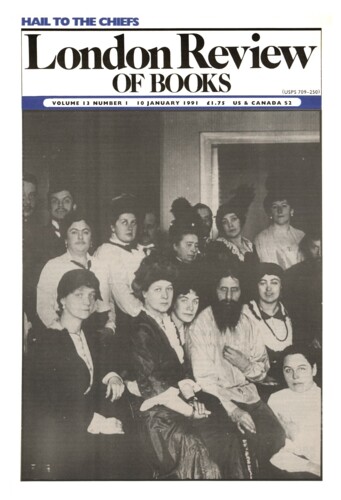
John Sutherland, 10 January 1991

There are up to ten thousand American academics who could claim the job description ‘literary critic’ as they make their way to the annual convention of the Modern Languages Association. J. Hillis Miller is one of the handful who matter. Like those mystic few who know the Coca Cola formula, such people shouldn’t be allowed to travel on the same plane. The collective loss would be irreparable. Harvester Press salutes Miller with a three-volume retrospective of his incidental essays. His pieces on Victorian and modern literature are published now. The theoretical essays will come out next May.

Nelly gets her due

John Sutherland, 8 November 1990

‘I don’t handle divorce business.’ In general, scholarly investigators should follow Philip Marlowe’s rule. One feels degraded when Dickens’s private letters are subjected to infra-red photographic analysis (as they were in the 1950s). Beneath the crossings-out are references to Ellen Ternan, his mistress – or perhaps not his mistress. It is only by chance that any incriminating letters survive: Dickens’s son Henry and Ellen Ternan’s son Geoffrey Robinson destroyed all such correspondence. Dickens himself burned any personal letters that he could come by. He also destroyed his diaries at the end of every year. One diary – that for 1867 – was lost or, more likely, stolen in America. It resurfaced in 1943. ‘Since then,’ as Claire Tomalin puts it, ‘scholars have been squeezing it like a tiny sponge for every drop of information it can yield.’ Scholars justify their curiosity on the grounds that anything which throws light on Dickens’s art is justified, however faint that light may be. But it looks very like keyhole-peeping. One of Tomalin’s achievements is that she investigates the private recesses of Dickens’s life without prurience and without making the reader feel prurient. One comes away with a sense that justice has at last been done.’

Devouring the pangolin

John Sutherland, 25 October 1990

Robert Darnton’s reputation was founded on his monumental The Business of Enlightenment (1979). In this study of ‘the life-cycle of a single book’ Darnton tracked the creation, manufacture, distribution and reception of the fourth edition of Diderot’s Encyclopédie, 1775-1800. His account drew on the archive of the Société Typographique de Neuchâtel, on the Franco-Swiss border. Using this material with great skill, Darnton was able to narrate what was involved in making and importing (sometimes smuggling) a subversive book into France in the Revolutionary era. He expertly digested the technicalities of the 18th-century printing trade, the historical-political background, and summarised a wealth of information into graph and tabular form. What kept the book from the fatal dryness of most economic history was the author’s gift for animating detail. At every point, Darnton seemed able to extract a human interest angle from his manuscript sources. He had, as reviewers noted, a novelist’s eye and a novelist’s power of evocation. Noting the prim engravings of the printing shop to be found in the Encyclopédie itself, Darnton observed that

Like it or not, ‘Orwell’ is a brand: ordinariness, common decency, speaking plain truths to power, a haggard, prophetic gaze.

Read more reviews

Kids Gone Rotten: ‘Treasure Island’

Matthew Bevis, 25 October 2012

John Singer Sargent’s ‘Robert Louis Stevenson and His Wife’ (1885). The first return to Treasure Island was made by Robert Louis Stevenson himself. Fourteen years after the...

Read more reviews

Stephen Spender was a visitor to the city of Hamburg both before the war and after, when he played a part in the work of occupation and recovery. He was well on his way to being the noted...

Read more reviews

When Stephen Spender’s son Matthew was ten years old, he caught his hand in a car door. ‘The event,’ John Sutherland writes, ‘recalled other tragedies in the boy’s...

Read more reviews

Look here, Mr Goodwood

John Bayley, 19 September 1996

A learned, indeed an erudite little book; but also one that is so absorbing, so readable, so quietly and deftly humorous, that it shows up all the dull pretentiousness of nine-tenths of the stuff...

Read more reviews

Burying Scott

Marilyn Butler, 7 September 1995

John Sutherland’s pithy, cynical Life of Scott is very much a biography of our time: irreverent, streetwise, set foursquare in a ‘real world’ in which careers achieve money and...

Read more reviews

The Great Mary

Dinah Birch, 13 September 1990

‘No Arnold can write a novel; if they could, I should have done it.’ That was Matthew Arnold’s reaction to his niece’s first significant attempt at fiction, Miss...

Read more reviews

An Infinity of Novels

Philip Horne, 14 September 1989

Anthony Trollope once proposed to write ‘a history of English prose fiction’, but ‘broke down in the task, because I could not endure the labour in addition to the other labours...

Read more reviews

Read anywhere with the London Review of Books app, available now from the App Store for Apple devices, Google Play for Android devices and Amazon for your Kindle Fire.

Sign up to our newsletter

For highlights from the latest issue, our archive and the blog, as well as news, events and exclusive promotions.

Newsletter Preferences