John Sutherland

John Sutherland’s Life of Stephen Spender was published in May 2004. Formerly of University College London, he teaches at Caltech in Pasadena.

My Missus

John Sutherland, 13 May 1993

A hundred and fifty years ago William Thackeray observed – after a trawl through London bookstalls – that middle-class litterateurs like himself knew (and cared) less about working-class literature than about Lapland. In a much quoted essay twenty years later, Wilkie Collins, after a similar expedition, coined the phrase ‘the Unknown Public’. It was something of a misnomer since the public was well enough known. It was their ‘entertaining literature’ that was the mystery. English society put such a moral premium on advanced literacy that it was shameful for a middle-class person to be caught buying a penny dreadful or a mill-girl romance in anything other than a spirit of intrepid anthropological duty. One glimpses the same nervousness today: the eagerness with which left copies of the Sun are seized on in railway carriages by passengers who could never bring themselves to be seen buying a copy; the eyes studiously averted from the top shelf while buying the Spectator or Private Eye.’
Ripping Yarns

John Sutherland, 8 April 1993

Victorian biography has recently come in clusters. In the last decade there have been four authoritative biographies of Trollope; two of Dickens; two of Wilkie Collins; three of Stevenson (one down, two to come); and – with the present centennial haul – three of Tennyson. Given the huge expenditure of scholarly energy modern biography demands it would be rational to redistribute some of it. One would like more studies such as Claire Tomalin’s of Ellen Ternan, or Rosemary Ashton’s of G.H. Lewes, which illumine by side-light. But just as publishers have found it pays to have five separate editions of Barchester Towers in print, but no Meredith or Lytton, so it pays to commission the same big familiar lives time and again.’

Well done, you forgers

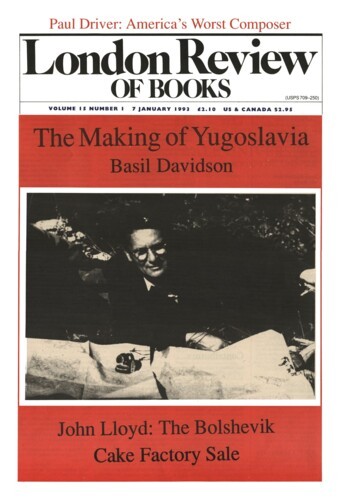
John Sutherland, 7 January 1993

It is difficult to talk sensibly about literary forgery when one has to call it that. The term carries heavy legal baggage. Criminal forgery – in the form of counterfeit money or altered wills – is a major felony. Like poisoning, or arson, it receives sentences of medieval harshness. Literary forgery is much hazier. Meum and Tuum are routinely confused in creative writing. Many of literature’s conventions – the ‘found’ manuscript, the ‘true history’, pseudonymy – originate in primitive forgery, or mimic it. It is not clear that even an arch literary forger like Thomas J. Wise actually committed a criminal act for which he could be prosecuted by the DPP. It would be sensible to replace the term ‘literary forgery’ with Anthony Grafton’s neologism, ‘pseudepigrapha’. This blanket description would cover everything from Chatterton’s fake poems to George MacDonald Fraser’s ‘Flashman’ spoofs without any automatic presumptions of wrong-doing.’

Heliotrope

John Sutherland, 3 December 1992

Ian Bell protests his disqualifications as a biographer rather too much: ‘I have approached Stevenson in the most unscholarly way. I am a journalist, and do not pretend to be anything else.’ But Bell, as he is at pains to point out, is a Scottish journalist and it is through the privilege of shared race and place of origin that he claims a blood-intimacy denied scholars. The key to Stevenson’s personality, as Bell apprehends it, is that however far he travelled, he could never leave. Scotland came too. In the wilds of Northern California, where he and his wife spent their honeymoon as Silverado squatters, Stevenson pondered the paradoxes of being a Scot out of Scotland. Many emigrants sentimentalise the old country – not least fellow Celts like the Welsh and Irish. But the difference with Scots is that, however moist-eyed, they carry with them an undimmed recollection of how awful the place was and how right any sane person is to get out and stay out: ‘There is no special loveliness in that gray country, with its rainy, sea-beat archipelago; its fields of dark mountains; its unsightly places, black with coal; its treeless, sour, unfriendly-looking cornlands; its quaint, gray, castled city, where the bells clash of a Sunday, and the wind squalls, and the salt showers fly and beat. I do not even know if I desire to live there; but let me hear, in some far land, a kindred voice sing out, “Oh, why left I my hame?” and it seems at once as if no beauty under the kind heavens, and no society of the wise and good, can repay me for my absence from my country. And though I think I would rather die elsewhere, yet in my heart of hearts I long to be buried among good Scots clods.’’

After-Lives

John Sutherland, 5 November 1992

A man of many literary parts, Ian Hamilton came to biography late and triumphantly with his life of the dead but still warm Robert Lowell. Riding high, he went on to attempt an unauthorised life of the aged but very much alive J.D. Salinger and was comprehensively outfoxed by the second most reclusive man in American letters. Hamilton wrote up his experience as a rueful memoir, In Search of J.D. Salinger. Keepers of the Flame is a further cogitation on the woes of biography, this time in a more objectively historical context. Hamilton offers 22 case studies, from John Donne – the first properly biographed English author – to Philip Larkin of last month’s Observer fame.’

Like it or not, ‘Orwell’ is a brand: ordinariness, common decency, speaking plain truths to power, a haggard, prophetic gaze.

Read more reviews

Kids Gone Rotten: ‘Treasure Island’

Matthew Bevis, 25 October 2012

John Singer Sargent’s ‘Robert Louis Stevenson and His Wife’ (1885). The first return to Treasure Island was made by Robert Louis Stevenson himself. Fourteen years after...

Read more reviews

Stephen Spender was a visitor to the city of Hamburg both before the war and after, when he played a part in the work of occupation and recovery. He was well on his way to being the noted...

Read more reviews

When Stephen Spender’s son Matthew was ten years old, he caught his hand in a car door. ‘The event,’ John Sutherland writes, ‘recalled other tragedies in the boy’s...

Read more reviews

Look here, Mr Goodwood

John Bayley, 19 September 1996

A learned, indeed an erudite little book; but also one that is so absorbing, so readable, so quietly and deftly humorous, that it shows up all the dull pretentiousness of nine-tenths of the stuff...

Read more reviews

Burying Scott

Marilyn Butler, 7 September 1995

John Sutherland’s pithy, cynical Life of Scott is very much a biography of our time: irreverent, streetwise, set foursquare in a ‘real world’ in which careers achieve money and...

Read more reviews

The Great Mary

Dinah Birch, 13 September 1990

‘No Arnold can write a novel; if they could, I should have done it.’ That was Matthew Arnold’s reaction to his niece’s first significant attempt at fiction, Miss...

Read more reviews

An Infinity of Novels

Philip Horne, 14 September 1989

Anthony Trollope once proposed to write ‘a history of English prose fiction’, but ‘broke down in the task, because I could not endure the labour in addition to the other labours...

Read more reviews

Read anywhere with the London Review of Books app, available now from the App Store for Apple devices, Google Play for Android devices and Amazon for your Kindle Fire.

Sign up to our newsletters

For highlights from the latest issue, our archive and the blog, as well as news, events and exclusive promotions.

Newsletter Preferences