John Lanchester

John Lanchester is the author of six novels – The Debt to Pleasure, Mr Phillips, Fragrant Harbour, Capital, The Wall and Look What You Made Me Do – and a collection of ghost stories, Reality, and Other Stories. He has also written a memoir, Family Romance, and two books about the financial system, Whoops!, and How to Speak Money.

His first piece for the LRB, on Martin Amis, appeared in 1987, when he was a junior member of staff at the paper. He has since written well over a hundred pieces on subjects including agoraphobia, Don De Lillo, Anthony Powell, Ian Rankin, Ian Fleming, Rupert Murdoch, Google, Wal-Mart, Alastair Campbell’s diaries, Cityphilia and Cityphobia, the failure of the banking system in 2008, Marx, getting hooked on Game of Thrones, the PPI scandal, the robotified future, bitcoin, Facebook, Agatha Christie, Maigret, Universal Basic Income, the shipping industry, cheating in sport, Covid, statistics and the uselessness of modern finance.

Absent Authors

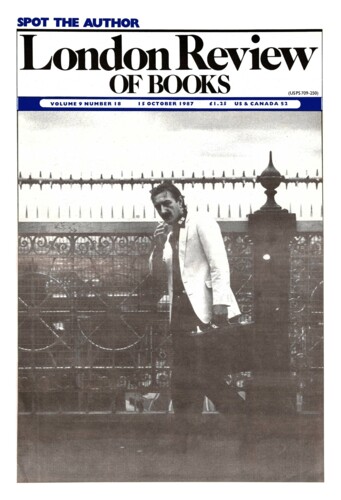
John Lanchester, 15 October 1987

‘Those who have much leisure to think, Dr Johnson wrote, ‘will always be enlarging the stock of ideas, and every increase of knowledge, whether real or imagined, will produce new words or combinations of words.’ The words that aren’t in a dictionary can convey nearly as much information as the words that are: the main body of the OED, which was completed in 1933, has no entry for the first word I looked up in it – ‘genocide’. There is as yet no mention of ‘Deconstruction’ in the OED or in its Supplement.’
Dying Falls

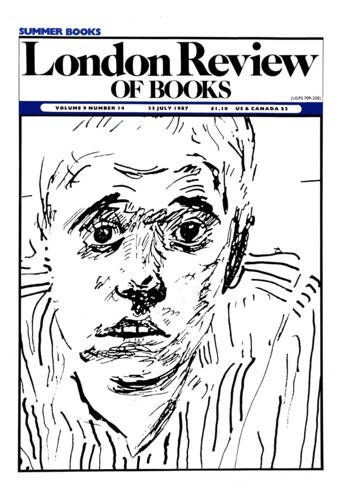
John Lanchester, 23 July 1987

As well as having themes, preoccupations and voices, writers often have a favourite cadence, which is sometimes apparent as the shape towards which their fictions tend. If they do have such a cadence, it will be more apparent in short fictions than in their longer work, for very prosaic reasons: because the beginning and the ending of a short story are more likely to be read in the same sitting, and because you get more endings per volume to judge by. In poetry the tendency is more marked still – so marked, in fact, that a lot of contemporary verse seems to have the same shape, with the poem moving towards the ironic, downbeat shape that Terry Eagleton has called a ‘pulled punch’.’

As a returning lord

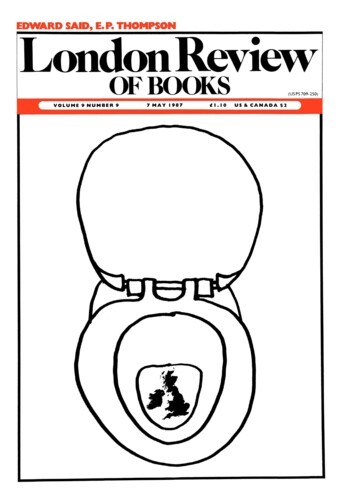
John Lanchester, 7 May 1987

This comes from ‘Thinkability’, the introduction to Einstein’s Monsters, and is, in a way, a typical Martin Amis paragraph:

Letter
SIR: Mike Selvey’s diary piece in your last issue (LRB, 8 January) hits several nails on the head, and he is at least half-right in his assertion that ‘the real enemy of cricket as she is known is the limited overs stuff.’ The game is subject to its own version of Gresham’s Law, with bad cricket driving out good: in recent years this has been made especially clear by the way...

Hong Pong: John Lanchester

Thomas Jones, 25 July 2002

First, let me declare a disinterest. John Lanchester and I are both involved, in different ways, with the London Review of Books, but otherwise have nothing to do with one another. Now...

Read more reviews

On the Run: John Lanchester

Adam Phillips, 2 March 2000

The name is ordinary, so the book announces itself as a book about no one special; though, of course, when men without qualities become the subjects of novels a certain gravity (if not grace) is...

Read more reviews

Read anywhere with the London Review of Books app, available now from the App Store for Apple devices, Google Play for Android devices and Amazon for your Kindle Fire.

Sign up to our newsletters

For highlights from the latest issue, our archive and the blog, as well as news, events and exclusive promotions.

Newsletter Preferences