John Lanchester

John Lanchester is the author of six novels – The Debt to Pleasure, Mr Phillips, Fragrant Harbour, Capital, The Wall and Look What You Made Me Do – and a collection of ghost stories, Reality, and Other Stories. He has also written a memoir, Family Romance, and two books about the financial system, Whoops!, and How to Speak Money.

His first piece for the LRB, on Martin Amis, appeared in 1987, when he was a junior member of staff at the paper. He has since written well over a hundred pieces on subjects including agoraphobia, Don De Lillo, Anthony Powell, Ian Rankin, Ian Fleming, Rupert Murdoch, Google, Wal-Mart, Alastair Campbell’s diaries, Cityphilia and Cityphobia, the failure of the banking system in 2008, Marx, getting hooked on Game of Thrones, the PPI scandal, the robotified future, bitcoin, Facebook, Agatha Christie, Maigret, Universal Basic Income, the shipping industry, cheating in sport, Covid, statistics and the uselessness of modern finance.

Quarterly GDP data don’t, on the whole, tend to make the person studying them laugh out loud. The most recent set, however, are an exception, despite the fact that the general picture is of unrelieved and spreading economic gloom. Instead of the surge of rebounding growth which historically accompanies successful exit from a recession, we have the UK’s disappointing 0.2 per cent growth, the US’s anaemic 0.3 per cent and the glum eurozone average figure of 0.2 per cent. That number includes the surprising and alarming German 0.1 per cent, the desperately poor French 0 per cent and then, wait for it, the agreeably frisky Belgian 0.7 per cent. Why is that, if you’ve been following the story, laugh-aloud funny? Because Belgium doesn’t have a government.


The economic crisis in Greece is the most important thing to have happened in Europe since the Balkan wars. That isn’t because Greece is economically central to the European order: at barely 3 per cent of Eurozone GDP, the Greek economy could vanish without trace and scarcely be missed by anyone else. The dangers posed by the imminent Greek default are all to do with how it happens. I speak of the Greek default as a sure thing because it is: the markets are pricing Greek government debt as if it has already defaulted. This in itself is a huge deal, because the euro was built on the assumption that no country in it would ever default, and as a result there is no precedent and, more important still, no mechanism for what is about to happen.

Short Cuts: Unlikeabilityfest

John Lanchester, 17 February 2011

Back when I was at university, the only people who ever used the word ‘narrative’ were literature students with an interest in critical theory. Everyone else made do with ‘story’ and ‘plot’. Since then, the n-word has been on a long journey towards the spotlight – especially the political spotlight. Everybody in politics now seems to talk about...

From The Blog
8 February 2011

The BBC is encouraging its specialist reporters to blog, as a way of going into subjects at greater length and a greater degree of wonkery than they can manage in their broadcasting. The results are often interesting, especially on the economics side, where writers such as Stephanie Flanders and Robert Peston often allow themselves to get more technical than they can when they're appearing on any of the Beeb's various news outlets. Here is an absolute corker of a piece from Paul Mason, offering 'Twenty reasons why it's kicking off everywhere', from UCL to Tahrir Square. Here are some of them:

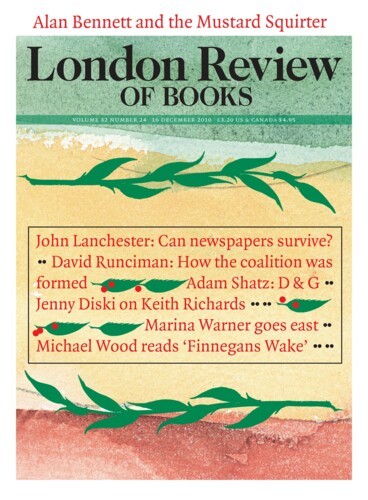
Let Us Pay: Can newspapers survive?

John Lanchester, 16 December 2010

During 2009, it was difficult to find anybody inside the newspaper business who was not profoundly depressed about the future of the industry. All the trend lines were downwards. The migration of readers and advertisers towards digital media was already a long-standing headache for the industry. Then came the credit crunch, whose aftermath brought recession, further decline in sales, and a sharp downturn in advertising. The result was industry-wide gloom. The historic strength of the newspaper business, from an economic point of view, is the fact that it offers two revenue streams, sales and advertising. Both of these have for years been under severe pressure. The story told by circulation figures is so obvious that it’s difficult to find anything interesting to point out about it. A recent OECD report, The Evolution of News and the Internet, makes the picture clear. Between 2004 and 2009, the US newspaper industry lost 34 per cent of its readers; the UK industry lost 22 per cent. Since then, the speed of the downturn has increased.

Hong Pong: John Lanchester

Thomas Jones, 25 July 2002

First, let me declare a disinterest. John Lanchester and I are both involved, in different ways, with the London Review of Books, but otherwise have nothing to do with one another. Now...

Read more reviews

On the Run: John Lanchester

Adam Phillips, 2 March 2000

The name is ordinary, so the book announces itself as a book about no one special; though, of course, when men without qualities become the subjects of novels a certain gravity (if not grace) is...

Read more reviews

Read anywhere with the London Review of Books app, available now from the App Store for Apple devices, Google Play for Android devices and Amazon for your Kindle Fire.

Sign up to our newsletters

For highlights from the latest issue, our archive and the blog, as well as news, events and exclusive promotions.

Newsletter Preferences