John Bayley

John Bayley, who died in 2015, was the first holder of the Warton chair in English literature at Oxford. He wrote 153 pieces for the LRB, some of which were collected in The Power to Delight: A Lifetime in Literature. His other books include The Romantic Survival, The Characters of Love and studies of Shakespeare, Hardy, Pushkin and Tolstoy.

Our Founder: Papa Joyce

John Bayley, 19 February 1998

Joyce’s prose is ‘beautifully written’, as they used to say. Written, like his poems, in the old style of the Nineties. Paradoxically, it is not composed but spoken. The voice that echoes through it, the voices rather, and the tones, are those of the old artificer, the father of the tribe, Simon Dedalus, John Stanislaus Joyce. Like the violins of Cremona, Dubliners, Ulysses, Finnegans Wake are the products of a joint concern, a family undertaking. Joyce himself was frank about this. As long as he had escaped he could still be in the bosom of the family. As long as he remained in Trieste or Zurich or Paris he was able to take the part of maestro, conducting the chorus of voices in the parlour of the grandest house they had once lived in – 23 Castlewood Avenue, off Belgrave Square, Rathmines – or in the back kitchen of some much more modest establishment. As Richard Ellmann emphasised in his biography, Joyce employed his father till the very end, requiring the particulars of the ‘Star of the Sea’ church when Pappie was at death’s door. In his last remembered words the old man replied to another of his son’s queries: ‘Tell Jim he was born at six in the morning.’ Unknowing, John Stanislaus died the begetter of what was to become the greatest of all enterprises in modern Irish mythology.’‘
A Subtle Form of Hypocrisy

John Bayley, 2 October 1997

On the jacket of Playing the Game is a portrait of the man who played it: a portrait by William Strang (1859-1921), a Late Victorian artist now much undervalued. He did what is by far the best portrait of Hardy, and his special ability seems to have lain in pleasing his subjects and their public by making them look suitably grave and important, even a shade portentous, while at the same time revealing hidden traces of weakness, perhaps of meanness. Newbolt’s is a close little face, the small mouth primly clenched over an aggressively cloven chin, the brows knitted in a frown which seems to tell less of imperial visions than of inner worries and embarrassments. It is the kind of face to whose owner a bank manager might think twice before making a loan. No wonder Newbolt felt uneasy when he went to look at the portrait exhibited at the Tate. ‘Had a good laugh,’ he none the less gamely recorded.

Such a Husband

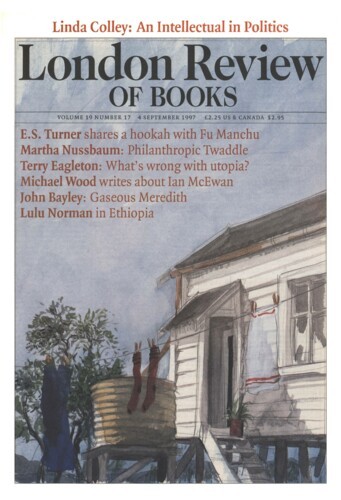
John Bayley, 4 September 1997

The two most interesting letters in this selection are not by Meredith: a fact suggestive of the Meredithian tendency to evade evidence or embodiment of a personal sort, and disappear into the airier world of ideas about him – his own or those of others. His personality, like that of his creations, is of a gaseous nature. Max Beerbohm once wrote a memorable little sketch of a visit to the Sage of Box Hill, and of hearing Meredith’s voice addressing the air as he approached, and recommencing the conversation as he walked away. In mid-century Meredith dazzled his friends and public, but the bubble eventually burst. Had there ever been anything in his coruscating characters and their sprightly utterance? Even old loyalties turned a bit sceptical. In her Memories of George Meredith one of his fans, Lady Butcher, recalled how he had thrilled her with his first inspiration for One of Our Conquerors, as they walked together on Box Hill.’

Anything that Burns

John Bayley, 3 July 1997

Five years ago the formidable chairwoman of the first Russian Booker Prize remarked of one of the entries that she’d never been so disgusted in her life. There was an American judge on the panel, also a woman, who looked surprised. Conditioned as she and I were to the novel in the West, we had scarcely noticed what seemed to us rather quaint attempts by younger Russian novelists – aspirants for the prize – to shock and repel their readers. The new sexual and scatological candour in Russian writing was for us run-of-the-mill stuff, obviously copied from Western colleagues.’

So wrote Yeats of Swift’s Latin epitaph for himself in Dublin Cathedral, and it had been an epitaph well earned. The fashionable aspect of social indignation was to come later. To the heroes of the Irish revolution, twenty years after the American, it was nothing of the kind. In his poem ‘September 1913’ Yeats was convinced that Ireland in his own time had ‘come to sense’, and had nothing to do now ‘but fumble in a greasy till’. Was it’

In their very different ways, the three most prominent Oxford professors of English since the war have all been populist pretenders. John Carey, scourge of Modernist ‘intellectuals’...

Read more reviews

The first thing Alzheimer’s disease took away from Iris Murdoch was her luminous powers. At a conference in Israel in 1994, she was unable to answer her audience’s questions. In 1995,...

Read more reviews

Distant Sheep

Penelope Fitzgerald, 21 July 1994

John Bayley’s new novel is largely about those who are had on, or taken in, and this may well include his readers, who need to keep their wits about them. To begin with, he conjures up a...

Read more reviews

A Poetry of Opposites

C.H. Sisson, 9 July 1992

Whatever may now be the state of the market for A Shropshire Lad, the poetry of A.E. Housman has certainly been among the most read of the 20th century. Or in the 20th century, for the earlier...

Read more reviews

In a recent issue of Index on Censorship, Vaclav Havel, the dissident Czech playwright and essayist who has spent long periods in prison, tells the following tale: A friend of mine who is...

Read more reviews

The Things about Bayley

Nicholas Spice, 7 May 1987

There is a certain kind of knowledge – perhaps the most important – that cannot be explicitly taught or diligently learnt. For example, a tribe of Indians on the river Xingu lives on...

Read more reviews

Foreigners

Denis Donoghue, 21 June 1984

One of Anthony Thwaite’s poems, ‘Tell it slant’, swerves from Emily Dickinson’s line ‘Tell all the Truth but tell it slant’ to settle upon an aesthetic...

Read more reviews

Theatre-proof

Anne Barton, 2 July 1981

Twenty-one years ago, in The Characters of Love, John Bayley suggested that ‘there is a sense in which the highest compliment we can pay to Shakespeare is to discuss his great plays as if...

Read more reviews

Read anywhere with the London Review of Books app, available now from the App Store for Apple devices, Google Play for Android devices and Amazon for your Kindle Fire.

Sign up to our newsletter

For highlights from the latest issue, our archive and the blog, as well as news, events and exclusive promotions.

Newsletter Preferences