John Bayley

John Bayley, who died in 2015, was the first holder of the Warton chair in English literature at Oxford. He wrote 153 pieces for the LRB, some of which were collected in The Power to Delight: A Lifetime in Literature. His other books include The Romantic Survival, The Characters of Love and studies of Shakespeare, Hardy, Pushkin and Tolstoy.

In Memoriam: V.S. Pritchett

John Bayley, 24 April 1997

It’s often said that the short story today goes with poetry. But the trouble with bringing poetry in is not only that the ‘poetic’ is a bad thing in prose but that it implies a degree of consciousness and concentration which the very best stories don’t seem to have. William Gass rationally observed that the story ‘is a poem grafted onto a sturdier stock’ but Borges decreed that ‘unlike the novel, it may be essential.’ That has an ominous sound.
Our Boys

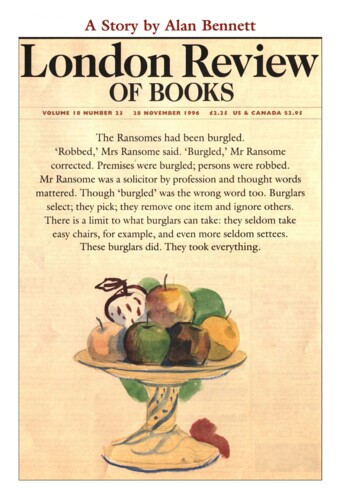
John Bayley, 28 November 1996

Lionel Tennyson, the Poet Laureate’s second son, had what might be called an interesting marriage. Interesting from our point of view, however difficult from his own. Like everyone who married a Tennyson, Eleanor Locker had been in their circle since childhood. After her mother’s death her father married an American million-dollar heiress of unbending Quaker principles, and became Frederick Locker-Lampson, one of the arch little poets whose presence embarrasses the later pages of Q’s first attempt at an Oxford Book of English Verse. Eleanor sounds a jolly girl, unremittingly flirtatious before and after marriage, and a source of some anxiety to her august in-laws, and particularly to Emily, the Poet Laureate’s wife. Lively Lionel, who had romped with her since childhood, fell for the flirtiness as she grew up and wrote her a rather touching little poem.

Letter

Blame it on the claret

14 November 1996

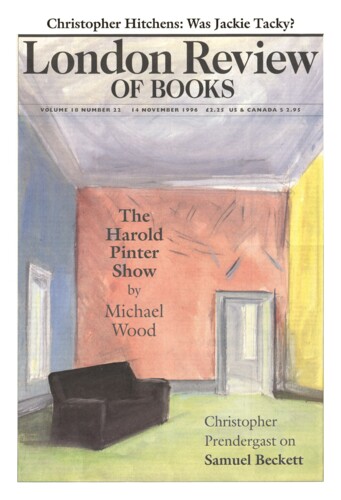
I haven’t read Billington on Pinter, but I gather from Michael Wood’s review (LRB, 14 November) that Billington says I must have been the victim of spite or delusion in making a reference to Pinter’s visible rage at a dinner party. Pinter never displays anger but only ‘impassioned integrity’. No doubt; and I yield to none in admiration for the playwright and his integrities. On this occasion,...

Look here, Mr Goodwood

John Bayley, 19 September 1996

A learned, indeed an erudite little book; but also one that is so absorbing, so readable, so quietly and deftly humorous, that it shows up all the dull pretentiousness of nine-tenths of the stuff that gets written nowadays about Eng. Lit. A fascinating and major paradox is involved; but what would be the point of the author displaying it when a fabulous gathering of fictional puzzles will do it for him? The best critic, like the best novelist, leaves the reader to decide. The paradox remains, however. On the one hand, the novelist must tell the truth, and want to tell nothing else: on the other, he has the irresponsibility of a creator whose fondness for his creatures is no guarantee that he will not kill them or save them at a whim, show them up or let them down. You want a happy ending? Dickens, Hardy and above all Thackeray will oblige, however much with tongue in cheek. Dickens and Hardy will do it, while taking the opportunity, in letters or prefaces or afterthoughts, of making clear that it goes against their artistic consciences. Thackeray will exhibit the absurdity of novel-writing with a shrug and a smile of apparent shamelessness.

Letter

The Buttocks Problem

5 September 1996

Apart from general arguments against corporal punishment, Paul Foot is clearly right (LRB, 5 September) about the grotesque unsuitability of Anthony Chenevix-Trench as a headmaster in a position to beat pupils. Trench no doubt had academic gifts and teaching abilities, but he quite possibly owed his appointment to an establishment-minded respect for his war service, and the horrors and humiliations...

In their very different ways, the three most prominent Oxford professors of English since the war have all been populist pretenders. John Carey, scourge of Modernist ‘intellectuals’...

Read more reviews

The first thing Alzheimer’s disease took away from Iris Murdoch was her luminous powers. At a conference in Israel in 1994, she was unable to answer her audience’s questions. In 1995,...

Read more reviews

Distant Sheep

Penelope Fitzgerald, 21 July 1994

John Bayley’s new novel is largely about those who are had on, or taken in, and this may well include his readers, who need to keep their wits about them. To begin with, he conjures up a...

Read more reviews

A Poetry of Opposites

C.H. Sisson, 9 July 1992

Whatever may now be the state of the market for A Shropshire Lad, the poetry of A.E. Housman has certainly been among the most read of the 20th century. Or in the 20th century, for the earlier...

Read more reviews

In a recent issue of Index on Censorship, Vaclav Havel, the dissident Czech playwright and essayist who has spent long periods in prison, tells the following tale: A friend of mine who is...

Read more reviews

The Things about Bayley

Nicholas Spice, 7 May 1987

There is a certain kind of knowledge – perhaps the most important – that cannot be explicitly taught or diligently learnt. For example, a tribe of Indians on the river Xingu lives on...

Read more reviews

Foreigners

Denis Donoghue, 21 June 1984

One of Anthony Thwaite’s poems, ‘Tell it slant’, swerves from Emily Dickinson’s line ‘Tell all the Truth but tell it slant’ to settle upon an aesthetic...

Read more reviews

Theatre-proof

Anne Barton, 2 July 1981

Twenty-one years ago, in The Characters of Love, John Bayley suggested that ‘there is a sense in which the highest compliment we can pay to Shakespeare is to discuss his great plays as if...

Read more reviews

Read anywhere with the London Review of Books app, available now from the App Store for Apple devices, Google Play for Android devices and Amazon for your Kindle Fire.

Sign up to our newsletter

For highlights from the latest issue, our archive and the blog, as well as news, events and exclusive promotions.

Newsletter Preferences