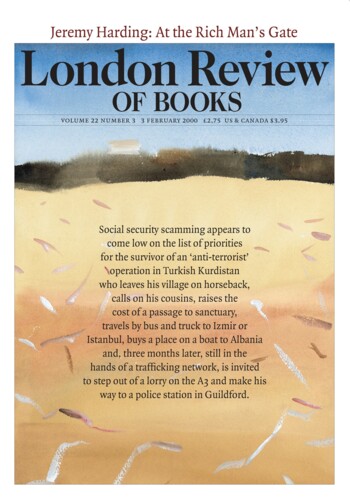
The Uninvited: At The Rich Man’s Gate
Jeremy Harding, 3 February 2000
In the early 1990s, about 80 million people – roughly 1.5 per cent of the world’s population – were living outside the country of their birth. The figure now is closer to 120 million. Migration across international borders is not a simple phenomenon and migrants themselves are as diverse as people who stay put. The banker from Seattle who signs a five-year contract for a post in Berlin is a migrant; so is the lay-out editor in Paris who moves to Moscow to work on a Russian edition of her magazine; so is the labourer from Indonesia or Thailand who becomes a building worker in Brunei; so is the teenage boy from Shanghai indentured to a Chinese crime ring in New York. Refugees, too, are migrants. Often they share their route to safety with others who are not seeking asylum: the smuggling syndicates known as snakeheads, which induct Chinese women into a life of semi-slavery in Europe and the US, also ran dissidents to freedom in the retreat from Tiananmen Square. These things are largely a question of money. Refugees are not necessarily poor, but by the time they have reached safety, the human trafficking organisations on which they depend have eaten up much of their capital. In the course of excruciating journeys, mental and physiological resources are also expended – some of them non-renewable.’