Jeremy Harding

Jeremy Harding is a contributing editor at the LRB. His books include Border Vigils: Keeping Migrants Out of the Rich World and Mother Country, a memoir. His essay collection, Analogue Africa: Notes on the Anti-Colonial Imagination, was published in March.

Delirium: Arthur Rimbaud

Jeremy Harding, 30 July 1998

Jean-Nicolas-Arthur Rimbaud, poet and ex-poet, took a 41 shoe – about a seven in British sizes, an American seven and a half. We have his own word on this, in a letter written shortly before his death at the age of 37, requesting a stocking for varicose veins. The jaunty teenager smoking a pipe in Verlaine’s famous sketch – dearer to Rimbaud’s admirers than the simpering soul in Fantin-Latour’s group portrait of the same year – has elegant legs. But of the eight pairs hidden from view in the Fantin-Latour, Rimbaud’s were surely the toughest, the most serviceable, when it came to getting about. Nimble feet on peasant legs which, against every impulse of peasant culture, propelled him away from the farmyard across the dank pastures of Northern France and Belgium and, a few years later, down through Italy, racking up great distances in the course of a day.’

‘Martha Gellhorn (1908-98), war correspondent and heroine’. Since her death in February, this epitaph has become a depressing possibility. Now we can say what we like about her, but during the last ten years of her life, though she could do little about criticism, she tried to keep the mythologising, much of it from friends, within the bounds of taste. She didn’t care for anything, or anyone, with a propensity to gush. She is thought of, primarily, as a journalist – and one whose subject was war. Since the second half of the Eighties, her two collections of reportage, The Face of War and The View from the Ground, have enjoyed a wider readership than her novels, of which there are five, or the novellas, roughly a dozen, or the numerous short stories.’‘

Best Remain Seated: travel guides

Jeremy Harding, 1 January 1998

For some varieties of ‘new traveller’, as the guide books refer to him, fun, or value for money, can only be had when the going gets rough. He is, without question, a man. He likes to keep count of his change and clock up the kilometres. Once abroad he’s a seigneur of the road; the locals are vassals, trespassers, con-artists and thieves. The new traveller knows how to deal with them. He’s the strongish, silent type who won’t complain if there are no croissants at breakfast. He may not succumb to the t-shirt, but he’s busy having been there, done that. He can be moved by a spectacular view at the end of a dreadful day. He believes that nothing should come easy, there must be endemic hassle and haggle from dawn to dusk. And because the business of getting there is really the whole point, or much of it, it turns out that, with his preferred form of leisure, there’s no distinguishing the thing pursued from the pursuit of it. It’s already done though he’s still looking forward to it. Queuing seven hours for a visa while suffering a bad case of dysentery, multiple snakebite and severe heatstroke, or being run off the road by a truck and later robbed at gun-point, is evidently what makes the earth move for the kind of traveller the Lonely Planet guides have in mind.‘

Elective Outsiders

Jeremy Harding, 3 July 1997

That Iain Sinclair, poet, essayist, impresario and weaver of arcane fictions, is one of the more generous spirits around is obvious from this brave, demanding and often flummoxing anthology. Thirty or forty poets are represented; most have remained in relative obscurity, partly because their work fell on deaf ears, partly because they believed in the notion of a mainstream which intellectual loyalties led them to disparage quicker than it could disparage them. ‘The voices here,’ says Sinclair in the Introduction, ‘are the ones who have been locked away, those who rather enjoy it.’ Twenty-five, thirty years after the best of them began to publish – John James, Chris Torrance, Lee Harwood, Andrew Crozier, Peter Riley, J.H. Prynne, Michael Haslam, Douglas Oliver, Barry MacSweeney, Denise Riley – they must nonetheless wonder, from time to time, whether theirs is a case of having missed the boat which would only have been worth catching if they’d been on it in the first place. Perhaps that is why Sinclair gives the impression of his poets as a ship of fools docking for an open day. ‘The work I value is that which seems most remote, alienated, fractured. I don’t claim to “understand” it but I like having it around.’ Plenty of his contributors are not chaoticians at all. They do not make a meal out of alienation and fracture. Yet the alternative to implying, as Sinclair does in his adversarial way, that because they are crazy and wild, his favourites can wipe the floor with the dandies of the London lists, would have been to argue that they were an avant garde with coherent ideas whose bearing on British poetry will in time become clear – and this is unlikely. Their identity is now too loose, the poetic culture on which they might have a bearing too amorphous. Their vanities, moreover, are not those of an avant garde: Sinclair’s people have too much both in the way of an admirable reticence and a less admirable vigilance which drives some to any lengths to avoid the sin of facility. Most important, the forms of patronage that made avant-gardism a reliable means of insertion in a ‘prevailing’ discourse, and the political contexts in which this was possible, no longer exist. Low-paid day jobs or faculty teaching posts have kept too many of Sinclair’s unworldly contributors at a remove from anything resembling an open forum. If they now speak largely to one another, sometimes in a mysterious babble, that is our loss, for many of them are, or have been, very good indeed.’

The Frighteners

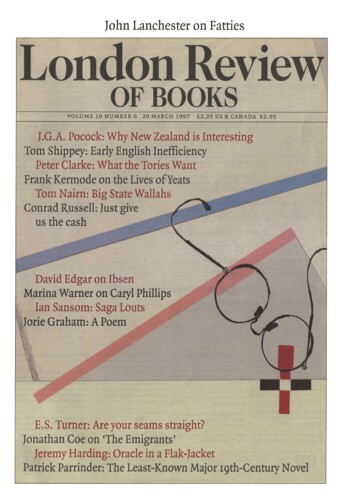
Jeremy Harding, 20 March 1997

The world according to Robert Kaplan has arrived in Britain. The Ends of the Earth is a piece of blockbuster journalism by an American reporter/traveller of some influence whose thinking has shaped the way that other people, more influential still – in the White House, the State Department, the United Nations and the international aid agencies – go about their business. The US edition will already be on a few desks here, and despite the fact that much of it reads like a long assignment by a man in a flak-jacket for other men in suits, this relentless survey of the fate of the world circa the millennium looks set for a wider readership. The sooner it is opposed, the better.

Bloody-Minded

Basil Davidson, 9 September 1993

‘In olden times, which is when God was deciding what blessings he would give to the countries he was creating, after a long while he finally got to Angola and he asked Gabriel his angel to...

Read more reviews

Read anywhere with the London Review of Books app, available now from the App Store for Apple devices, Google Play for Android devices and Amazon for your Kindle Fire.

Sign up to our newsletters

For highlights from the latest issue, our archive and the blog, as well as news, events and exclusive promotions.

Newsletter Preferences