James Wood

James Wood is professor of the practice of literary criticism at Harvard and a staff writer at the New Yorker. His books include The Broken EstateThe Irresponsible SelfHow Fiction Works and Serious Noticing: Selected Essays 1999-2019. Show Us the Father is due next March.

Like Welch’s work, Pilcrow gets nowhere very elegantly. Adam Mars-Jones has been celebrated for the slenderness of his work, increasingly for its non-existence, as if his career were an exercise in negative theology. Pilcrow is not only very long; it measures its length in such tiny units that at times you feel that a version of Zeno’s paradox will stop you from ever reaching its end.
These days, God-like authorial omniscience is permitted only if God is a sweet ghost, the kind with whom the residents can peaceably coexist. This is especially true in most contemporary short stories, where the narrator may be wildly unreliable (first person) or reliably invisible (third person), but not wildly visible and reliable. Few younger contemporary writers risk the kind of biblical...

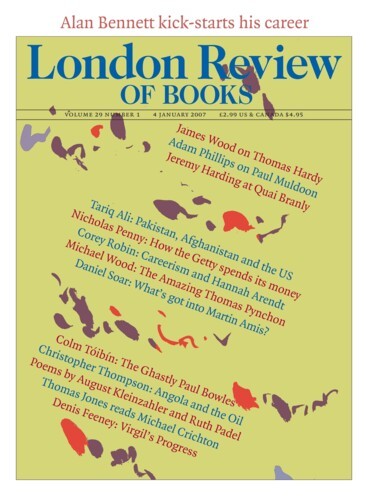
Anxious Pleasures: Thomas Hardy

James Wood, 4 January 2007

What is this? ‘Two miles behind it a jet of white steam was travelling from the left to the right of the picture.’ It is a train, viewed across a valley, in Jude the Obscure (1895), and it is the only sentence offered there about this train. Flaubert is always described as the great cinematic novelist, the great novelist of detail, and indeed Flaubert has his own described...

Can you always count on a bastard for a fancy prose style? It is hard to imagine the fiction of Edward St Aubyn stripped of the cool silver of its style. I am not accusing St Aubyn of being a bastard; I mean that he writes very well about bastards, and that both their contempt for the world and St Aubyn’s contempt for them find their best expression in a certain kind of intelligent,...

Letter
One doesn’t need to have Richard Dawkins’s level of certainty to find Terry Eagleton’s Catholic sermon utterly incoherent (LRB, 19 October). On the one hand, according to Eagleton, God is transcendent, invisible, not a principle nor an entity, not even ‘existent’: indeed, ‘in one sense of that word it would be perfectly coherent for religious types to claim that...

Read anywhere with the London Review of Books app, available now from the App Store for Apple devices, Google Play for Android devices and Amazon for your Kindle Fire.

Sign up to our newsletters

For highlights from the latest issue, our archive and the blog, as well as news, events and exclusive promotions.

Newsletter Preferences