James Wood

James Wood is professor of the practice of literary criticism at Harvard and a staff writer at the New Yorker. His books include The Broken EstateThe Irresponsible SelfHow Fiction Works and, most recently, Serious Noticing: Selected Essays 1999-2019.

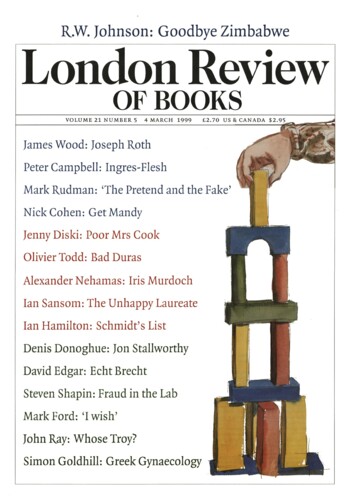
Empire of Signs: Joseph Roth

James Wood, 4 March 1999

With Joseph Roth, you begin – and end – with the prose. The great delight of this Austrian novelist, who wrote in the Twenties and Thirties, lies in his strange, nimble, curling sentences, which are always skewing into the most unexpected metaphors. It is rare to find luminous powers of realism and narrative clarity so finely combined with a high poetic temperature. Joseph Brodsky said that there is a poem on every page of Roth, and certainly, Roth’s almost nervous fondness for metaphor recalls the image-blessed, image-sick prose of another poet, Osip Mandelstam, sooner than any novelist.’
Letter

Nom de Guerre

26 November 1998

Alexis Lykiard (Letters, 10 December 1998) is quite right to point out that, in Knut Hamsun’s novel Hunger, the narrator announces his name to a policeman only to tell the reader immediately that he is lying: ‘I lied unnecessarily.’ I had written that the reader ‘fumblingly’ learns that the narrator’s name is Andreas Tangen, with the hope that my wavering adverb might catch some thing of...

A young man, hectic and dirty, sits on a park bench in a cold city. He is wild, nervous, seems to fiddle with his soul. Beside him, an old man is holding a newspaper. The young man begins a conversation. In its course, the old man reveals that he is blind. He asks the young man where he lives. The young man decides to lie, and names a pleasant square, somewhere he could not afford in his present circumstances. The blind man knows the square, knows the building, in fact. What is the name of the landlord again, asks the blind man. The young man says the first word that comes into his head: ‘Hippolati.’ Ah yes, says the blind man, Hippolati, that’s right, he knows the name, it was on the tip of his tongue. The young man is enjoying this; he froths his lies up into greater extravagances. He reminds the old man that Hippolati is something of an inventor, that he invented an electric prayer-book. Yes, says the blind man, he recalls hearing something like that. And, Hippolati was for seven years a cabinet minister in Persia, adds the young man. Ah yes, says the old man.‘

Ceaseless Anythings: Robert Stone

James Wood, 1 October 1998

American realism, once a belief, is now an idle liberty. Writers such as Robert Stone, Joan Didion, John Irving and even Don DeLillo, are praised for their ‘realism’, for the solidity of their plots, the patience of their characterisation, the capillary spread of their social portraits, the leverage of their political insight. Robert Stone is one of the best contemporary realists America has. But it is difficult to read Damascus Gate with anything like the respect it seems to desire, and with which it has been received in the United States. With its carefully mortised scenes, its dialogue intelligently starved, its descriptions shaved down to a familiar stubble, and the squeezed reticence of its prose (hardly a single simile in the book, each word a little hiatus of arrival), Damascus Gate is never dull, and never unintelligent. But it is never literature, either. Instead, it reveals contemporary realism to be only a series of techniques and conventions aimed at the management of simplicity. Realism, in Stone’s hands, is a calm firefighter, able to travel anywhere and put out the fire of complexity at a moment’s notice.‘

Alan Hollinghurst’s new novel is a spoiled gift which, as an ugly baby makes us search for deficiencies in its attractive parents, forces us to reconsider its creator’s talents. That Hollinghurst possesses great talents is certainly not in question. There is probably no novelist alive with such a deeply historical feeling for English poetic lyricism. His prose is almost drowsy with inheritance. Yet he is wakeful, too – intelligent, droll, social, especially good at capturing snobbery’s self-grooming. He has a beautifully loitering instinct for form and sentence: his novels never hustle themselves to conclusion, or to heavily obvious theme.’

Read anywhere with the London Review of Books app, available now from the App Store for Apple devices, Google Play for Android devices and Amazon for your Kindle Fire.

Sign up to our newsletter

For highlights from the latest issue, our archive and the blog, as well as news, events and exclusive promotions.

Newsletter Preferences