Hal Foster

Hal Foster teaches art history at Princeton. He has written widely on postmodernism, the avant-garde and aesthetic theory, both in the LRB and in his books, which include Recodings, The Return of the Real and The First Pop Age. He edited the influential essay collection The Anti-Aesthetic. Fail Better: Reckonings with Artists and Critics was published in February 2025.

Global Style: Renzo Piano

Hal Foster, 20 September 2007

A tension runs through the work of Renzo Piano. Born in 1937 into a prominent family of Genoese builders, he has long stressed his commitment to craft, to the particularities of material and making, and, though his firm has multiple offices with international projects, it is still called Building Workshop. Yet Piano burst into public view with the Centre Pompidou (1971-77), which, designed with Richard Rogers, is the most celebrated of the high-tech megastructures of the period, and today he is also associated with large urban schemes, including the redevelopment of the old harbour in Genoa (1985-92) and Potsdamer Platz in Berlin (1992-2000), as well as massive infrastructural projects such as Kansai International Airport (1988-94), for which an entire island was engineered into being in the Bay of Osaka.
It sounds like a modern fairytale: in 1971 two architects, neither of them French, win the most important commission in Paris since the war, the design for the Centre Pompidou, and become famous overnight. The two – a 38-year-old Englishman called Richard Rogers and a 35-year-old Italian called Renzo Piano – design an exuberant building that delights some and outrages others: a...

Go, Modernity: Norman Foster

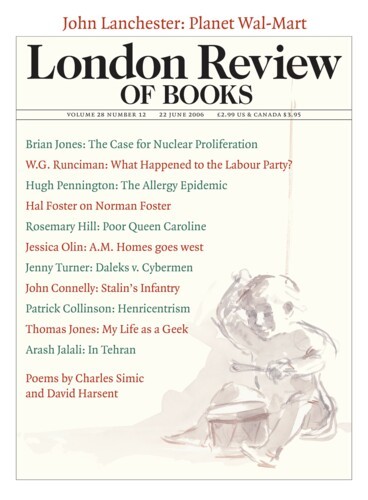
Hal Foster, 22 June 2006

Has any other contemporary designer ‘signed’ as many cityscapes as Norman Foster? Perhaps no architect since Christopher Wren has affected the London skyline so dramatically, from the Swiss Re ‘gherkin’ to the new Wembley Stadium arch. Foster has a right to be immodest, and the Catalogue of his work is punctuated with adjectives like ‘first’ and...

At the Guggenheim: David Smith

Hal Foster, 9 March 2006

David Smith is often seen as the Jackson Pollock of modern sculpture, the artist who transformed European innovations (in welded steel above all) into an American idiom of expanded scale and expressive power. Like most legends in art history, this isn’t false, despite the immediate catch that his greatest follower, Anthony Caro, is English. Yet it does play too neatly into the usual...

At the Guggenheim: Russian Art

Hal Foster, 3 November 2005

Viktor Popkov, ‘Builders of the Bratsk Hydro-electric Power Station’ (1960-61).

With every blockbuster, the Guggenheim prompts suspicion: ‘How did it get the loot, and to what end?’ The current mega-show, Russia! Nine Hundred Years of Masterworks and Master Collections, on until 11 January, is drawn mostly from the Tretyakov Gallery and the Hermitage, and it...

When Hal Foster uses the word ‘first’ in the title of his confidently focused study, he means to start us thinking about Pop now and then. It is a reference to Reyner Banham’s

Read more reviews

White Hat/Black Hat: 20th-Century Art

Frances Richard, 6 April 2006

Helen Gardner’s benevolently dictatorial Art through the Ages was published in 1926, and remained the pre-eminent survey for American undergraduates until 1962, when H.W. Janson’s

Read more reviews

Read anywhere with the London Review of Books app, available now from the App Store for Apple devices, Google Play for Android devices and Amazon for your Kindle Fire.

Sign up to our newsletters

For highlights from the latest issue, our archive and the blog, as well as news, events and exclusive promotions.

Newsletter Preferences