Frank Kermode

Frank Kermode, whose books include Romantic Image (1957), The Sense of an Ending (1967) and Shakespeare’s Language (2000), was the Lord Northcliffe Professor of Modern English Literature at University College London and the King Edward VII Professor of English Literature at Cambridge. He inspired the founding of the LRB in 1979 and wrote more than two hundred pieces for it.

His first, in the first issue of the paper, was on millenarianism, ‘the myth concerning the End’, and his last on Philip Pullman and the parable of the prodigal son. In between he wrote on poets (‘T.S. Eliot and the Shudder’), novelists (Zadie Smith), critics (Paul de Man), Shakespeare, music, psychoanalysis and his wartime experience in the navy (‘My Mad Captains’). A selection of his pieces for the paper is available from the LRB store. He died in 2010 at the age of ninety and a collection of short memoirs by LRB contributors can be found here. ‘Papers speak through their writers,’ Mary-Kay Wilmers wrote after his death. ‘And of all the London Review’s writers Frank Kermode was the one through whom we spoke most often and most eloquently.’

The conversion of Ford’s novel into a television play was an enterprise even more foolhardy than the BBC’s Golden Bowl some years back. The adapter must at once resign himself to the sacrifice of dozens of ambiguities and implications, for they are made possible by purely novelistic means – in this instance, by the taste of the narrator for seeming irrelevance, for digressions that do not digress, for missing apparently obvious connections and for insisting hysterically upon others that look imaginary and without point, Ford professed to despise story: the idea was, by using all the available liberty of discourse, to represent an ‘affair’ in such a way as to extract every drop of meaning from it, which you could not do if you recounted it in story sequence. And although film and television drama can perfectly well do something like this, they lack the power to comment, with the suspicious certainty or the dubious innocence of Ford’s narrator, on the events and utterances thus artfully represented. The Good Soldier is continually preoccupied with knowing: it looks at that word, as at the word ‘heart’ from many semantic angles, and in consequence allows very little to be certainly known. But in dramatic adaptation there is a requirement that characters should do things much less ambiguously: their acts cannot be filtered through the head of John Dowell, the rich American simpleton (if indeed that is what he is) who tells the story. Moreover Dowell has to be there with the others, objectively represented as well as in voice-over; and it is beyond the power of any actor to play an impotent bonehead who is also a cauldron of passion and a sensitive register of cultural disaster (if that is indeed what he is).
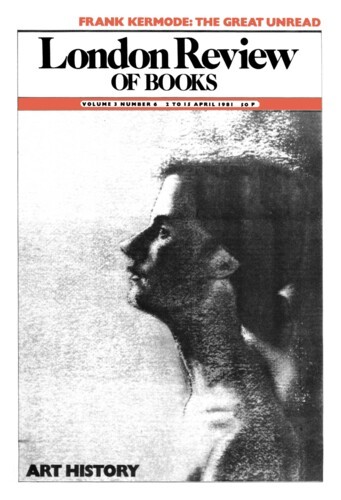
Getting it right

Frank Kermode, 7 May 1981

Literary theory is somewhat bewilderingly in the news, and it is worth pausing over this well-written book, in which a young American Germanist develops his thoughts about the variety of it known as hermencutics. One sometimes hears this word uttered in tones of deep distrust or derision, as if it were some foreign novelty recently imported into a soundly pragmatical Britain by trendy malcontents intent on disturbing the peace: in fact, it is very ancient, though it has, of course, widened its scope and altered its aims. In its earlier forms, it usually amounted to prescriptions and prohibitions relating to the interpretation of Scripture. Its promotion to the status of the science or art of interpreting texts generally was effected in the early 19th century by Schleiermacher; and it achieved with Heidegger a philosophical apotheosis. Modern hermencutics is predominantly German in provenance. Central to it are Schleiermacher’s principle of the hermeneutic circle, which will be mentioned below; and the distinctions developed by his successors between the natural sciences and humane studies (Naturwissenschaften and Geisteswissenschaften). Neither of these developments has attracted much comment over here.

Posterity

Frank Kermode, 2 April 1981

Gerhardie is one of those writers who are periodically rescued from near-oblivion. In 1947, a temporary revival of interest was brought about by the publication of a ‘Uniform Edition’ of his novels, and there was another in 1970, when the same edition was republished with prefaces by Michael Holroyd. Gerhardie himself prefixed to the reissue of his first book, Futility, an important essay called ‘My Literary Credo’, which is unfortunately omitted from the new Penguin Modern Classics reprint. (Futility is the only novel in paperback, another omission that Penguin ought to rectify.) The most recent upsurge of interest has been caused by the posthumous publication of God’s Fifth Column, in the preparation of which Mr Holroyd, sticking to his noble task, has sensibly enlisted the help of a historian expert in the period reviewed by the book.

Letter

Vulgar Chauvinism

5 February 1981

SIR: Since my attitude to Professor Rawson, and to your paper, has always been one of friendly respect (indeed I have collaborated with both), I cannot conceal my astonishment that he should have written, and you published, his review of Susanne Kappeler’s book on Henry James (LRB, 5 February). He sets the tone by expressing contempt for critics with funny foreign names like Lugowski. The name...

The Essential Orwell

Frank Kermode, 22 January 1981

Professor Crick’s subject is important and his research has evidently been diligent. We now know a lot more about Orwell than we did, and the increment of knowledge is not always trivial. Why, then, is it impossible to commend this book with warmth? For two main reasons: first, in a work of such length the prevalence of carelessly written pages is a strong disincentive to continuing (and of course they are shown up all the more by their proximity to quotations from Orwell); and secondly, Orwell was a literary figure as well as a political thinker, and Crick’s literary touch is far from certain.

The Oxford English Dictionary cites more than 33,000 passages from Shakespeare to illustrate the sense of English words. About 1900 of its main entries have first citations from Shakespeare....

Read more reviews

Out of the Lock-Up: Wallace Stevens

Michael Wood, 2 April 1998

Asked in 1933 what his favourite among his own poems was, Wallace Stevens said he liked best ‘The Emperor of Ice-Cream’, from Harmonium (1923). The work ‘wears a deliberately...

Read more reviews

A Sort of Nobody

Michael Wood, 9 May 1996

Criticism for Frank Kermode is the articulation of assumptions, a sort of phenomenology of interpretative need. Its job, as he says in The Sense of an Ending (1967), is ‘making sense of the...

Read more reviews

Real Absences

Barbara Johnson, 19 October 1995

‘Reading others people’s letters, like reading private diaries, offers thrilling and unexpected glimpses into the lives of others,’ claims the dustjacket of The Oxford Book of...

Read more reviews

Kermode’s Changing Times

P.N. Furbank, 7 March 1991

Frank Kermode having now become ‘Sir Frank’, it seems a good moment to take a look back over his remarkable career: though by no means because that career is at an end, for he is...

Read more reviews

Kermode and Theory

Hayden White, 11 October 1990

Frank Kermode belongs to no sect of literary criticism, and he has founded no school. Like William Empson, whom he praises as a ‘genius’ of criticism, Kermode has always been more...

Read more reviews

Loose Canons

Edward Mendelson, 23 June 1988

Frank Kermode’s History and Value reads the literature of the Thirties as ‘a love story, almost a story of forbidden love’. The story is usually told in political terms, but the...

Read more reviews

Reading the Bible

John Barton, 5 May 1988

‘Everyone communes with the Bible,’ wrote Marilyn Butler recently in her Cambridge inaugural lecture, commenting on the recent re-inclusion of the Biblical canon in the canon of...

Read more reviews

Mulberrying

Andrew Gurr, 6 February 1986

Like relics of the True Cross, there are said to be enough splinters to make an orchard from the mulberry tree planted by Shakespeare in his garden at New Place. The Shakespeare canon has excited...

Read more reviews

From Plato to Nato

Christopher Norris, 7 July 1983

Eagleton’s book is both a primer and a postmortem. It surveys the varieties of recent and present-day literary theory, only to suggest – in its closing chapter – that they had...

Read more reviews

Advanced Thought

William Empson, 24 January 1980

Frank Kermode’s new book contains a great deal of graceful and dignified prose, especially in the last chapter, and many of the examples are of great interest. It seems to argue that no...

Read more reviews

Read anywhere with the London Review of Books app, available now from the App Store for Apple devices, Google Play for Android devices and Amazon for your Kindle Fire.

Sign up to our newsletters

For highlights from the latest issue, our archive and the blog, as well as news, events and exclusive promotions.

Newsletter Preferences