Frank Kermode

Frank Kermode, whose books include Romantic Image (1957), The Sense of an Ending (1967) and Shakespeare’s Language (2000), was the Lord Northcliffe Professor of Modern English Literature at University College London and the King Edward VII Professor of English Literature at Cambridge. He inspired the founding of the LRB in 1979 and wrote more than two hundred pieces for it.

His first, in the first issue of the paper, was on millenarianism, ‘the myth concerning the End’, and his last on Philip Pullman and the parable of the prodigal son. In between he wrote on poets (‘T.S. Eliot and the Shudder’), novelists (Zadie Smith), critics (Paul de Man), Shakespeare, music, psychoanalysis and his wartime experience in the navy (‘My Mad Captains’). A selection of his pieces for the paper is available from the LRB store. He died in 2010 at the age of ninety and a collection of short memoirs by LRB contributors can be found here. ‘Papers speak through their writers,’ Mary-Kay Wilmers wrote after his death. ‘And of all the London Review’s writers Frank Kermode was the one through whom we spoke most often and most eloquently.’

The Duckworth School of Writers

Frank Kermode, 20 November 1980

The potter William de Morgan, finding himself at the age of 65 without a studio, decided not to look for another but instead to change his trade and become a novelist. Not so long ago the lucky and the cunning were picking up de Morgan tiles for a song, but it is altogether otherwise with his novels. Almost nobody seems to have picked them up for at least half a century The best-known, or anyway the only one that ever gets mentioned, is Joseph Vance, the first of them, which was published in 1906; the best, or at any rate the most interesting, is Alice-for-Short, which followed, in spite of its great length, only a year later. De Morgan lived to be 88 and wrote seven novels, as well as two more which were completed by another hand and published posthumously. They were mostly long books, and the first four came out at annual intervals, for de Morgan seems to have found fiction very easy after all that arduous tiling. He was writing at a time when such masters as Henry James, Conrad and Ford were agonising a lot about modern technique, but although he seems to have found the business of technique quite interesting – or rather, although he made a few knowing nods in that direction – what he really liked was to get on with his solid and complicated stories. According to the Cambridge Bibliography nobody has had a go at de Morgan since 1926, and there is clearly a case for fishing the novels out of oblivion.
Tennyson’s Nerves

Frank Kermode, 6 November 1980

Robert Martin’s book is not one of those literary biographies that reshuffle a familiar narrative and perhaps add a few bits of new information or conjecture. It is a full-scale life, founded on primary sources, many of them previously unpublished. As the first major biography since Hallam Tennyson’s pious memoir of 1897, it has obvious importance. Moreover, it is for the most part very well-written, affectionate without idolatry, well-proportioned and full of entertaining detail. Mr Martin, in short, has scored a considerable success.

Joseph Conrad’s Flight from Poland

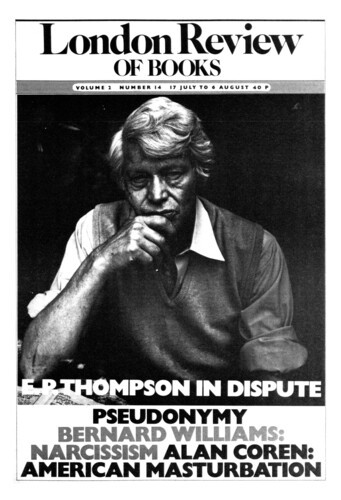
Frank Kermode, 17 July 1980

Ian Watt began work on this book in 1955, and the intervening years have seen a boom in Conrad studies: but the thought that there might be nothing left for him to say quite rightly didn’t enter his head. What’s more, he has only just got under way: for all that it contains close on 200,000 words, this book is merely an antechapel to the main building. It considers the career of Conrad from Almayer’s Folly to Lord Jim, and it does so at its own majestic pace. The section on Heart of Darkness is much longer than the novella itself, and those on The Nigger of the ‘Narcissus’ and Lord Jim are on a scale only a little less generous. No space could be found for extended treatment of the other early works, except Almayer’s Folly. One can’t help wondering how Watt expects to get the rest of Conrad – which includes what most people regard as his greatest work – into one volume, given that he proposes to proceed with the same deliberateness, to have his fully matured say on everything he regards as relevant, and to dismiss with due consideration all that isn’t.

Youth

Frank Kermode, 19 June 1980

‘Generationalism’, as Mr Wohl designates the practice of thinking about history and society in terms of the characteristics attributed, usually by themselves, to members of particular age-groups, is a conceptual device nobody seems to have studiedvery closely till the 19th century. Not, of course, that conflicts between youth and agehadn’t been noticed: ‘they hate us youth,’ as Falstaff remarked, thinking of his behaviour rather than his age. Nor is it always the part of youth to be the wild ones. They may come on strong for discipline, reversing decadent trends, restraining reckless middle age. The novelty of 19th-century generationalism lay in a new self-consciousness about generational differences, and a desire to discover in them some historical dynamic. The result was a good deal of tediously abstract speculation about the length of a generation, the manner in which it acquired its characteristics, and so forth. Meanwhile more practical politicians found ways of using the cults of youth which acquired dignity as a consequence of all this cerebration.

It seemed to be happening only yesterday, but Blake Morrison was born in 1950, and for him the Movement is something you have to work on in a library. So it suddenly comes to seem rather remote, as deep in the past as those files of the Spectator where he found the famous pieces by J.D. Scott and Anthony Hartley, or the scripts of John Wain’s Third Programme magazine First Reading, or copies of the Reading limited editions of Wain and Amis. Mr Morrison claims to have eschewed gossip and attended instead to such questions as: ‘Did the writers know each other? Is there any evidence of mutual admiration, mutual influence, or collaboration?’ It is almost as if he were seeking information about Spenser, Gabriel Harvey and the Areopagus. Yet most of the poets he is writing about are ascertainably hale and not yet eligible for the Old Age Pension; even the few living elders they respected are still around, and capable of spry conversation – Empson, Fuller, Graves. Mr Morrison, of course, knew this, and addressed some inquiries to relevant survivors. Some responded – not Amis, I notice, and not Larkin, for reasons no doubt easily guessed at; but Conquest, doyen of the group, co-operated, and so did Davie, who is quoted more than anybody, though in my view (and in that of certain members of the group) he was never really in the middle of it, partly because he was an interloper from Cambridge, and partly because of all the talents assembled his was the least identifiable with the Movement’s mood and programme.

The Oxford English Dictionary cites more than 33,000 passages from Shakespeare to illustrate the sense of English words. About 1900 of its main entries have first citations from Shakespeare....

Read more reviews

Out of the Lock-Up: Wallace Stevens

Michael Wood, 2 April 1998

Asked in 1933 what his favourite among his own poems was, Wallace Stevens said he liked best ‘The Emperor of Ice-Cream’, from Harmonium (1923). The work ‘wears a deliberately...

Read more reviews

A Sort of Nobody

Michael Wood, 9 May 1996

Criticism for Frank Kermode is the articulation of assumptions, a sort of phenomenology of interpretative need. Its job, as he says in The Sense of an Ending (1967), is ‘making sense of the...

Read more reviews

Real Absences

Barbara Johnson, 19 October 1995

‘Reading others people’s letters, like reading private diaries, offers thrilling and unexpected glimpses into the lives of others,’ claims the dustjacket of The Oxford Book of...

Read more reviews

Kermode’s Changing Times

P.N. Furbank, 7 March 1991

Frank Kermode having now become ‘Sir Frank’, it seems a good moment to take a look back over his remarkable career: though by no means because that career is at an end, for he is...

Read more reviews

Kermode and Theory

Hayden White, 11 October 1990

Frank Kermode belongs to no sect of literary criticism, and he has founded no school. Like William Empson, whom he praises as a ‘genius’ of criticism, Kermode has always been more...

Read more reviews

Loose Canons

Edward Mendelson, 23 June 1988

Frank Kermode’s History and Value reads the literature of the Thirties as ‘a love story, almost a story of forbidden love’. The story is usually told in political terms, but the...

Read more reviews

Reading the Bible

John Barton, 5 May 1988

‘Everyone communes with the Bible,’ wrote Marilyn Butler recently in her Cambridge inaugural lecture, commenting on the recent re-inclusion of the Biblical canon in the canon of...

Read more reviews

Mulberrying

Andrew Gurr, 6 February 1986

Like relics of the True Cross, there are said to be enough splinters to make an orchard from the mulberry tree planted by Shakespeare in his garden at New Place. The Shakespeare canon has excited...

Read more reviews

From Plato to Nato

Christopher Norris, 7 July 1983

Eagleton’s book is both a primer and a postmortem. It surveys the varieties of recent and present-day literary theory, only to suggest – in its closing chapter – that they had...

Read more reviews

Advanced Thought

William Empson, 24 January 1980

Frank Kermode’s new book contains a great deal of graceful and dignified prose, especially in the last chapter, and many of the examples are of great interest. It seems to argue that no...

Read more reviews

Read anywhere with the London Review of Books app, available now from the App Store for Apple devices, Google Play for Android devices and Amazon for your Kindle Fire.

Sign up to our newsletters

For highlights from the latest issue, our archive and the blog, as well as news, events and exclusive promotions.

Newsletter Preferences