Frank Kermode

Frank Kermode, whose books include Romantic Image (1957), The Sense of an Ending (1967) and Shakespeare’s Language (2000), was the Lord Northcliffe Professor of Modern English Literature at University College London and the King Edward VII Professor of English Literature at Cambridge. He inspired the founding of the LRB in 1979 and wrote more than two hundred pieces for it.

His first, in the first issue of the paper, was on millenarianism, ‘the myth concerning the End’, and his last on Philip Pullman and the parable of the prodigal son. In between he wrote on poets (‘T.S. Eliot and the Shudder’), novelists (Zadie Smith), critics (Paul de Man), Shakespeare, music, psychoanalysis and his wartime experience in the navy (‘My Mad Captains’). A selection of his pieces for the paper is available from the LRB store. He died in 2010 at the age of ninety and a collection of short memoirs by LRB contributors can be found here. ‘Papers speak through their writers,’ Mary-Kay Wilmers wrote after his death. ‘And of all the London Review’s writers Frank Kermode was the one through whom we spoke most often and most eloquently.’

Diary: American Books

Frank Kermode, 1 April 1983

All the signs, we are continually told, point to rapid economic recovery in the US, and the Stock Market, perhaps because of this iteration, moves almost daily to new record highs. But unofficial individuals seem cautious or sceptical. Friendly foreigners, especially if they knew this country a generation back, are likely to note the discrepancy between the adman bullishness of government spokesmen and a certain dour disenchantment that has persisted as an ingredient of the American mood during the post-Camelot, post-Watergate, post-Vietnam years. Perhaps this is most noticeable in New York, a city now too notorious for its filth, brutality and cynical manners; the two notions that you need to be pretty tough to live there, and that things can only get worse, cause people to act tough and do a lot of complaining, especially about the economic situation.
Squalor

Frank Kermode, 3 February 1983

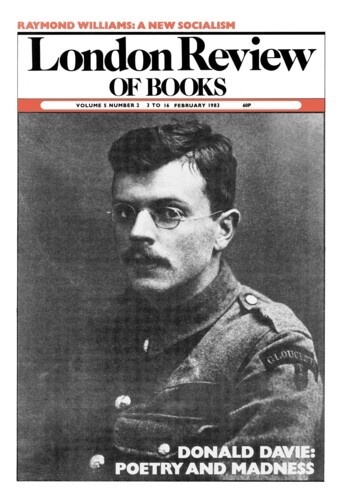
The books listed below have been my leisure reading for many weeks, and I have a glimmering as to what it is that prompts the converted to claim so much for Gissing. But my own view, which is very commonplace, remains the same: New Grub Street is a novel of extraordinary power, and without it the oeuvre would be no more than the interesting record of a pained but minor artist.

Intelligent Theory

Frank Kermode, 7 October 1982

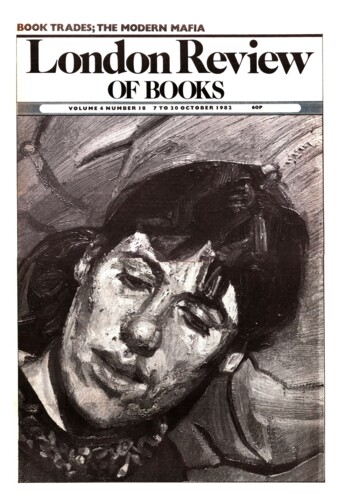
The first four books would normally be described as literary criticism, though they exhibit a considerable variety of interests, sociological, historical, theoretical; in Harold Bloom’s case ordinary language is defeated, for we need some such compound as cabbalistic-rhapsodic. None of them shows much interest in British writing, or the British literary scene, or in literary criticism...

Diary: Theatre of Violence

Frank Kermode, 7 October 1982

There occurred recently the first successful prosecution of videotapes under the Obscene Publications Act. As far as one can tell, the offending material had more to do with violence and cruelty than with simple sex, an interest they appear to be superseding. Around the same time we read of allegations that the Greek police had been inflicting some form of bastinado on a British woman prisoner. They were said to use this means of persuasion as a matter of course.

Diary: Jerusalem

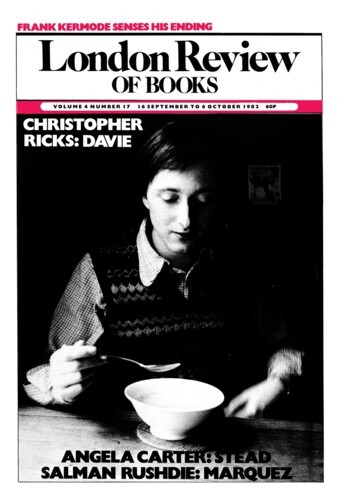
Frank Kermode, 16 September 1982

Retirement, like other less pleasant conditions, is something one never seriously expects to suffer. After a lifetime of compliance with constraints which, however gentle, were not of one’s own choosing, one experiences for the first time a dreadful liberty to do as one likes. In principle, anyway. For example, in principle I can now live anywhere I want. The other day I had a letter from a distinguished colleague, postmarked ‘Verona’, which described the almost terminal happiness of living there and ended: ‘I don’t mean to die in Cambridge.’ Of course not: but where? Supposing for a moment that there were no considerations at all except the immediate satisfaction of my own desire, I think I might choose Jerusalem.

The Oxford English Dictionary cites more than 33,000 passages from Shakespeare to illustrate the sense of English words. About 1900 of its main entries have first citations from Shakespeare....

Read more reviews

Out of the Lock-Up: Wallace Stevens

Michael Wood, 2 April 1998

Asked in 1933 what his favourite among his own poems was, Wallace Stevens said he liked best ‘The Emperor of Ice-Cream’, from Harmonium (1923). The work ‘wears a deliberately...

Read more reviews

A Sort of Nobody

Michael Wood, 9 May 1996

Criticism for Frank Kermode is the articulation of assumptions, a sort of phenomenology of interpretative need. Its job, as he says in The Sense of an Ending (1967), is ‘making sense of the...

Read more reviews

Real Absences

Barbara Johnson, 19 October 1995

‘Reading others people’s letters, like reading private diaries, offers thrilling and unexpected glimpses into the lives of others,’ claims the dustjacket of The Oxford Book of...

Read more reviews

Kermode’s Changing Times

P.N. Furbank, 7 March 1991

Frank Kermode having now become ‘Sir Frank’, it seems a good moment to take a look back over his remarkable career: though by no means because that career is at an end, for he is...

Read more reviews

Kermode and Theory

Hayden White, 11 October 1990

Frank Kermode belongs to no sect of literary criticism, and he has founded no school. Like William Empson, whom he praises as a ‘genius’ of criticism, Kermode has always been more...

Read more reviews

Loose Canons

Edward Mendelson, 23 June 1988

Frank Kermode’s History and Value reads the literature of the Thirties as ‘a love story, almost a story of forbidden love’. The story is usually told in political terms, but the...

Read more reviews

Reading the Bible

John Barton, 5 May 1988

‘Everyone communes with the Bible,’ wrote Marilyn Butler recently in her Cambridge inaugural lecture, commenting on the recent re-inclusion of the Biblical canon in the canon of...

Read more reviews

Mulberrying

Andrew Gurr, 6 February 1986

Like relics of the True Cross, there are said to be enough splinters to make an orchard from the mulberry tree planted by Shakespeare in his garden at New Place. The Shakespeare canon has excited...

Read more reviews

From Plato to Nato

Christopher Norris, 7 July 1983

Eagleton’s book is both a primer and a postmortem. It surveys the varieties of recent and present-day literary theory, only to suggest – in its closing chapter – that they had...

Read more reviews

Advanced Thought

William Empson, 24 January 1980

Frank Kermode’s new book contains a great deal of graceful and dignified prose, especially in the last chapter, and many of the examples are of great interest. It seems to argue that no...

Read more reviews

Read anywhere with the London Review of Books app, available now from the App Store for Apple devices, Google Play for Android devices and Amazon for your Kindle Fire.

Sign up to our newsletter

For highlights from the latest issue, our archive and the blog, as well as news, events and exclusive promotions.

Newsletter Preferences