Frank Kermode

Frank Kermode, whose books include Romantic Image (1957), The Sense of an Ending (1967) and Shakespeare’s Language (2000), was the Lord Northcliffe Professor of Modern English Literature at University College London and the King Edward VII Professor of English Literature at Cambridge. He inspired the founding of the LRB in 1979 and wrote more than two hundred pieces for it.

His first, in the first issue of the paper, was on millenarianism, ‘the myth concerning the End’, and his last on Philip Pullman and the parable of the prodigal son. In between he wrote on poets (‘T.S. Eliot and the Shudder’), novelists (Zadie Smith), critics (Paul de Man), Shakespeare, music, psychoanalysis and his wartime experience in the navy (‘My Mad Captains’). A selection of his pieces for the paper is available from the LRB store. He died in 2010 at the age of ninety and a collection of short memoirs by LRB contributors can be found here. ‘Papers speak through their writers,’ Mary-Kay Wilmers wrote after his death. ‘And of all the London Review’s writers Frank Kermode was the one through whom we spoke most often and most eloquently.’

Semiotics is a fashionable subject, but semioticians do not normally become international best-sellers, which is the fate that, in apparent violation of this familiar cultural assumption, has befallen the Professor of Semiotics at Bologna, Umberto Eco. Academic novelists aren’t rare, of course, but it’s hard to think of one who regards fiction as not only entertainment but material for the practice of a professional discipline. Eco’s novel is a very complicated instance of what he would call semiosis, of the production of signs and their vicissitudes in a network of codes. It also contains many disquisitions on semiotics and related subjects. If that were all, it might be expected to give keen pleasure to a rather small audience: but it seems to go down well with a very large one. That is because it is also, for the most part, as lively and interesting as it is weird and extravagant.
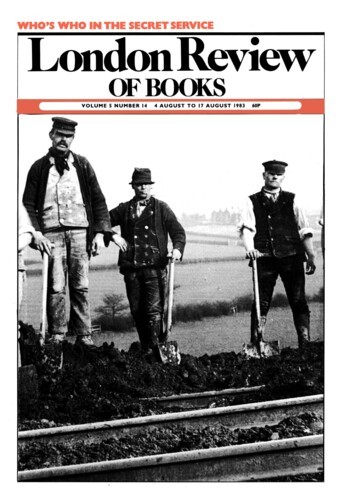
Last Man of Letters

Frank Kermode, 15 September 1983

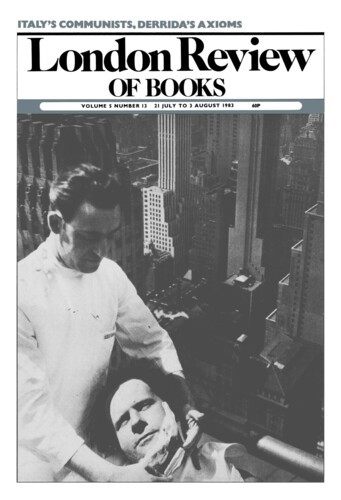
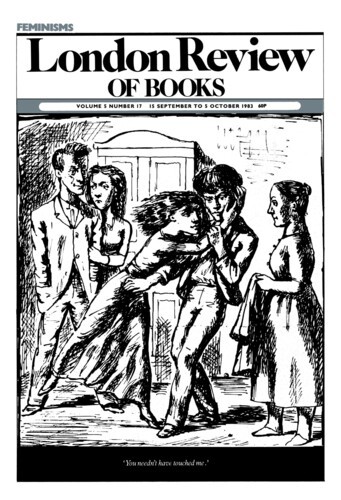
Lewis Dabney, editor of the Portable Edmund Wilson, makes the slightly surprising claim that Wilson’s ‘reputation continues to grow’. I had supposed that it was, at least temporarily, in abeyance, and for reasons that Wilson would have easily understood. Mr Dabney remarks that Wilson’s work ‘reminds students of literature and history of their heritage from a time when these were the joint concerns of educated men rather than separated fields in the academy’. He presumably means that it ought to; there is very little evidence that it does. Dabney says that Wilson’s biographical emphasis (‘he sees society through the individual, takes style as a mirror of personality, and has the old 19th-century interest in authors as persons’) displeased the New Critics: ‘but their taboos have long since faded, and their heirs seek alternatives to the endless interpretation of texts.’ This rather amazing assertion is perhaps only a sign that the editor of the Portable E.W. would like his author’s stock to rally. The posthumous publication of The Twenties and The Thirties – Wilson’s notebooks and diaries for those decades – may have done something to further this end. Wilson had done some of the preparation for their publication before his death in 1972. The Forties is wholly edited by Leon Edel, who says in his Preface that this decade, at any rate the first half of it, is pretty scrappy so far as journal entries go, and it has to be said that the whole collection does Wilson no good whatsoever: which, considering his genuine importance, is a pity.–

Broken Knowledge

Frank Kermode, 4 August 1983

Richard Rorty has made us familiar with the distinction between two sorts of philosophy, which he calls ‘systematic’ and (I think infelicitously) ‘edifying’. The first sticks to the central epistemological tradition, which assumes that it can deal systematically and progressively with reality; the second is essentially of the periphery, and its exponents are pragmatical opponents of the institutional tradition. They include Kierkegaard, Nietzsche, William James, the later Wittgenstein and the later Heidegger, all philosophers who ‘want to keep the space open for the sense of wonder which poets can sometimes cause’. Bacon once called wonder ‘broken knowledge’ – a definition that suits Rorty’s needs. These people, he argues, substitute for continuous inquiry into the way things are all manner of discontinuous instrumentalities, and one of these is the aphorism.–

Diary: In Salt Lake City

Frank Kermode, 21 July 1983

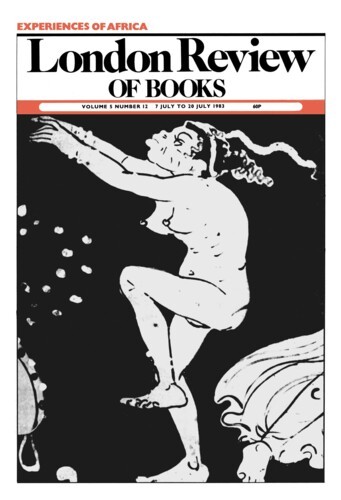
Even if you enjoy Southern California as much as Reyner Banham you may still, like him, draw the line at those discreetly fenced-in and fortified cities in which the better-off sometimes choose to live, and at whose gates the visitor must check with the guardians before being allowed to enter. I recently spent a few days in one of these suburban paradises. It occupies a large tract of the Palos Verdes peninsula, its hills dotted with single-storey houses, tennis courts, swimming pools, corrals, and crisscrossed by trails created by the settlers for the use of their equestrian families. The endless rains of last winter have washed out many of the trails, and streams flow across them, scaring horses which have never seen running water. Large pieces of property have dropped off and blocked the roads. The nearby beaches have been shrunk by storms. It all seems a bit hard on people who have accepted the high risk of earthquakes but never dreamed of such destructive weather.

Diary: Being in New York

Frank Kermode, 7 July 1983

Tony Smith, reviewing J.K. Oates’s Penguin on herpes (LRB, Vol. 5, No 9), sounded, thank God, a cheerful rather than a holy note. Far from being a divine visitation on lechery, herpes is a manageable minor affliction. It may, however, be easier for the righteous to approve, and more difficult for doctors to demythologise, the condition Dr Smith called ‘the gay compromise syndrome’, better-known as AIDS. This may sound like a brand name for an indigestion tablet, but it is an acronym for Auto-Immune Deficiency Syndrome. Unlike herpes, this disease is a killer: the normal defences of the body fail, and the patient is vulnerable to rare forms of cancer and other disastrous infections. It is said that 80 per cent of those diagnosed three years ago are now dead. They were practically all male homosexuals, Haitian immigrants, heroin addicts or haemophiliacs. Some at least of the Haitians are now known to have histories of homosexuality. Since the number of sufferers doubles every six months, the gay community is not unreasonable in talking about an epidemic. Nobody knows what the agent is, and nobody knows why the more promiscuous are likelier victims than the less.

The Oxford English Dictionary cites more than 33,000 passages from Shakespeare to illustrate the sense of English words. About 1900 of its main entries have first citations from Shakespeare....

Read more reviews

Out of the Lock-Up: Wallace Stevens

Michael Wood, 2 April 1998

Asked in 1933 what his favourite among his own poems was, Wallace Stevens said he liked best ‘The Emperor of Ice-Cream’, from Harmonium (1923). The work ‘wears a deliberately...

Read more reviews

A Sort of Nobody

Michael Wood, 9 May 1996

Criticism for Frank Kermode is the articulation of assumptions, a sort of phenomenology of interpretative need. Its job, as he says in The Sense of an Ending (1967), is ‘making sense of the...

Read more reviews

Real Absences

Barbara Johnson, 19 October 1995

‘Reading others people’s letters, like reading private diaries, offers thrilling and unexpected glimpses into the lives of others,’ claims the dustjacket of The Oxford Book of...

Read more reviews

Kermode’s Changing Times

P.N. Furbank, 7 March 1991

Frank Kermode having now become ‘Sir Frank’, it seems a good moment to take a look back over his remarkable career: though by no means because that career is at an end, for he is...

Read more reviews

Kermode and Theory

Hayden White, 11 October 1990

Frank Kermode belongs to no sect of literary criticism, and he has founded no school. Like William Empson, whom he praises as a ‘genius’ of criticism, Kermode has always been more...

Read more reviews

Loose Canons

Edward Mendelson, 23 June 1988

Frank Kermode’s History and Value reads the literature of the Thirties as ‘a love story, almost a story of forbidden love’. The story is usually told in political terms, but the...

Read more reviews

Reading the Bible

John Barton, 5 May 1988

‘Everyone communes with the Bible,’ wrote Marilyn Butler recently in her Cambridge inaugural lecture, commenting on the recent re-inclusion of the Biblical canon in the canon of...

Read more reviews

Mulberrying

Andrew Gurr, 6 February 1986

Like relics of the True Cross, there are said to be enough splinters to make an orchard from the mulberry tree planted by Shakespeare in his garden at New Place. The Shakespeare canon has excited...

Read more reviews

From Plato to Nato

Christopher Norris, 7 July 1983

Eagleton’s book is both a primer and a postmortem. It surveys the varieties of recent and present-day literary theory, only to suggest – in its closing chapter – that they had...

Read more reviews

Advanced Thought

William Empson, 24 January 1980

Frank Kermode’s new book contains a great deal of graceful and dignified prose, especially in the last chapter, and many of the examples are of great interest. It seems to argue that no...

Read more reviews

Read anywhere with the London Review of Books app, available now from the App Store for Apple devices, Google Play for Android devices and Amazon for your Kindle Fire.

Sign up to our newsletters

For highlights from the latest issue, our archive and the blog, as well as news, events and exclusive promotions.

Newsletter Preferences