Frank Kermode

Frank Kermode, whose books include Romantic Image (1957), The Sense of an Ending (1967) and Shakespeare’s Language (2000), was the Lord Northcliffe Professor of Modern English Literature at University College London and the King Edward VII Professor of English Literature at Cambridge. He inspired the founding of the LRB in 1979 and wrote more than two hundred pieces for it.

His first, in the first issue of the paper, was on millenarianism, ‘the myth concerning the End’, and his last on Philip Pullman and the parable of the prodigal son. In between he wrote on poets (‘T.S. Eliot and the Shudder’), novelists (Zadie Smith), critics (Paul de Man), Shakespeare, music, psychoanalysis and his wartime experience in the navy (‘My Mad Captains’). A selection of his pieces for the paper is available from the LRB store. He died in 2010 at the age of ninety and a collection of short memoirs by LRB contributors can be found here. ‘Papers speak through their writers,’ Mary-Kay Wilmers wrote after his death. ‘And of all the London Review’s writers Frank Kermode was the one through whom we spoke most often and most eloquently.’

The Purser’s Tale

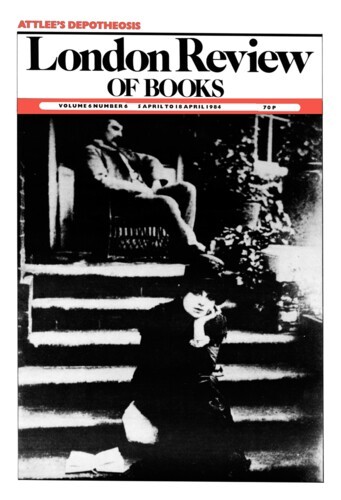
Frank Kermode, 5 April 1984

This is the third and last volume of Roy Fuller’s memoirs, and it takes him up to the end of the war. It may sound ungracious, but I can’t help wondering why I find all three books so appealing that the strong implication of finality seems quite unacceptable. Though literate and pleasantly, even amusingly morose, these are not what are commonly called compulsive reads. Not everybody will experience an irresistible need to go on turning their pages. But I do, and would like three or four more, all about the Woolwich, the Arts Council, the BBC and Oxford, with incidental observations on the conduct of the young, the remembered follies of youth, the tiresome defects of age, and so forth.
Superplot

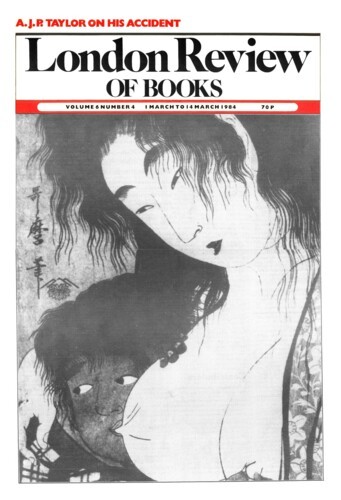
Frank Kermode, 1 March 1984

Even in the days of what is now called ‘classical realism’ it was understood that plot, as a human contrivance meant to suggest intelligible causal relations between history-like events, could sometimes seem to be shadowed by other and larger plots, of uncertain and superhuman provenance. The relation between the two sorts of plot will vary – it is not the same in George Eliot and Hardy, but in both there is such a relation. Later, when to be modern meant to be inquisitive about technical refinement, one might have the story told by somebody unaware of its larger plot, which is what Ford Madox Ford arranged.–

Letter

Canons

2 February 1984

Frank Kermode writes: I set up no dichotomy; my purpose was to describe an interesting disagreement. What I said about Augustine was correct, though of course many other things may correctly be said of him, including – with some reservations – what Dr White says. As he must know, Augustine’s interest in the historical sense of the Old Testament bears no resemblance to Professor Barr’s....

Canons

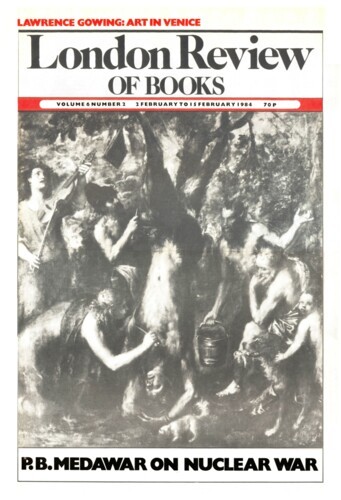
Frank Kermode, 2 February 1984

For reasons that are not immediately obvious, the question of canons is at present much discussed by literary critics. Their canons are of course so called only by loose analogy with the Biblical canons, so it may be of more than strictly clerical interest that there is a major row going on among the professionals who deal with the real thing. This powerfully written book by James Barr is for the most part a polemic against a new wave of Biblical criticism called by its proponents ‘canonical criticism’, and to get the hang of Barr’s book one needs some idea of what he is attacking.

Conrad’s Complaint

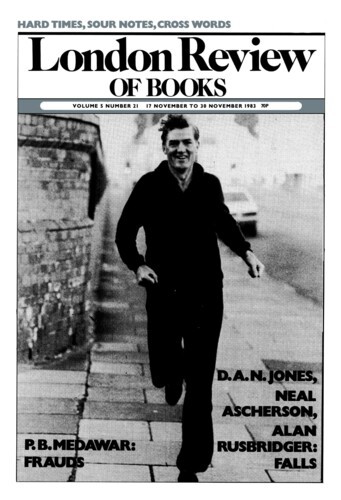
Frank Kermode, 17 November 1983

A great many Conrad letters have already been published, notably in Jean-Aubry’s Life and Letters, but also in smaller collections containing his correspondence with one or more persons – for example, Edward Garnett, William Blackwood and Cunninghame Graham. Early letters to Polish friends and relations have been translated, and a series of about a hundred to Marguerite Poradowska appeared in the original French. However, it seems that ‘more than a third of Conrad’s extant correspondence – close to 1500 letters – has not yet been made available.’ Since Professor Karl, who makes this statement, elsewhere speaks of 3500 known letters, the mathematics seems a bit hazy, though in his biography, published four years ago, he says there are nearly 4000. However, there are certainly lots of unpublished letters, including a hundred-odd to Galsworthy, the same quantity to Ford Madox Ford, ‘several dozen’ to Thomas Wise, an unspecified but obviously vast number to the agent Pinker, and so on.–

The Oxford English Dictionary cites more than 33,000 passages from Shakespeare to illustrate the sense of English words. About 1900 of its main entries have first citations from Shakespeare....

Read more reviews

Out of the Lock-Up: Wallace Stevens

Michael Wood, 2 April 1998

Asked in 1933 what his favourite among his own poems was, Wallace Stevens said he liked best ‘The Emperor of Ice-Cream’, from Harmonium (1923). The work ‘wears a deliberately...

Read more reviews

A Sort of Nobody

Michael Wood, 9 May 1996

Criticism for Frank Kermode is the articulation of assumptions, a sort of phenomenology of interpretative need. Its job, as he says in The Sense of an Ending (1967), is ‘making sense of the...

Read more reviews

Real Absences

Barbara Johnson, 19 October 1995

‘Reading others people’s letters, like reading private diaries, offers thrilling and unexpected glimpses into the lives of others,’ claims the dustjacket of The Oxford Book of...

Read more reviews

Kermode’s Changing Times

P.N. Furbank, 7 March 1991

Frank Kermode having now become ‘Sir Frank’, it seems a good moment to take a look back over his remarkable career: though by no means because that career is at an end, for he is...

Read more reviews

Kermode and Theory

Hayden White, 11 October 1990

Frank Kermode belongs to no sect of literary criticism, and he has founded no school. Like William Empson, whom he praises as a ‘genius’ of criticism, Kermode has always been more...

Read more reviews

Loose Canons

Edward Mendelson, 23 June 1988

Frank Kermode’s History and Value reads the literature of the Thirties as ‘a love story, almost a story of forbidden love’. The story is usually told in political terms, but the...

Read more reviews

Reading the Bible

John Barton, 5 May 1988

‘Everyone communes with the Bible,’ wrote Marilyn Butler recently in her Cambridge inaugural lecture, commenting on the recent re-inclusion of the Biblical canon in the canon of...

Read more reviews

Mulberrying

Andrew Gurr, 6 February 1986

Like relics of the True Cross, there are said to be enough splinters to make an orchard from the mulberry tree planted by Shakespeare in his garden at New Place. The Shakespeare canon has excited...

Read more reviews

From Plato to Nato

Christopher Norris, 7 July 1983

Eagleton’s book is both a primer and a postmortem. It surveys the varieties of recent and present-day literary theory, only to suggest – in its closing chapter – that they had...

Read more reviews

Advanced Thought

William Empson, 24 January 1980

Frank Kermode’s new book contains a great deal of graceful and dignified prose, especially in the last chapter, and many of the examples are of great interest. It seems to argue that no...

Read more reviews

Read anywhere with the London Review of Books app, available now from the App Store for Apple devices, Google Play for Android devices and Amazon for your Kindle Fire.

Sign up to our newsletters

For highlights from the latest issue, our archive and the blog, as well as news, events and exclusive promotions.

Newsletter Preferences