Frank Kermode

Frank Kermode, whose books include Romantic Image (1957), The Sense of an Ending (1967) and Shakespeare’s Language (2000), was the Lord Northcliffe Professor of Modern English Literature at University College London and the King Edward VII Professor of English Literature at Cambridge. He inspired the founding of the LRB in 1979 and wrote more than two hundred pieces for it.

His first, in the first issue of the paper, was on millenarianism, ‘the myth concerning the End’, and his last on Philip Pullman and the parable of the prodigal son. In between he wrote on poets (‘T.S. Eliot and the Shudder’), novelists (Zadie Smith), critics (Paul de Man), Shakespeare, music, psychoanalysis and his wartime experience in the navy (‘My Mad Captains’). A selection of his pieces for the paper is available from the LRB store. He died in 2010 at the age of ninety and a collection of short memoirs by LRB contributors can be found here. ‘Papers speak through their writers,’ Mary-Kay Wilmers wrote after his death. ‘And of all the London Review’s writers Frank Kermode was the one through whom we spoke most often and most eloquently.’

Talk about doing

Frank Kermode, 26 October 1989

Anyone presuming to review works of modern literary theory must expect to be depressed by an encounter with large quantities of deformed prose. The great ones began it, and aspiring theorists usually carry their heads grotesquely to one side in emulation of these models. What begins as servile mimicry soon becomes a pathological condition. It is a relief that two of the present five books may be pronounced orthopaedically sound.

Power-Seeker

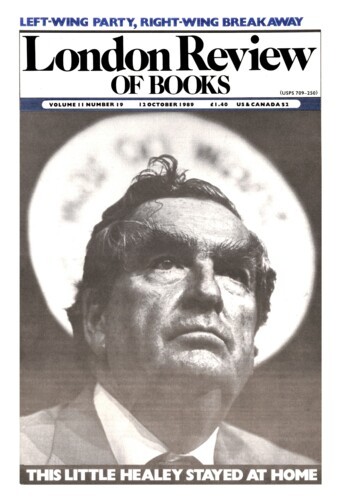
Frank Kermode, 12 October 1989

Having followed Shaw on a largely unsuccessful pursuit of love in Volume I, Mr Holroyd in his second instalment sets him off on what turns out to be an equally frustrated pursuit of power. It may seem curious that we are being asked to regard a man of such dazzling achievement as repeatedly failing in his aims, and at this stage we can only speculate about what he will be pursuing and not catching up with in Volume III. However that may be, Mr Holroyd regards the quest for power as his subject’s principal activity and ‘growing obsession’ during what might be thought, and is so named by the blurb, his prime, from 1898 to 1918 – that is, from his early forties to his early sixties.’

Talking about Shakespeare

Frank Kermode, 28 September 1989

Barbara Everett’s book consists of her four Northcliffe Lectures, given at University College London in 1988, on Hamlet and the other ‘major’ tragedies, together with a number of shorter pieces on Romeo and Juliet, Troilus and Cressida, Othello, Twelfth Night, and quite a lot more about Hamlet. This account may make the book sound scrappy, but it holds together. Its chief hero Hamlet keeps returning to the scene like a reassuring leitmotif, and there are other compensating virtues. Ms Everett is, as always, discursive, and as always ready to take any promising detour – a habit which, though occasionally exasperating, reinforces one’s sense of her independence and her confidence. We are told that the whole business of criticism, not excluding Shakespearian criticism, has been changed utterly in the last few years, but you would never guess it from Everett’s writing, which is distinctive without excessive straining for novelty: this presumably goes to show that it is more interesting to do criticism than to argue about what criticism ought to do, and to what. She will worry away at a word – for example, ‘success’ in Macbeth – with as much determination as a deconstructor in search of an aporia, but she is always trying for solutions, however complex, rather than merely detecting problems, and although success, in the old sense of what’s going to come next, is frequently in doubt, there is no doubt that this is, in a more modern sense, a highly successful performance.’

Yesterday

Frank Kermode, 27 July 1989

‘The immediate past can frequently seem very distant and very alien; that strangeness can only be perceived through the medium of the present.’ Thus Bryan Appleyard, conscious of the difficulty of his project, which is to sketch the history of British art in the post-war years.

Stowaway Woodworm

Frank Kermode, 22 June 1989

About a century ago Henry James remarked sadly that, unlike the French, the English novel was not discutable. It had no theory behind it. Its practitioners were largely unaware that ‘there is no limit’ to what the novelist ‘may attempt as an executant – no limit to his possible experiments, efforts, discoveries, successes’. A new novel by Julian Barnes is a reminder that – up to a point, anyway – the situation has changed. Without being defiantly weird or consciously trying to alter the future, Barnes is clearly no slave to limit; he does something different every time, and if he were French and not just Francophile, his textes, as they say, might be called recherches. On the other hand, he has an English modesty about Theory, and though he does here and there drop a demure hint that matters of that sort are not absent from his mind, he leaves his readers to work them out as they choose.’

The Oxford English Dictionary cites more than 33,000 passages from Shakespeare to illustrate the sense of English words. About 1900 of its main entries have first citations from Shakespeare....

Read more reviews

Out of the Lock-Up: Wallace Stevens

Michael Wood, 2 April 1998

Asked in 1933 what his favourite among his own poems was, Wallace Stevens said he liked best ‘The Emperor of Ice-Cream’, from Harmonium (1923). The work ‘wears a deliberately...

Read more reviews

A Sort of Nobody

Michael Wood, 9 May 1996

Criticism for Frank Kermode is the articulation of assumptions, a sort of phenomenology of interpretative need. Its job, as he says in The Sense of an Ending (1967), is ‘making sense of the...

Read more reviews

Real Absences

Barbara Johnson, 19 October 1995

‘Reading others people’s letters, like reading private diaries, offers thrilling and unexpected glimpses into the lives of others,’ claims the dustjacket of The Oxford Book of...

Read more reviews

Kermode’s Changing Times

P.N. Furbank, 7 March 1991

Frank Kermode having now become ‘Sir Frank’, it seems a good moment to take a look back over his remarkable career: though by no means because that career is at an end, for he is...

Read more reviews

Kermode and Theory

Hayden White, 11 October 1990

Frank Kermode belongs to no sect of literary criticism, and he has founded no school. Like William Empson, whom he praises as a ‘genius’ of criticism, Kermode has always been more...

Read more reviews

Loose Canons

Edward Mendelson, 23 June 1988

Frank Kermode’s History and Value reads the literature of the Thirties as ‘a love story, almost a story of forbidden love’. The story is usually told in political terms, but the...

Read more reviews

Reading the Bible

John Barton, 5 May 1988

‘Everyone communes with the Bible,’ wrote Marilyn Butler recently in her Cambridge inaugural lecture, commenting on the recent re-inclusion of the Biblical canon in the canon of...

Read more reviews

Mulberrying

Andrew Gurr, 6 February 1986

Like relics of the True Cross, there are said to be enough splinters to make an orchard from the mulberry tree planted by Shakespeare in his garden at New Place. The Shakespeare canon has excited...

Read more reviews

From Plato to Nato

Christopher Norris, 7 July 1983

Eagleton’s book is both a primer and a postmortem. It surveys the varieties of recent and present-day literary theory, only to suggest – in its closing chapter – that they had...

Read more reviews

Advanced Thought

William Empson, 24 January 1980

Frank Kermode’s new book contains a great deal of graceful and dignified prose, especially in the last chapter, and many of the examples are of great interest. It seems to argue that no...

Read more reviews

Read anywhere with the London Review of Books app, available now from the App Store for Apple devices, Google Play for Android devices and Amazon for your Kindle Fire.

Sign up to our newsletters

For highlights from the latest issue, our archive and the blog, as well as news, events and exclusive promotions.

Newsletter Preferences