
Frank Kermode

Frank Kermode, whose books include Romantic Image (1957), The Sense of an Ending (1967) and Shakespeare’s Language (2000), was the Lord Northcliffe Professor of Modern English Literature at University College London and the King Edward VII Professor of English Literature at Cambridge. He inspired the founding of the LRB in 1979 and wrote more than two hundred pieces for it.

His first, in the first issue of the paper, was on millenarianism, ‘the myth concerning the End’, and his last on Philip Pullman and the parable of the prodigal son. In between he wrote on poets (‘T.S. Eliot and the Shudder’), novelists (Zadie Smith), critics (Paul de Man), Shakespeare, music, psychoanalysis and his wartime experience in the navy (‘My Mad Captains’). A selection of his pieces for the paper is available from the LRB store. He died in 2010 at the age of ninety and a collection of short memoirs by LRB contributors can be found here. ‘Papers speak through their writers,’ Mary-Kay Wilmers wrote after his death. ‘And of all the London Review’s writers Frank Kermode was the one through whom we spoke most often and most eloquently.’

Southern Virtues

Frank Kermode, 4 May 1989

Naipaul’s epigraph – ‘There is a history in all men’s lives/Figuring the natures of the times deceased’ – warns us that on these journeys through the South of the United States he will always carry with him his own origins in Trinidad; properly studied, those beginnings, as Shakespeare suggests in the following lines, may foretell the hatch and brood of time. The book is dedicated to the memory of his father.’
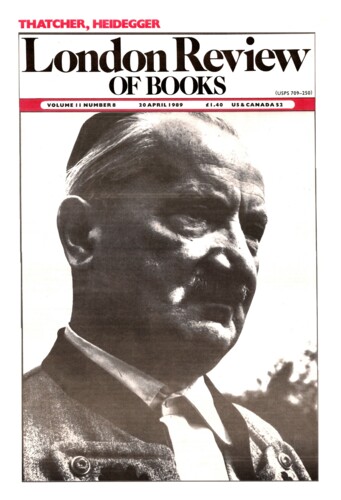

Diary: Everybody loves the OED

Frank Kermode, 20 April 1989

On 29 March a large number of lexicographers and other drudges met at Claridge’s to celebrate the publication of the second edition of what was once the New English Dictionary on Historical Principles. The occasion was properly festive, indeed a super-bash for the super-book. Before lunch the men who put it together in only five years told us how they did it. A wizard from IBM said how thrilled they were to have made the whole thing possible by supplying the computer, the computer know-how-and a lot of computer-generated money. Representing the constituency of the users, Malcolm Bradbury, gracefully grateful on behalf of the writing profession for so writer-friendly a dictionary, offered some innocent jests about bazooms – the last word actually defined in Volume One (A-Bazouki), though, as various persons complained from the floor, lacking any quotation from the Sun. (We were, however, assured by the editors that this paper does get into the great work under page-three girl.) Along the way Bradbury, though seeming very relaxed, dropped a reference to a work of his own, and also a parapraxis (‘my own mother, Rates of Exchange’) which Christopher Ricks, come all the way from Boston to perform an unjetlagged, nay virtuoso lexical dance before the ark, dexterously picked up and developed in a perfectly smooth improvisation.’

Paul de Man’s Abyss

Frank Kermode, 16 March 1989

Paul de Man was born in 1919 to a high-bourgeois Antwerp family, Flemish but sympathetic to French language and culture. He studied at the Free University of Brussels, where he wrote some pieces for student magazines. When the Germans occupied Belgium in 1940 he and his wife fled, but were turned back at the Spanish frontier and resumed life in Brussels. The Germans closed the Free University in 1941, so frustrating one possible career; but de Man’s uncle, the socialist politician Hendrik de Man, helped him to a job on Le Soir, the biggest newspaper in Belgium, which was then under German control. Hendrik de Man had supported the King’s decision to surrender, and for a time persuaded himself that the German takeover, though not quite the revolution he had looked forward to, was a revolution none the less, and might bring about what men of good will had wanted so desperately in the pre-war years – an end to decadent pseudo-democratic capitalism and a new era of socialism, even if it had to be national socialism.’

Third World

Frank Kermode, 2 March 1989

In 1989 it would occur to nobody to invent the Third Programme. It probably couldn’t have happened at any time except when it did. The war seemed to have shown that the public for music and books and culture generally had been thrillingly enlarged. The Forces had developed a keen appetite for education, cultural and civic, some of it pretty subversive, for the service vote is known to have had a lot to do with the election of the Labour Government of 1945. Among my few wholly happy memories of the war years are the stricken faces of fellow officers when they heard the news: only the evil of Education, they felt, could explain it.

Feast of St Thomas

Frank Kermode, 29 September 1988

‘The idea that Eliot’s poetry was rooted in private aspects of his life has now been accepted,’ says Lyndall Gordon in the Foreword to her second volume of biographical rooting among these aspects. This acceptance, which she evidently approves, has undoubtedly occurred, as a root through the enormous heap of books about the poet, now augmented by the centenary of his birth, will quickly demonstrate.

The Oxford English Dictionary cites more than 33,000 passages from Shakespeare to illustrate the sense of English words. About 1900 of its main entries have first citations from Shakespeare....

Read more reviews

Out of the Lock-Up: Wallace Stevens

Michael Wood, 2 April 1998

Asked in 1933 what his favourite among his own poems was, Wallace Stevens said he liked best ‘The Emperor of Ice-Cream’, from Harmonium (1923). The work ‘wears a deliberately...

Read more reviews

A Sort of Nobody

Michael Wood, 9 May 1996

Criticism for Frank Kermode is the articulation of assumptions, a sort of phenomenology of interpretative need. Its job, as he says in The Sense of an Ending (1967), is ‘making sense of the...

Read more reviews

Real Absences

Barbara Johnson, 19 October 1995

‘Reading others people’s letters, like reading private diaries, offers thrilling and unexpected glimpses into the lives of others,’ claims the dustjacket of The Oxford Book of...

Read more reviews

Kermode’s Changing Times

P.N. Furbank, 7 March 1991

Frank Kermode having now become ‘Sir Frank’, it seems a good moment to take a look back over his remarkable career: though by no means because that career is at an end, for he is...

Read more reviews

Kermode and Theory

Hayden White, 11 October 1990

Frank Kermode belongs to no sect of literary criticism, and he has founded no school. Like William Empson, whom he praises as a ‘genius’ of criticism, Kermode has always been more...

Read more reviews

Loose Canons

Edward Mendelson, 23 June 1988

Frank Kermode’s History and Value reads the literature of the Thirties as ‘a love story, almost a story of forbidden love’. The story is usually told in political terms, but the...

Read more reviews

Reading the Bible

John Barton, 5 May 1988

‘Everyone communes with the Bible,’ wrote Marilyn Butler recently in her Cambridge inaugural lecture, commenting on the recent re-inclusion of the Biblical canon in the canon of...

Read more reviews

Mulberrying

Andrew Gurr, 6 February 1986

Like relics of the True Cross, there are said to be enough splinters to make an orchard from the mulberry tree planted by Shakespeare in his garden at New Place. The Shakespeare canon has excited...

Read more reviews

From Plato to Nato

Christopher Norris, 7 July 1983

Eagleton’s book is both a primer and a postmortem. It surveys the varieties of recent and present-day literary theory, only to suggest – in its closing chapter – that they had...

Read more reviews

Advanced Thought

William Empson, 24 January 1980

Frank Kermode’s new book contains a great deal of graceful and dignified prose, especially in the last chapter, and many of the examples are of great interest. It seems to argue that no...

Read more reviews

Read anywhere with the London Review of Books app, available now from the App Store for Apple devices, Google Play for Android devices and Amazon for your Kindle Fire.

Sign up to our newsletters

For highlights from the latest issue, our archive and the blog, as well as news, events and exclusive promotions.

Newsletter Preferences