Frank Kermode

Frank Kermode, whose books include Romantic Image (1957), The Sense of an Ending (1967) and Shakespeare’s Language (2000), was the Lord Northcliffe Professor of Modern English Literature at University College London and the King Edward VII Professor of English Literature at Cambridge. He inspired the founding of the LRB in 1979 and wrote more than two hundred pieces for it.

His first, in the first issue of the paper, was on millenarianism, ‘the myth concerning the End’, and his last on Philip Pullman and the parable of the prodigal son. In between he wrote on poets (‘T.S. Eliot and the Shudder’), novelists (Zadie Smith), critics (Paul de Man), Shakespeare, music, psychoanalysis and his wartime experience in the navy (‘My Mad Captains’). A selection of his pieces for the paper is available from the LRB store. He died in 2010 at the age of ninety and a collection of short memoirs by LRB contributors can be found here. ‘Papers speak through their writers,’ Mary-Kay Wilmers wrote after his death. ‘And of all the London Review’s writers Frank Kermode was the one through whom we spoke most often and most eloquently.’

Modern Masters

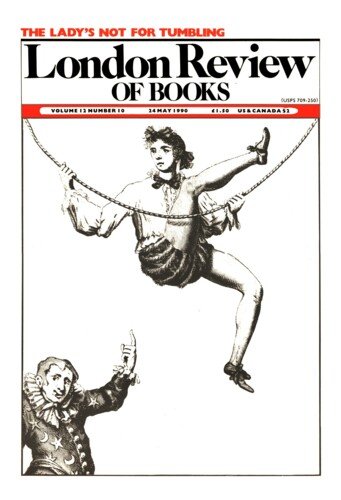
Frank Kermode, 24 May 1990

The qualities these Australian writers have in common, apart from their nationality, are exotic industry, autobiographical fluency and, to adapt what somebody once said about Ford Madox Ford, a desire to write well so strong that it shows.
Gloom without Doom

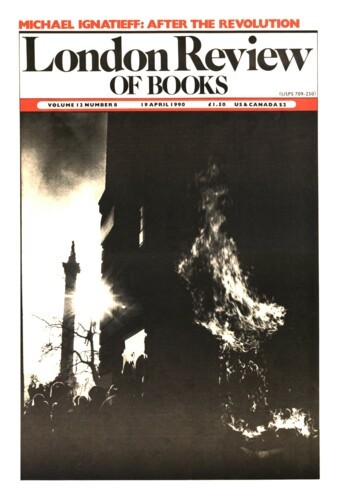
Frank Kermode, 19 April 1990

Leonard Woolf’s earlier years coincided with the last great age of letter-writing. Moreover his friends were people who had what may now seem an unusually pressing need to keep in touch with one another, even when not very far apart, and this need was well served by the Post Office, which, before 1914, gave London eight deliveries of mail each day. Woolf himself had a long spell as a colonial administrator in Ceylon, and finding there very little society he was willing to describe as congenial, he sought consolation by correspondence with his Cambridge friends, especially Lytton Strachey. Later on, he wrote a multitude of letters as editor, publisher and politician. So it is not remarkable that in the course of his life he wrote thousands of them. We still do that, even nowadays, in an age of reduced epistolary incentives, but fewer thousands and more trivial letters. What makes him different is that he wrote so many of substance and on such a variety of occasions and topics. And the interest of their contents, as well as the palpable authority of the writer, and the fact that most of the addressees were letter-keepers, ensured that many thousands were preserved.

Who can blame him?

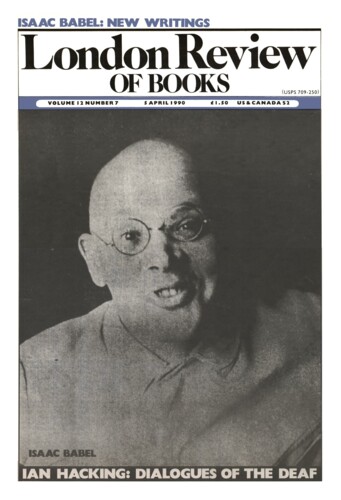
Frank Kermode, 5 April 1990

‘Something is happening to the way we think,’ said Clifford Geertz in 1980, and Stanley Fish is right to add that Geertz was partly responsible for the shift. But Fish, in a bold essay on rhetoric included in the Lentricchia-McLaughlin volume, qualifies Geertz’s remark: ‘something,’ he adds, ‘is always happening to the way we think.’ For he doesn’t quite agree with people who claim to have overthrown ‘the rival epistemology’, wiped out ‘foundationalism’, disposed once and for all of ‘essentialist’ thinking. Deploying new rhetorical, deconstructive and semiological tools, they believe they have taken apart all the assumptions by which we – imagining ourselves to be independent individuals in a world we knew roughly how to know – imagined we could deal justly or sensibly with the problems of literature, society and our own lives. They say we must now learn to think about these matters in entirely new ways.’

That was another planet

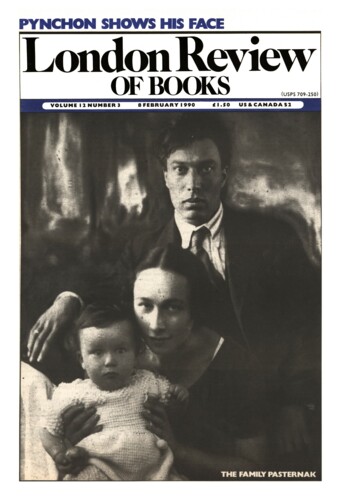
Frank Kermode, 8 February 1990

Seventeen years have passed since the publication of Pynchon’s immense Gravity’s Rainbow, during which time exegesis has continued more or less unabated. It is accompanied by tireless speculation as to what the author could be up to next, where he was, indeed who he was. Compared with Pynchon J.D. Salinger is a publicity-hunter. One daring scholarly conjecture, that these authors are one and the same person, is a paranoid fantasy that might well have been induced by prolonged exposure to Pynchon’s oeuvre.

Between centuries

Frank Kermode, 11 January 1990

To live in the Nineties is to have first-hand experience of l’entre-siècle, a useful word I picked up from Kenneth Silver. Expect to see signs of what Henri Focillon in his book on the year 1000 identified as ‘centurial mysticism’, an affliction even more likely to be endemic when the century that is ending is also ending a millennium. These chronological divisions are meaningless in themselves, but, as Focillon argued, we tend to project onto them aspirations and anxieties which have quite other sources. Conscious of personal and social decadence, hopeful of renovation, people transfer their mood to the decade, the illusory dead weight of an old century behind them, and before them the perhaps equally illusory promises of a new one. In the arts these ages of transition tend to breed avant-gardes to whom contempt for the past is a necessary condition of radical innovation, an old calendar thrown out as the new one is hung up. Yet when we look back at such movements, themselves now parts of the past they mistrusted, we see them differently: harbingers of the new, no doubt, but mired still in the tradition they thought to displace.

The Oxford English Dictionary cites more than 33,000 passages from Shakespeare to illustrate the sense of English words. About 1900 of its main entries have first citations from Shakespeare....

Read more reviews

Out of the Lock-Up: Wallace Stevens

Michael Wood, 2 April 1998

Asked in 1933 what his favourite among his own poems was, Wallace Stevens said he liked best ‘The Emperor of Ice-Cream’, from Harmonium (1923). The work ‘wears a deliberately...

Read more reviews

A Sort of Nobody

Michael Wood, 9 May 1996

Criticism for Frank Kermode is the articulation of assumptions, a sort of phenomenology of interpretative need. Its job, as he says in The Sense of an Ending (1967), is ‘making sense of the...

Read more reviews

Real Absences

Barbara Johnson, 19 October 1995

‘Reading others people’s letters, like reading private diaries, offers thrilling and unexpected glimpses into the lives of others,’ claims the dustjacket of The Oxford Book of...

Read more reviews

Kermode’s Changing Times

P.N. Furbank, 7 March 1991

Frank Kermode having now become ‘Sir Frank’, it seems a good moment to take a look back over his remarkable career: though by no means because that career is at an end, for he is...

Read more reviews

Kermode and Theory

Hayden White, 11 October 1990

Frank Kermode belongs to no sect of literary criticism, and he has founded no school. Like William Empson, whom he praises as a ‘genius’ of criticism, Kermode has always been more...

Read more reviews

Loose Canons

Edward Mendelson, 23 June 1988

Frank Kermode’s History and Value reads the literature of the Thirties as ‘a love story, almost a story of forbidden love’. The story is usually told in political terms, but the...

Read more reviews

Reading the Bible

John Barton, 5 May 1988

‘Everyone communes with the Bible,’ wrote Marilyn Butler recently in her Cambridge inaugural lecture, commenting on the recent re-inclusion of the Biblical canon in the canon of...

Read more reviews

Mulberrying

Andrew Gurr, 6 February 1986

Like relics of the True Cross, there are said to be enough splinters to make an orchard from the mulberry tree planted by Shakespeare in his garden at New Place. The Shakespeare canon has excited...

Read more reviews

From Plato to Nato

Christopher Norris, 7 July 1983

Eagleton’s book is both a primer and a postmortem. It surveys the varieties of recent and present-day literary theory, only to suggest – in its closing chapter – that they had...

Read more reviews

Advanced Thought

William Empson, 24 January 1980

Frank Kermode’s new book contains a great deal of graceful and dignified prose, especially in the last chapter, and many of the examples are of great interest. It seems to argue that no...

Read more reviews

Read anywhere with the London Review of Books app, available now from the App Store for Apple devices, Google Play for Android devices and Amazon for your Kindle Fire.

Sign up to our newsletters

For highlights from the latest issue, our archive and the blog, as well as news, events and exclusive promotions.

Newsletter Preferences