Frank Kermode

Frank Kermode, whose books include Romantic Image (1957), The Sense of an Ending (1967) and Shakespeare’s Language (2000), was the Lord Northcliffe Professor of Modern English Literature at University College London and the King Edward VII Professor of English Literature at Cambridge. He inspired the founding of the LRB in 1979 and wrote more than two hundred pieces for it.

His first, in the first issue of the paper, was on millenarianism, ‘the myth concerning the End’, and his last on Philip Pullman and the parable of the prodigal son. In between he wrote on poets (‘T.S. Eliot and the Shudder’), novelists (Zadie Smith), critics (Paul de Man), Shakespeare, music, psychoanalysis and his wartime experience in the navy (‘My Mad Captains’). A selection of his pieces for the paper is available from the LRB store. He died in 2010 at the age of ninety and a collection of short memoirs by LRB contributors can be found here. ‘Papers speak through their writers,’ Mary-Kay Wilmers wrote after his death. ‘And of all the London Review’s writers Frank Kermode was the one through whom we spoke most often and most eloquently.’

Hail to the Chief

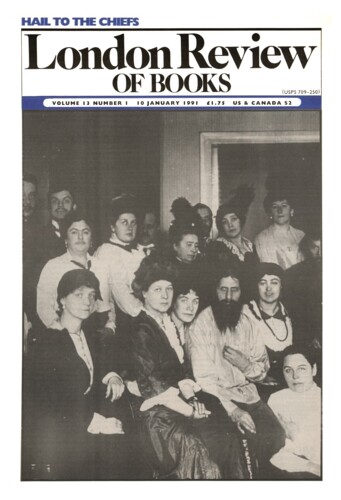
Frank Kermode, 10 January 1991

As befits an undisputed chef d’école, Stephen Greenblatt includes in this latest collection an account of his own ‘intellectual trajectory’, which features a decisive revulsion from his teachers at Yale, a submission to ‘the intellectual power and moral authority’ of Raymond Williams at Cambridge, and the almost inadvertent invention of the New Historicism, the école in question.
Letter

Burkebiz

20 December 1990

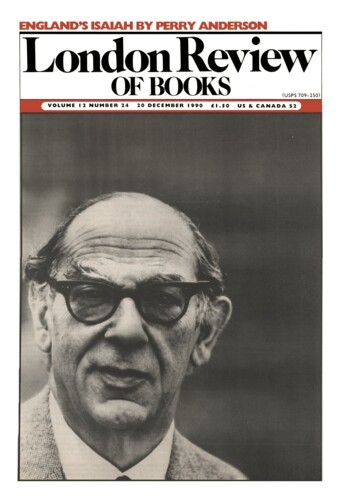
Reading Claude Rawson’s powerful essay on Burke (LRB, 20 December 1990), and in particular what he had to say about ‘Burke’s purplest passage’, I was reminded of an ancient discontent with the sentence in that passage that begins ‘Without force, or opposition’ and ends: ‘[This mixed system of opinion and sentiment] compelled stern authority to submit to elegance,...

Our Fault

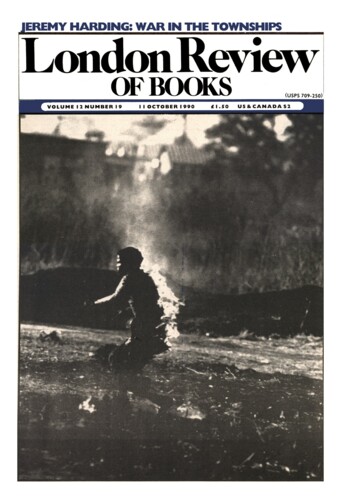
Frank Kermode, 11 October 1990

The title of this large, attractive book needs explanation. It isn’t to be understood as a claim to deal with the times of all of us who are now alive. First, there is a chronological limitation. ‘Our Age’ is used in a sense defined thus by Maurice Bowra: ‘anyone who came of age and went to the university in the thirty years between 1919, the end of the Great War, and 1949 – or, say, 1951’, by which date all who had served in the war had returned to the university. So constituent members of Our Age need to be over sixty and could be over ninety. Secondly, there is an obvious social or educational restriction, since a very large number of people who would qualify by reason of age fail to get in because they never went to a university. Moreover it is distinctly preferable to have been at Oxbridge, and to have made a mark there, so the number of the eligible is really quite small.’

Saving the Streams of Story

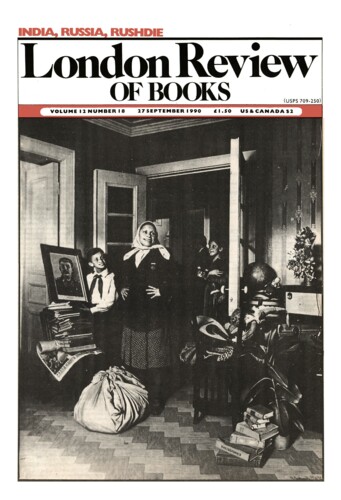
Frank Kermode, 27 September 1990

No doubt it would be possible to apply to this exercise in magic irrealism the terminology of V. Propp’s Morphology of the Folktale, by way of demonstrating that Salman Rushdie’s story has a perfectly normal structure. Temporal-Spatial Determination (‘There was once, in the kingdom of Alifbay, a sad city …’); Composition of the Family (Haroun, the Future Hero, his father Rashid, a professional storyteller, etc); Interdictions (Rashid loses his talent, Haroun cannot concentrate longer than 11 minutes); Helpers or Donors (a friendly hoopoe, a magic drink, a cartridge, concealed under Haroun’s tongue, which will emit blinding light at the moment of dark crisis); an Opponent or Villain with magic powers; an Arrival at an Appointed Place; an Imprisoned Princess; the Completion of the Task. Haroun, in short, is a folk tale, and indeed this is perfectly evident without the support of Propp’s insights. Of course, Rushdie’s story has more to do with the Arabian Nights type than with the Slavic. And as it incorporates English fantasy and humour, and could hardly have been as it is without an infusion of Alice, it can be seen as illustrating just such a glowing confusion of narrative traditions, of the diversities and affinities of stories, as it is itself about.

Dangerous Liaisons

Frank Kermode, 28 June 1990

Violet Hunt

The Oxford English Dictionary cites more than 33,000 passages from Shakespeare to illustrate the sense of English words. About 1900 of its main entries have first citations from Shakespeare....

Read more reviews

Out of the Lock-Up: Wallace Stevens

Michael Wood, 2 April 1998

Asked in 1933 what his favourite among his own poems was, Wallace Stevens said he liked best ‘The Emperor of Ice-Cream’, from Harmonium (1923). The work ‘wears a deliberately...

Read more reviews

A Sort of Nobody

Michael Wood, 9 May 1996

Criticism for Frank Kermode is the articulation of assumptions, a sort of phenomenology of interpretative need. Its job, as he says in The Sense of an Ending (1967), is ‘making sense of the...

Read more reviews

Real Absences

Barbara Johnson, 19 October 1995

‘Reading others people’s letters, like reading private diaries, offers thrilling and unexpected glimpses into the lives of others,’ claims the dustjacket of The Oxford Book of...

Read more reviews

Kermode’s Changing Times

P.N. Furbank, 7 March 1991

Frank Kermode having now become ‘Sir Frank’, it seems a good moment to take a look back over his remarkable career: though by no means because that career is at an end, for he is...

Read more reviews

Kermode and Theory

Hayden White, 11 October 1990

Frank Kermode belongs to no sect of literary criticism, and he has founded no school. Like William Empson, whom he praises as a ‘genius’ of criticism, Kermode has always been more...

Read more reviews

Loose Canons

Edward Mendelson, 23 June 1988

Frank Kermode’s History and Value reads the literature of the Thirties as ‘a love story, almost a story of forbidden love’. The story is usually told in political terms, but the...

Read more reviews

Reading the Bible

John Barton, 5 May 1988

‘Everyone communes with the Bible,’ wrote Marilyn Butler recently in her Cambridge inaugural lecture, commenting on the recent re-inclusion of the Biblical canon in the canon of...

Read more reviews

Mulberrying

Andrew Gurr, 6 February 1986

Like relics of the True Cross, there are said to be enough splinters to make an orchard from the mulberry tree planted by Shakespeare in his garden at New Place. The Shakespeare canon has excited...

Read more reviews

From Plato to Nato

Christopher Norris, 7 July 1983

Eagleton’s book is both a primer and a postmortem. It surveys the varieties of recent and present-day literary theory, only to suggest – in its closing chapter – that they had...

Read more reviews

Advanced Thought

William Empson, 24 January 1980

Frank Kermode’s new book contains a great deal of graceful and dignified prose, especially in the last chapter, and many of the examples are of great interest. It seems to argue that no...

Read more reviews

Read anywhere with the London Review of Books app, available now from the App Store for Apple devices, Google Play for Android devices and Amazon for your Kindle Fire.

Sign up to our newsletters

For highlights from the latest issue, our archive and the blog, as well as news, events and exclusive promotions.

Newsletter Preferences