Frank Kermode

Frank Kermode, whose books include Romantic Image (1957), The Sense of an Ending (1967) and Shakespeare’s Language (2000), was the Lord Northcliffe Professor of Modern English Literature at University College London and the King Edward VII Professor of English Literature at Cambridge. He inspired the founding of the LRB in 1979 and wrote more than two hundred pieces for it.

His first, in the first issue of the paper, was on millenarianism, ‘the myth concerning the End’, and his last on Philip Pullman and the parable of the prodigal son. In between he wrote on poets (‘T.S. Eliot and the Shudder’), novelists (Zadie Smith), critics (Paul de Man), Shakespeare, music, psychoanalysis and his wartime experience in the navy (‘My Mad Captains’). A selection of his pieces for the paper is available from the LRB store. He died in 2010 at the age of ninety and a collection of short memoirs by LRB contributors can be found here. ‘Papers speak through their writers,’ Mary-Kay Wilmers wrote after his death. ‘And of all the London Review’s writers Frank Kermode was the one through whom we spoke most often and most eloquently.’

Apocalyptic Opacity

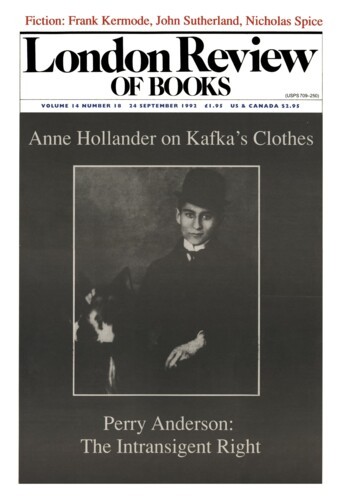
Frank Kermode, 24 September 1992

The title sounds apocalyptic, but all it means on the face of it is that this novel is set in New Zealand now. Doubtless it could be interpreted as having other implications, and there is some reason to believe the author would encourage his readers to discover or invent them.

A Dingy Start to the Day

Frank Kermode, 10 September 1992

The collocation of these books suggests a moral: it is easier to write well about living authors if they annoy you than if you worship the very paper they write on. Rob Nixon is censorious and lively; Dale Salwak is reverent and laboured. His is the second book in recent memory expressly to demand recognition for Kingsley Amis as a moralist; the other, John McDermott’s, is actually called Kingsley Amis: An English Moralist. McDermott says ‘moralist’ clearly and right away, whereas Salwak’s subtitle sounds like one of Amis’s phonetic reports on the way a drunken man might have struggled to get the word out. However, both insist on Amis’s serious ethical concerns.

Avoiding Colin

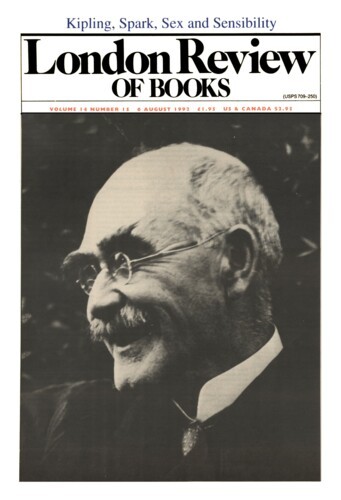
Frank Kermode, 6 August 1992

Once there were popular books with titles like Straight and Crooked Thinking, books in which professional philosophers, avoiding arcane speculation, tried to make the rest of us more sensible by sharing with us their philosophical wisdom. Nowadays such books seem to be less common, and in any case some quite important philosophers, doubting the claims of philosophy to have special wisdom qualifications, would think it presumptuous to write them. Colin McGinn does concede that specialist skills in philosophy don’t in themselves constitute a licence to preach or judge (‘morality isn’t the kind of thing in which you can have a special expertise’), but he seems confident all the same that a professional habit of straight thinking will enable him to advise lay folk whose moral thinking might be crooked, or, as he would prefer to say, stupid.

Asyah and Saif

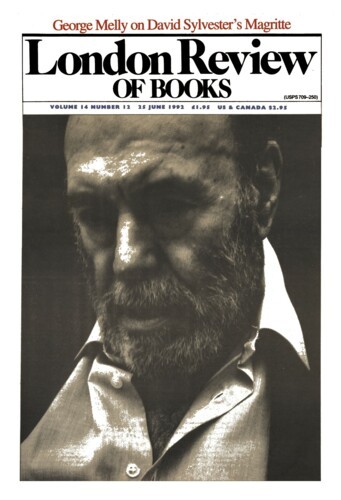
Frank Kermode, 25 June 1992

This remarkable novel labours under what some might think serious disadvantages. First of all, at around four hundred thousand words it could be thought on the long side for a book principally concerned with the life of a PhD candidate from childhood to the age of thirty. This judgment could be disputed on the ground of generic precedent, the Bildungs-roman habitually tending to length: but in these days blockbuster sizes tend to be associated either with the 19th century or with airport bookstalls, always excepting an occasional highbrow freak. However, respice finem; a fair reader will withhold condemnation on that score.

Making a start

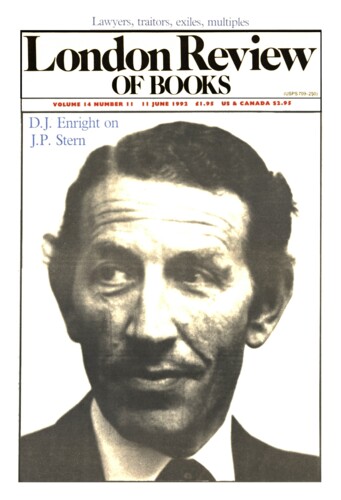
Frank Kermode, 11 June 1992

A.D Nuttall is among the most erudite Contemporary academic literary critics, at ease with the Classics, much given to philosophy. He is also disconcertingly bold and curious, and his latest book, like some of its predecessors, is as odd as it is learned. It begins, but by no means ends, with a minute enquiry into the expression in medias res. Horace observed that Homer, instead of starting his poem about the Trojan War from the beginning – ab ovo, Leda’s egg from which was hatched Helen of Troy – chose to rush his listeners ‘into the midst of things’, with a quarrel that occurred when the war had been going on for years.’

The Oxford English Dictionary cites more than 33,000 passages from Shakespeare to illustrate the sense of English words. About 1900 of its main entries have first citations from Shakespeare....

Read more reviews

Out of the Lock-Up: Wallace Stevens

Michael Wood, 2 April 1998

Asked in 1933 what his favourite among his own poems was, Wallace Stevens said he liked best ‘The Emperor of Ice-Cream’, from Harmonium (1923). The work ‘wears a deliberately...

Read more reviews

A Sort of Nobody

Michael Wood, 9 May 1996

Criticism for Frank Kermode is the articulation of assumptions, a sort of phenomenology of interpretative need. Its job, as he says in The Sense of an Ending (1967), is ‘making sense of the...

Read more reviews

Real Absences

Barbara Johnson, 19 October 1995

‘Reading others people’s letters, like reading private diaries, offers thrilling and unexpected glimpses into the lives of others,’ claims the dustjacket of The Oxford Book of...

Read more reviews

Kermode’s Changing Times

P.N. Furbank, 7 March 1991

Frank Kermode having now become ‘Sir Frank’, it seems a good moment to take a look back over his remarkable career: though by no means because that career is at an end, for he is...

Read more reviews

Kermode and Theory

Hayden White, 11 October 1990

Frank Kermode belongs to no sect of literary criticism, and he has founded no school. Like William Empson, whom he praises as a ‘genius’ of criticism, Kermode has always been more...

Read more reviews

Loose Canons

Edward Mendelson, 23 June 1988

Frank Kermode’s History and Value reads the literature of the Thirties as ‘a love story, almost a story of forbidden love’. The story is usually told in political terms, but the...

Read more reviews

Reading the Bible

John Barton, 5 May 1988

‘Everyone communes with the Bible,’ wrote Marilyn Butler recently in her Cambridge inaugural lecture, commenting on the recent re-inclusion of the Biblical canon in the canon of...

Read more reviews

Mulberrying

Andrew Gurr, 6 February 1986

Like relics of the True Cross, there are said to be enough splinters to make an orchard from the mulberry tree planted by Shakespeare in his garden at New Place. The Shakespeare canon has excited...

Read more reviews

From Plato to Nato

Christopher Norris, 7 July 1983

Eagleton’s book is both a primer and a postmortem. It surveys the varieties of recent and present-day literary theory, only to suggest – in its closing chapter – that they had...

Read more reviews

Advanced Thought

William Empson, 24 January 1980

Frank Kermode’s new book contains a great deal of graceful and dignified prose, especially in the last chapter, and many of the examples are of great interest. It seems to argue that no...

Read more reviews

Read anywhere with the London Review of Books app, available now from the App Store for Apple devices, Google Play for Android devices and Amazon for your Kindle Fire.

Sign up to our newsletter

For highlights from the latest issue, our archive and the blog, as well as news, events and exclusive promotions.

Newsletter Preferences