Frank Kermode

Frank Kermode, whose books include Romantic Image (1957), The Sense of an Ending (1967) and Shakespeare’s Language (2000), was the Lord Northcliffe Professor of Modern English Literature at University College London and the King Edward VII Professor of English Literature at Cambridge. He inspired the founding of the LRB in 1979 and wrote more than two hundred pieces for it.

His first, in the first issue of the paper, was on millenarianism, ‘the myth concerning the End’, and his last on Philip Pullman and the parable of the prodigal son. In between he wrote on poets (‘T.S. Eliot and the Shudder’), novelists (Zadie Smith), critics (Paul de Man), Shakespeare, music, psychoanalysis and his wartime experience in the navy (‘My Mad Captains’). A selection of his pieces for the paper is available from the LRB store. He died in 2010 at the age of ninety and a collection of short memoirs by LRB contributors can be found here. ‘Papers speak through their writers,’ Mary-Kay Wilmers wrote after his death. ‘And of all the London Review’s writers Frank Kermode was the one through whom we spoke most often and most eloquently.’

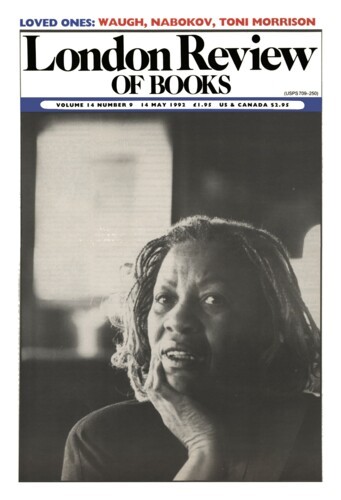
Sacrifice

Frank Kermode, 14 May 1992

Yeats avowed it more often and more impressively, but he was not alone in his belief that Maud Gonne’s beauty was of ‘a kind not natural in an age like this’. Shaw called her ‘outrageously beautiful’ and W.T. Stead, who could no more than Yeats isolate his admiration for her looks from an appraisal of her politics, described her as ‘one of the most beautiful women in the world’, going on to point out that ‘she is for the Irish Republic and total separation, peacefully if possible, but if necessary by the sword, that of France and Russia not excepted.’
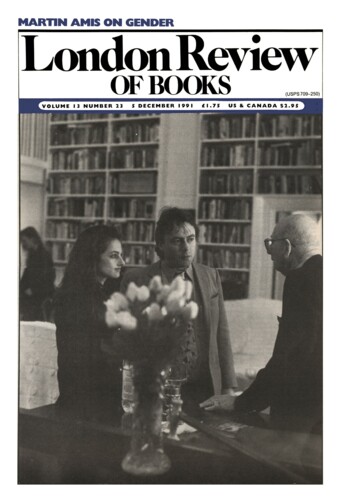
Part and Pasture

Frank Kermode, 5 December 1991

Henry Reed was a sad man but a funny man, and his poems are funny or sad – often, as in the celebrated ‘Lessons of the War’, both at once. I first met him in 1965, in the office of Robert Heilman, then the benevolent but firm head of the English Department at the University of Washington in Seattle. Calling to present my credentials, I walked into a row; Heilman benevolently firm, Reed furious, licensed to be furious. He was in Seattle as a replacement for Theodore Roethke, the regular poet in residence, who had suddenly died. Whether Roethke had contributed to the routine work of the department I don’t know, but if he hadn’t Heilman did not regard his immunity as a precedent and was requiring Reed to give some lectures on the Brontës. Reed argued that he had been hired exclusively as a poet and declined to speak of these tiresome women. I came in when he was telling Heilman this, and also scolding him for referring to the novelists by the fancy name their father had affected in order to suggest a connection with Lord Nelson. ‘How can you ask me to lecture on the O’Pruntys?’ he shouted. But he did as he was asked. He and Heilman were, or became, great friends.’

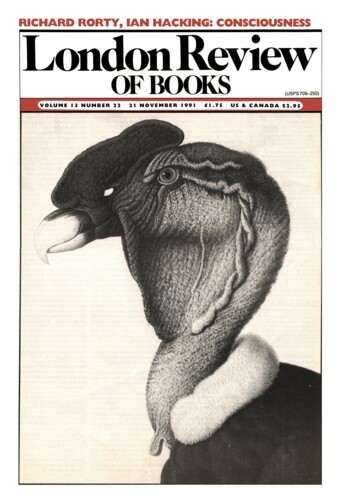
Theory and Truth

Frank Kermode, 21 November 1991

The autumn catalogues of some very enterprising publishers announce as many books as usual under the rubric Literary Criticism, or possibly more, but few have titles of a sort that, even ten years ago, would have been found there, and virtually none that would have much interest for the non-academic public that once read old-style literary criticism. This development is welcomed in some academic quarters as a triumph of technology, but it appears that certain persons of importance are beginning to wonder whether the hightech, jargoned, reader-alienating image of the modern product may not have some disadvantages. Of course it can be argued that there can be no going back, the old criticism having been declared intellectually deluded, dishonest and collusive with political authoritarianism. ‘With the advent of Post-Structuralism and the “death of literature”,’ says one current blurb, ‘the opposition between high and popular culture became untenable, transforming the field of enquiry from literary into cultural studies’ – incidentally, a fair sample of newera, defiantly messy prose. For, as everybody likes to say, there has been a Kuhnian paradigm-shift, and to be installed on the far side of it is to feel comfortable with the idea that it is no longer necessary to think about literature at all. Among the ancient assumptions now discounted is the notion that one piece of writing might somehow be better than another: and if you believe that, you lack much inducement to write decently, whatever that might mean, yourself.’

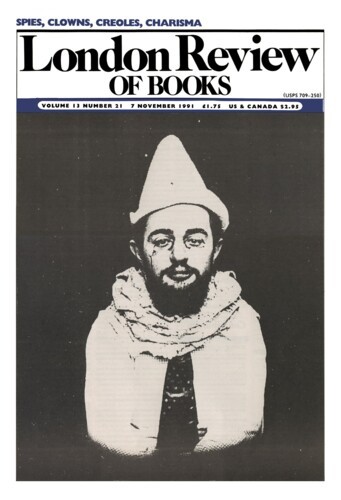
Off the edge

Frank Kermode, 7 November 1991

The Wellek Library Lectures at the University of California, Irvine, are meant to be about Critical Theory, and up to now they have, for good or ill, been faithful (in their fashion) to that intention: but it was an enlivening idea to ask Edward Said to talk about music as well, or instead. Said is a good enough pianist to understand what the professionals are up to. He knows a great deal more about music than most amateurs, and argues persuasively that it should not be left entirely to the rigorous mercies of the musicologists. The result is this very interesting, excited, crammed little book, in which admirable and questionable propositions jostle one another so bewilderingly that it isn’t always easy to know exactly where one is, or what might come next, rather as in a late Beethoven quartet.

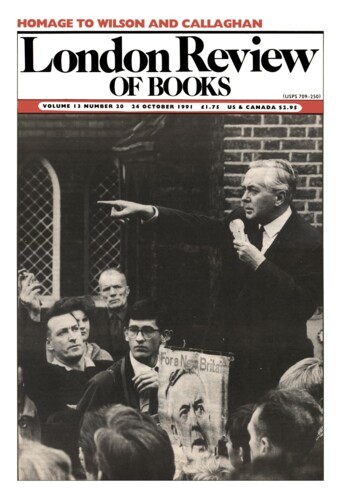
Cockaigne

Frank Kermode, 24 October 1991

There is already a lot of biographical writing about Orwell, including the memoir of Richard Rees and The Unknown Orwell by William Abrahams and Peter Stansky (lamed by the late Soni Orwell’s refusal of permission to quote), and, more recently, the expansive Life by Bernard Crick, at first authorised by the widow to emphasise her rejection of Stansky and Abrahams, and later de-authorised by her to indicate disapproval of Crick, who, much to her annoyance, had lawyers good enough to ensure that he was able to publish it anyway, quotations and all.

The Oxford English Dictionary cites more than 33,000 passages from Shakespeare to illustrate the sense of English words. About 1900 of its main entries have first citations from Shakespeare....

Read more reviews

Out of the Lock-Up: Wallace Stevens

Michael Wood, 2 April 1998

Asked in 1933 what his favourite among his own poems was, Wallace Stevens said he liked best ‘The Emperor of Ice-Cream’, from Harmonium (1923). The work ‘wears a deliberately...

Read more reviews

A Sort of Nobody

Michael Wood, 9 May 1996

Criticism for Frank Kermode is the articulation of assumptions, a sort of phenomenology of interpretative need. Its job, as he says in The Sense of an Ending (1967), is ‘making sense of the...

Read more reviews

Real Absences

Barbara Johnson, 19 October 1995

‘Reading others people’s letters, like reading private diaries, offers thrilling and unexpected glimpses into the lives of others,’ claims the dustjacket of The Oxford Book of...

Read more reviews

Kermode’s Changing Times

P.N. Furbank, 7 March 1991

Frank Kermode having now become ‘Sir Frank’, it seems a good moment to take a look back over his remarkable career: though by no means because that career is at an end, for he is...

Read more reviews

Kermode and Theory

Hayden White, 11 October 1990

Frank Kermode belongs to no sect of literary criticism, and he has founded no school. Like William Empson, whom he praises as a ‘genius’ of criticism, Kermode has always been more...

Read more reviews

Loose Canons

Edward Mendelson, 23 June 1988

Frank Kermode’s History and Value reads the literature of the Thirties as ‘a love story, almost a story of forbidden love’. The story is usually told in political terms, but the...

Read more reviews

Reading the Bible

John Barton, 5 May 1988

‘Everyone communes with the Bible,’ wrote Marilyn Butler recently in her Cambridge inaugural lecture, commenting on the recent re-inclusion of the Biblical canon in the canon of...

Read more reviews

Mulberrying

Andrew Gurr, 6 February 1986

Like relics of the True Cross, there are said to be enough splinters to make an orchard from the mulberry tree planted by Shakespeare in his garden at New Place. The Shakespeare canon has excited...

Read more reviews

From Plato to Nato

Christopher Norris, 7 July 1983

Eagleton’s book is both a primer and a postmortem. It surveys the varieties of recent and present-day literary theory, only to suggest – in its closing chapter – that they had...

Read more reviews

Advanced Thought

William Empson, 24 January 1980

Frank Kermode’s new book contains a great deal of graceful and dignified prose, especially in the last chapter, and many of the examples are of great interest. It seems to argue that no...

Read more reviews

Read anywhere with the London Review of Books app, available now from the App Store for Apple devices, Google Play for Android devices and Amazon for your Kindle Fire.

Sign up to our newsletter

For highlights from the latest issue, our archive and the blog, as well as news, events and exclusive promotions.

Newsletter Preferences