Frank Kermode

Frank Kermode, whose books include Romantic Image (1957), The Sense of an Ending (1967) and Shakespeare’s Language (2000), was the Lord Northcliffe Professor of Modern English Literature at University College London and the King Edward VII Professor of English Literature at Cambridge. He inspired the founding of the LRB in 1979 and wrote more than two hundred pieces for it.

His first, in the first issue of the paper, was on millenarianism, ‘the myth concerning the End’, and his last on Philip Pullman and the parable of the prodigal son. In between he wrote on poets (‘T.S. Eliot and the Shudder’), novelists (Zadie Smith), critics (Paul de Man), Shakespeare, music, psychoanalysis and his wartime experience in the navy (‘My Mad Captains’). A selection of his pieces for the paper is available from the LRB store. He died in 2010 at the age of ninety and a collection of short memoirs by LRB contributors can be found here. ‘Papers speak through their writers,’ Mary-Kay Wilmers wrote after his death. ‘And of all the London Review’s writers Frank Kermode was the one through whom we spoke most often and most eloquently.’

Yoked together

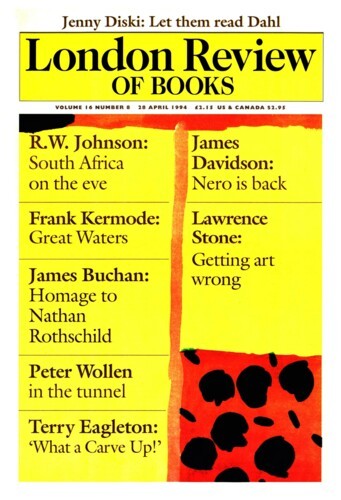
Frank Kermode, 22 September 1994

‘There is hardly a stanza in the long poem which is not vivid, hardly one which is not more or less odd, and the reader feels … as if he had been riding on the rims over an endless timber bridge.’ As I read Craig Raine’s new poem (a novel, an epic, a film, says the ebullient blurb) something stirred in the depths of memory, and I found myself thinking of Theophila, a very long poem published by Edward Benlowes in 1652. Theophila is written in three-line stanzas, a pentameter, a tetrameter and an alexandrine, all on a single rhyme. The judgment on Theophila quoted above comes from The Oxford History of English Literature, which rightly regards Benlowes as representing the giddy limit in 17th-century attempts to write ‘heroic’ poetry in the high metaphysical manner. And this must surely seem an unpromising way to tackle extended argument or narrative. Benlowes was a devotee of the far-fetched conceit, in the by now degenerate tradition of Donne, perhaps with some input from the smoother baroque concettismo of Marino and his followers. (On the evidence of some of his delightful earlier poems I had privately awarded Craig Raine an honorary position in the company of the marinisti.) Marino produced narrative in this style, but in more fluent stanzas, and without proceeding to the metaphorical extremes of the English. Though often eloquent, Benlowes is neither fluent nor moderate, and clearly it formed no part of his plan to make it easy for his readers to know exactly what he was on about.…
Breeding

Frank Kermode, 21 July 1994

Sylvia Townsend Warner died in 1978, aged 84. Her first novel, Lolly Willowes, appeared in 1926, and none of her later works quite matched its success. In her later years she was probably better known to most people as a name that appeared under rather than above story after story in the New Yorker; that journal published about fifty over a period of some forty years. She was a copious, elegant and witty writer, and since she produced these stories rather easily, she came to think of the New Yorker, for a long time an indispensable financial support, as a generous old admirer whom she could please fairly easily when she needed to.

With the Aid of a Lorgnette

Frank Kermode, 28 April 1994

Alain Corbin is a prolific new-style French historian, and these books are notable contributions to an interesting genre he describes as ‘the history of sensibilities’. The Foul and the Fragrant created something of a stir some years ago when the translation appeared in hardback, partly, I suppose, because no respected historian had ever before written so much, and so explicitly, about shit, which, as more sanitised historians had omitted to specify, occupied in former times the worry-space now claimed by nuclear waste. And by reason of its natural properties it had much greater power to compel contemporary attention.

This Charming Man

Frank Kermode, 24 February 1994

It sometimes happens that an exceptionally talented person dies rather young, leaving behind him friends, still in their prime, who happen to be good writers – witness the post-humous celebrations of Shelley and D.H. Lawrence. Mark Boxer was famous at Cambridge; he was even famous for the manner of his leaving it; and then, without serious intermission, he became and remained famous in London. And so, throughout his life, he was unwittingly acquiring eulogists.

Disintegration

Frank Kermode, 27 January 1994

Eliot’s Clark Lectures ‘On the Metaphysical Poetry of the 17th Century with Special Reference to Donne, Crashaw and Cowley’ were commissioned in 1925 and delivered at Trinity College, Cambridge in 1926. Since then they have been famous for not being available. Eliot intended to make them into a book called The School of Donne, which would be far longer, partly because – on the face of it unexpectedly, given his title – he wanted to write a lot more about Dante. On Dante, as he remarked in a preface, the whole of his argument depended. But this book was itself to be merely part of a larger project, a trilogy of which the other volumes would deal with the Elizabethan drama (on which he had already written a good deal) and the Sons of Ben. The whole would be known as The Disintegration of the Intellect, a title suggesting an almost Spenglerian ambition, and a scope beyond the usual range of literary criticism as he himself claimed to understand it.’

The Oxford English Dictionary cites more than 33,000 passages from Shakespeare to illustrate the sense of English words. About 1900 of its main entries have first citations from Shakespeare....

Read more reviews

Out of the Lock-Up: Wallace Stevens

Michael Wood, 2 April 1998

Asked in 1933 what his favourite among his own poems was, Wallace Stevens said he liked best ‘The Emperor of Ice-Cream’, from Harmonium (1923). The work ‘wears a deliberately...

Read more reviews

A Sort of Nobody

Michael Wood, 9 May 1996

Criticism for Frank Kermode is the articulation of assumptions, a sort of phenomenology of interpretative need. Its job, as he says in The Sense of an Ending (1967), is ‘making sense of the...

Read more reviews

Real Absences

Barbara Johnson, 19 October 1995

‘Reading others people’s letters, like reading private diaries, offers thrilling and unexpected glimpses into the lives of others,’ claims the dustjacket of The Oxford Book of...

Read more reviews

Kermode’s Changing Times

P.N. Furbank, 7 March 1991

Frank Kermode having now become ‘Sir Frank’, it seems a good moment to take a look back over his remarkable career: though by no means because that career is at an end, for he is...

Read more reviews

Kermode and Theory

Hayden White, 11 October 1990

Frank Kermode belongs to no sect of literary criticism, and he has founded no school. Like William Empson, whom he praises as a ‘genius’ of criticism, Kermode has always been more...

Read more reviews

Loose Canons

Edward Mendelson, 23 June 1988

Frank Kermode’s History and Value reads the literature of the Thirties as ‘a love story, almost a story of forbidden love’. The story is usually told in political terms, but the...

Read more reviews

Reading the Bible

John Barton, 5 May 1988

‘Everyone communes with the Bible,’ wrote Marilyn Butler recently in her Cambridge inaugural lecture, commenting on the recent re-inclusion of the Biblical canon in the canon of...

Read more reviews

Mulberrying

Andrew Gurr, 6 February 1986

Like relics of the True Cross, there are said to be enough splinters to make an orchard from the mulberry tree planted by Shakespeare in his garden at New Place. The Shakespeare canon has excited...

Read more reviews

From Plato to Nato

Christopher Norris, 7 July 1983

Eagleton’s book is both a primer and a postmortem. It surveys the varieties of recent and present-day literary theory, only to suggest – in its closing chapter – that they had...

Read more reviews

Advanced Thought

William Empson, 24 January 1980

Frank Kermode’s new book contains a great deal of graceful and dignified prose, especially in the last chapter, and many of the examples are of great interest. It seems to argue that no...

Read more reviews

Read anywhere with the London Review of Books app, available now from the App Store for Apple devices, Google Play for Android devices and Amazon for your Kindle Fire.

Sign up to our newsletters

For highlights from the latest issue, our archive and the blog, as well as news, events and exclusive promotions.

Newsletter Preferences