Frank Kermode

Frank Kermode, whose books include Romantic Image (1957), The Sense of an Ending (1967) and Shakespeare’s Language (2000), was the Lord Northcliffe Professor of Modern English Literature at University College London and the King Edward VII Professor of English Literature at Cambridge. He inspired the founding of the LRB in 1979 and wrote more than two hundred pieces for it.

His first, in the first issue of the paper, was on millenarianism, ‘the myth concerning the End’, and his last on Philip Pullman and the parable of the prodigal son. In between he wrote on poets (‘T.S. Eliot and the Shudder’), novelists (Zadie Smith), critics (Paul de Man), Shakespeare, music, psychoanalysis and his wartime experience in the navy (‘My Mad Captains’). A selection of his pieces for the paper is available from the LRB store. He died in 2010 at the age of ninety and a collection of short memoirs by LRB contributors can be found here. ‘Papers speak through their writers,’ Mary-Kay Wilmers wrote after his death. ‘And of all the London Review’s writers Frank Kermode was the one through whom we spoke most often and most eloquently.’

Dangerous Faults

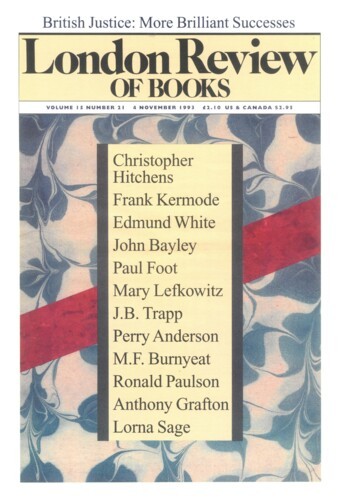
Frank Kermode, 4 November 1993

This is Tim Parks’s sixth novel. He has also done some serious translation – Moravia, Calvino, Calasso’s The Marriage of Cadmus and Harmony – and written a lively book about his life in Italy. And now, by way of explaining the highly technical lexicon of Shear, he tells us in an Author’s Note that he did ‘years of work for the Italian quarrying industry’: consequently ‘a huge burden of geological/mechanical vocabulary … was bound to shape the terrain of some novel or other.’ This is, quite properly, not an apology; he has won the right to shape his own terrains. As he is still (at a guess) under forty he can’t be said to have lost much time in doing so. He has won several prizes and on his jackets great names affirm that he is not only prolific but very good indeed.’…
Letter

Authority

9 September 1993

Readers of Malise Ruthven’s excellent piece on the Waco siege (LRB, 9 September) should seek authority for the Rapture of the born-again not in the Book of Revelation but in 1 Thessalonians, 4.17, a text just as highly valued by those eight million American fundamentalists.

Big Fish

Frank Kermode, 9 September 1993

The portrait of Lord Goodman on the jacket of his memoirs is from a photograph; the one on David Selbourne’s book is from a portrait by Lucian Freud. In the first he looks severe but quizzical, a kind man but not a man to be put upon; in the second he looks quite desperately sad, as if he had done much to little or no avail, and might well have been put upon quite heavily. Neither quite matches the public image: the ebullient achiever, the man whom everybody in London, from prime ministers, important artists and rich businessmen, down to more ordinarily harassed mortals, regarded as the only present help in time of trouble.

Letter

Cold Feet

22 July 1993

When you really get down to it Barbara Everett’s letter (Letters, 19 August) is about a single disputed reading in Donne’s ‘Valediction: of weeping’, so I will refrain from comment on her more general remarks and merely say why I think she is wrong about that reading. I do not know why the modernised text was ‘tendentious’, nor is any evidence adduced to suggest that it was. However, I...

Cold Feet

Frank Kermode, 22 July 1993

William Empson maintained that there was a right and a wrong moment to bring theory into the business of intelligent reading, and that the professionals chose the wrong one, but he could not do without theory altogether. His book The Structure of Complex Words (1951) contains quite a lot of it; so it is not surprising that a generation of literary theorists, having sensibly decided not to remain totally out of touch with the best critic of his time, has decided to appropriate Complex Words, a work hitherto much less influential than the very early (and prodigious) Seven Types of Ambiguity. Christopher Norris comes right out and calls Complex Words ‘a work of deconstruction’. His collection is meant to demonstrate that Empson can be accommodated in modern theory. It can now be shown that he was in many ways anticipating the interests and procedures of a newer criticism, though Norris in his Preface cautiously denies any intention to annex Empson’s criticism to any one prevailing trend: ‘it is a hopeful sign,’ he remarks, ‘that “theory” is coming of age when it manages to find room for a strong but problematical figure like Empson, a critic whose thinking goes so markedly against some of its basic precepts and principles.’

The Oxford English Dictionary cites more than 33,000 passages from Shakespeare to illustrate the sense of English words. About 1900 of its main entries have first citations from Shakespeare....

Read more reviews

Out of the Lock-Up: Wallace Stevens

Michael Wood, 2 April 1998

Asked in 1933 what his favourite among his own poems was, Wallace Stevens said he liked best ‘The Emperor of Ice-Cream’, from Harmonium (1923). The work ‘wears a deliberately...

Read more reviews

A Sort of Nobody

Michael Wood, 9 May 1996

Criticism for Frank Kermode is the articulation of assumptions, a sort of phenomenology of interpretative need. Its job, as he says in The Sense of an Ending (1967), is ‘making sense of the...

Read more reviews

Real Absences

Barbara Johnson, 19 October 1995

‘Reading others people’s letters, like reading private diaries, offers thrilling and unexpected glimpses into the lives of others,’ claims the dustjacket of The Oxford Book of...

Read more reviews

Kermode’s Changing Times

P.N. Furbank, 7 March 1991

Frank Kermode having now become ‘Sir Frank’, it seems a good moment to take a look back over his remarkable career: though by no means because that career is at an end, for he is...

Read more reviews

Kermode and Theory

Hayden White, 11 October 1990

Frank Kermode belongs to no sect of literary criticism, and he has founded no school. Like William Empson, whom he praises as a ‘genius’ of criticism, Kermode has always been more...

Read more reviews

Loose Canons

Edward Mendelson, 23 June 1988

Frank Kermode’s History and Value reads the literature of the Thirties as ‘a love story, almost a story of forbidden love’. The story is usually told in political terms, but the...

Read more reviews

Reading the Bible

John Barton, 5 May 1988

‘Everyone communes with the Bible,’ wrote Marilyn Butler recently in her Cambridge inaugural lecture, commenting on the recent re-inclusion of the Biblical canon in the canon of...

Read more reviews

Mulberrying

Andrew Gurr, 6 February 1986

Like relics of the True Cross, there are said to be enough splinters to make an orchard from the mulberry tree planted by Shakespeare in his garden at New Place. The Shakespeare canon has excited...

Read more reviews

From Plato to Nato

Christopher Norris, 7 July 1983

Eagleton’s book is both a primer and a postmortem. It surveys the varieties of recent and present-day literary theory, only to suggest – in its closing chapter – that they had...

Read more reviews

Advanced Thought

William Empson, 24 January 1980

Frank Kermode’s new book contains a great deal of graceful and dignified prose, especially in the last chapter, and many of the examples are of great interest. It seems to argue that no...

Read more reviews

Read anywhere with the London Review of Books app, available now from the App Store for Apple devices, Google Play for Android devices and Amazon for your Kindle Fire.

Sign up to our newsletter

For highlights from the latest issue, our archive and the blog, as well as news, events and exclusive promotions.

Newsletter Preferences
