Frank Kermode

Frank Kermode, whose books include Romantic Image (1957), The Sense of an Ending (1967) and Shakespeare’s Language (2000), was the Lord Northcliffe Professor of Modern English Literature at University College London and the King Edward VII Professor of English Literature at Cambridge. He inspired the founding of the LRB in 1979 and wrote more than two hundred pieces for it.

His first, in the first issue of the paper, was on millenarianism, ‘the myth concerning the End’, and his last on Philip Pullman and the parable of the prodigal son. In between he wrote on poets (‘T.S. Eliot and the Shudder’), novelists (Zadie Smith), critics (Paul de Man), Shakespeare, music, psychoanalysis and his wartime experience in the navy (‘My Mad Captains’). A selection of his pieces for the paper is available from the LRB store. He died in 2010 at the age of ninety and a collection of short memoirs by LRB contributors can be found here. ‘Papers speak through their writers,’ Mary-Kay Wilmers wrote after his death. ‘And of all the London Review’s writers Frank Kermode was the one through whom we spoke most often and most eloquently.’

Liveried

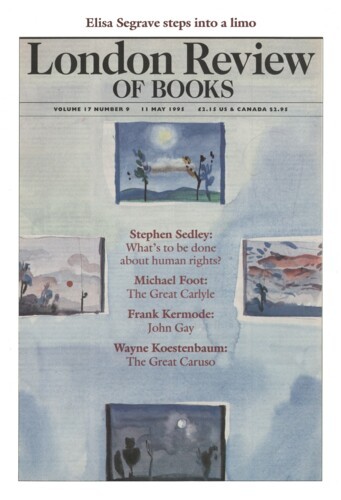
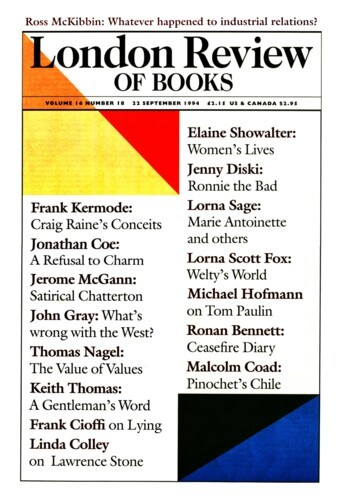
Frank Kermode, 11 May 1995

Like most biographies nowadays, David Nokes’s John Gay is very long, but unlike some of the others it is not much longer than it needed to be. Gay devoted so much of his attention to people grander than himself that his life story can’t be told without allusion to those of more complicated and ambitious figures like Pope, Swift and Addison. They in turn were involved in all manner of ways with even mightier men, especially politicians – for example, Oxford and Bolingbroke on one side and the powerful, unscrupulous Walpole on the other. And then there were the great lords and ladies who took or pretended to take an interest in writers and writing. So even the relatively peripheral movements of a self-consciously minor figure like Gay require for their useful exposition a lot of information about his betters.’

Strange, Sublime, Uncanny, Anxious

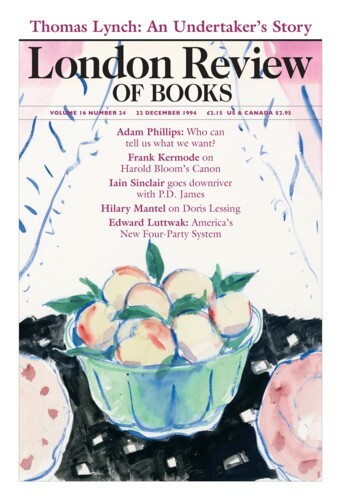
Frank Kermode, 22 December 1994

As one thinks of Harold Bloom, Auden’s description of Wyndham Lewis as a lonely old volcano comes to mind. Though not, like Lewis, ‘of the Right’, or indeed claiming any political alignment, Bloom erupts with comparable regularity and force. He prefers to be a one-man cultural opposition, waving only the banner of aesthetics; he says there are no Bloomians, but everybody knows him and all wonder, usually with exasperated affection, what he will do next. He is exceptionally and systematically well read, and exceptionally keen to promulgate his readings and his systems. Although, like Lewis, he loves to insult his opponents, he does so with amenity and apparent immunity. He has, in a quietly joyous fashion, the chutzpah to put his stamp on the whole of literature from Genesis to Ashbery, rivalling the scope of hero-critics like Saintsbury or Curtius or Auerbach though more giddily adventurous than they were. A few years ago he was maintaining that the parts of the Old Testament attributed to J, the Yahwist (that is, the author who refers to God as Yahveh), were written by a woman at the decadent court of Rehoboam. It seems a reviewer, entering into the spirit of this amusing but baseless conjecture, suggested that we might as well identify the author as Bathsheba, famous first as a bather, later as the mother of Solomon, and finally as J, mistress of the sublime and the uncanny as well as of King David. In this new book Bloom cheerfully accepts the reviewer’s proposal. That the author of what eventually became the Torah should have been the relict of the unlucky Uriah, and not an Israelite, but a Hittite, was plainly irresistible. Henceforth, he says, he will refer to J as Bathsheba. But I notice that he does not include Bathsheba’s name in the long list of canonical works in his appendix, nor among his authors in the index. Bloom is very serious but can also be a bit of a tease.

Made in Heaven

Frank Kermode, 10 November 1994

Looking down rather reprovingly from the shelf opposite are the three large volumes of Edward Nehls’s Composite Biography, a version or two of Harry T. Moore’s frequently revised biography, the first and so far the only volume of the three-tier Cambridge biography, and the ample lifework of Emile Delavenay. There are more beside them, and more to come: Rosie Jackson says there are ten in progress. Apart from the full-life biographies there are books covering short periods of Lawrence’s life: his wartime adventures and agonies, his years in Italy, in Australia, in New Mexico and Mexico, and so on. There are also numerous memoirs by people such as Jessie Chambers, Helen Corke, Catherine Carswell, Dorothy Brett, Mabel Dodge, a pair of gay Danes, and of course Frieda Lawrence, who knew the novelist at various times in various parts of the world. (There are naturally books also about Frieda, including this new one by Rosie Jackson, and about the von Richthofen family.) To back all this up we now have the seven lavishly annotated volumes of the Cambridge edition of the Letters, and a dozen or so lavishly annotated editions of the Works. I do not speak of more workaday stuff, all the books which have, possibly in the course of saying something else, to say something about Lawrence’s extraordinary life. Now they must all move over to allow another full-scale life, and an impassioned essay on Frieda, to be squeezed in.

My Mad Captains

Frank Kermode, 20 October 1994

I could give you the names of three captains now ’oo ought to be in an asylum, but you don’t find me interferin’ with the mentally afflicted till they begin to lay about than with rammers and winch-handles.

Letter

Kettle of Fish

22 September 1994

William Scammell (Letters, 20 October) lets us know that he too was taught in the Fourth Form that you can easily tell the difference between a simile and a metaphor: one always starts with ‘as’ or ‘like’ and the other doesn’t. But since he allows us to think he is acquainted with Aristotle, who was so interested in these modes of indicating resemblance that he went on...

The Oxford English Dictionary cites more than 33,000 passages from Shakespeare to illustrate the sense of English words. About 1900 of its main entries have first citations from Shakespeare....

Read more reviews

Out of the Lock-Up: Wallace Stevens

Michael Wood, 2 April 1998

Asked in 1933 what his favourite among his own poems was, Wallace Stevens said he liked best ‘The Emperor of Ice-Cream’, from Harmonium (1923). The work ‘wears a deliberately...

Read more reviews

A Sort of Nobody

Michael Wood, 9 May 1996

Criticism for Frank Kermode is the articulation of assumptions, a sort of phenomenology of interpretative need. Its job, as he says in The Sense of an Ending (1967), is ‘making sense of the...

Read more reviews

Real Absences

Barbara Johnson, 19 October 1995

‘Reading others people’s letters, like reading private diaries, offers thrilling and unexpected glimpses into the lives of others,’ claims the dustjacket of The Oxford Book of...

Read more reviews

Kermode’s Changing Times

P.N. Furbank, 7 March 1991

Frank Kermode having now become ‘Sir Frank’, it seems a good moment to take a look back over his remarkable career: though by no means because that career is at an end, for he is...

Read more reviews

Kermode and Theory

Hayden White, 11 October 1990

Frank Kermode belongs to no sect of literary criticism, and he has founded no school. Like William Empson, whom he praises as a ‘genius’ of criticism, Kermode has always been more...

Read more reviews

Loose Canons

Edward Mendelson, 23 June 1988

Frank Kermode’s History and Value reads the literature of the Thirties as ‘a love story, almost a story of forbidden love’. The story is usually told in political terms, but the...

Read more reviews

Reading the Bible

John Barton, 5 May 1988

‘Everyone communes with the Bible,’ wrote Marilyn Butler recently in her Cambridge inaugural lecture, commenting on the recent re-inclusion of the Biblical canon in the canon of...

Read more reviews

Mulberrying

Andrew Gurr, 6 February 1986

Like relics of the True Cross, there are said to be enough splinters to make an orchard from the mulberry tree planted by Shakespeare in his garden at New Place. The Shakespeare canon has excited...

Read more reviews

From Plato to Nato

Christopher Norris, 7 July 1983

Eagleton’s book is both a primer and a postmortem. It surveys the varieties of recent and present-day literary theory, only to suggest – in its closing chapter – that they had...

Read more reviews

Advanced Thought

William Empson, 24 January 1980

Frank Kermode’s new book contains a great deal of graceful and dignified prose, especially in the last chapter, and many of the examples are of great interest. It seems to argue that no...

Read more reviews

Read anywhere with the London Review of Books app, available now from the App Store for Apple devices, Google Play for Android devices and Amazon for your Kindle Fire.

Sign up to our newsletters

For highlights from the latest issue, our archive and the blog, as well as news, events and exclusive promotions.

Newsletter Preferences