Frank Kermode

Frank Kermode, whose books include Romantic Image (1957), The Sense of an Ending (1967) and Shakespeare’s Language (2000), was the Lord Northcliffe Professor of Modern English Literature at University College London and the King Edward VII Professor of English Literature at Cambridge. He inspired the founding of the LRB in 1979 and wrote more than two hundred pieces for it.

His first, in the first issue of the paper, was on millenarianism, ‘the myth concerning the End’, and his last on Philip Pullman and the parable of the prodigal son. In between he wrote on poets (‘T.S. Eliot and the Shudder’), novelists (Zadie Smith), critics (Paul de Man), Shakespeare, music, psychoanalysis and his wartime experience in the navy (‘My Mad Captains’). A selection of his pieces for the paper is available from the LRB store. He died in 2010 at the age of ninety and a collection of short memoirs by LRB contributors can be found here. ‘Papers speak through their writers,’ Mary-Kay Wilmers wrote after his death. ‘And of all the London Review’s writers Frank Kermode was the one through whom we spoke most often and most eloquently.’

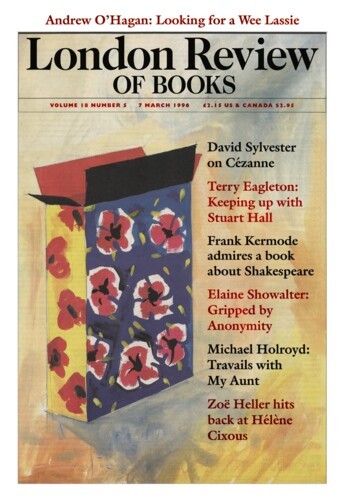
Improving the Plays

Frank Kermode, 7 March 1996

John Jones, sometime Professor of Poetry at Oxford, has written a number of good, idiosyncratic books on topics as diverse as Greek tragedy and Wordsworth, together with an excellent novel. The Same God, published in 1972 and apparently without a successor. He has now produced a good, idiosyncratic book on Shakespeare. In the nature of the project he can’t avoid technical questions, and readers new to the complex problems of Shakespearean texts may find some parts hard going, but Jones avoids all temptation to be impressively professional and bejargoned; and his book is indeed so courteously written, so curiously intimate in manner and so engagingly clear and resourceful in argument, that anybody with a genuine interest in Shakespeare, and particularly in Hamlet, King Lear and Othello, should read it for pleasure and then reread it to pick quarrels about details.
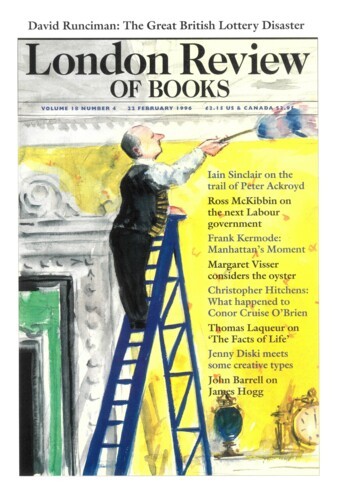
The Spree

Frank Kermode, 22 February 1996

Ann Douglas’s The Feminisation of American Culture, first published in 1977, now appears in Britain at the same moment as its long-delayed successor, Terrible Honesty. Looking back at the earlier book, Douglas remarks that her ‘excavation and re-evaluation of American feminine 19th-century literature’ has been continued by many other historians, mostly women, who have rebelled against what she calls, in tones more civil than those of some of her successors, a literary canon consisting ‘of almost exclusively male-authored, conspicuously shaped and achieved works’. She herself merely wants to give to other books (not necessarily all by women) the same measure of attention accorded to those more celebrated achievements. In her new book she claims to have taken another emancipatory step, for she will henceforth consider examples of ‘mass’ as well as of ‘élite’ art, thus admitting into the discussion many more writers and performers, male and female, black and white.

A Likely Story

Frank Kermode, 25 January 1996

Faced with such books as these it is hard not to regret the passing of an age when it seemed easy to write about painting and painters. The grapes of Zeuxis, as Pliny admiringly observed, were so real that birds came and pecked at them. Vasari, a painter himself, believed that in his day art had rediscovered those lost antique skills, built on them, and was now close to perfection. To make representations look deceptively real, and to remain untroubled by considerations of what ‘real’ could possibly mean, was the aim of the artist, and the function of the critic was simply to admire the technical accomplishments that made the illusion credible.

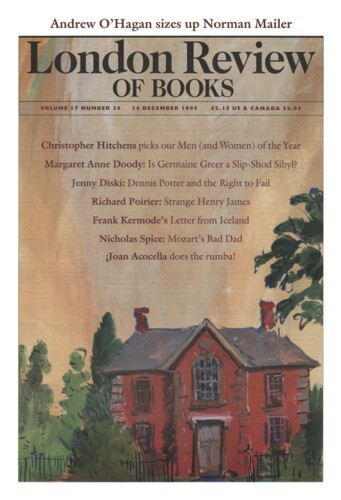
My Mad Captains

Frank Kermode, 14 December 1995

We did our fighting for freedom by proxy. Bad news drifted in, terrible things happened to other people. One of our sailors lost his wife and four children in a bombing raid on Hull. For a reason I forget, or perhaps for no good reason, all compassionate leave from Iceland had been stopped, but I thought that in the circumstances I should try to get the rule bent for this man. When I told him I’d see if I could work this, he replied: ‘Why bother? They were the only reason I had for going home.’

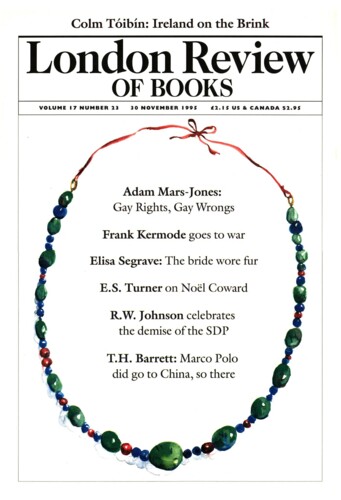
My Mad Captains

Frank Kermode, 30 November 1995

Up in Sunderland I reflected that Sierra got rid of its captains at a pretty impressive rate. I speculated about the fate of the next one and the possible forms of his mania. Would he be insensitive enough to last longer than his predecessors?

The Oxford English Dictionary cites more than 33,000 passages from Shakespeare to illustrate the sense of English words. About 1900 of its main entries have first citations from Shakespeare....

Read more reviews

Out of the Lock-Up: Wallace Stevens

Michael Wood, 2 April 1998

Asked in 1933 what his favourite among his own poems was, Wallace Stevens said he liked best ‘The Emperor of Ice-Cream’, from Harmonium (1923). The work ‘wears a deliberately...

Read more reviews

A Sort of Nobody

Michael Wood, 9 May 1996

Criticism for Frank Kermode is the articulation of assumptions, a sort of phenomenology of interpretative need. Its job, as he says in The Sense of an Ending (1967), is ‘making sense of the...

Read more reviews

Real Absences

Barbara Johnson, 19 October 1995

‘Reading others people’s letters, like reading private diaries, offers thrilling and unexpected glimpses into the lives of others,’ claims the dustjacket of The Oxford Book of...

Read more reviews

Kermode’s Changing Times

P.N. Furbank, 7 March 1991

Frank Kermode having now become ‘Sir Frank’, it seems a good moment to take a look back over his remarkable career: though by no means because that career is at an end, for he is...

Read more reviews

Kermode and Theory

Hayden White, 11 October 1990

Frank Kermode belongs to no sect of literary criticism, and he has founded no school. Like William Empson, whom he praises as a ‘genius’ of criticism, Kermode has always been more...

Read more reviews

Loose Canons

Edward Mendelson, 23 June 1988

Frank Kermode’s History and Value reads the literature of the Thirties as ‘a love story, almost a story of forbidden love’. The story is usually told in political terms, but the...

Read more reviews

Reading the Bible

John Barton, 5 May 1988

‘Everyone communes with the Bible,’ wrote Marilyn Butler recently in her Cambridge inaugural lecture, commenting on the recent re-inclusion of the Biblical canon in the canon of...

Read more reviews

Mulberrying

Andrew Gurr, 6 February 1986

Like relics of the True Cross, there are said to be enough splinters to make an orchard from the mulberry tree planted by Shakespeare in his garden at New Place. The Shakespeare canon has excited...

Read more reviews

From Plato to Nato

Christopher Norris, 7 July 1983

Eagleton’s book is both a primer and a postmortem. It surveys the varieties of recent and present-day literary theory, only to suggest – in its closing chapter – that they had...

Read more reviews

Advanced Thought

William Empson, 24 January 1980

Frank Kermode’s new book contains a great deal of graceful and dignified prose, especially in the last chapter, and many of the examples are of great interest. It seems to argue that no...

Read more reviews

Read anywhere with the London Review of Books app, available now from the App Store for Apple devices, Google Play for Android devices and Amazon for your Kindle Fire.

Sign up to our newsletters

For highlights from the latest issue, our archive and the blog, as well as news, events and exclusive promotions.

Newsletter Preferences