Dinah Birch

Dinah Birch is Emeritus Professor of English at the University of Liverpool. She has written extensively on John Ruskin, as well as Dickens, Tennyson and the Brontës, and is the general editor of the Oxford Companion to English LiteratureAnthony Trollope: A Very Short Introduction is available now.

The Unwritten Fiction of Dead Brothers

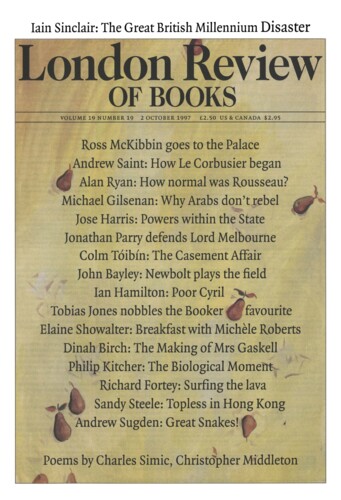
Dinah Birch, 2 October 1997

The daughter of Samuel Holland, a prosperous Cheshire farmer and land agent, the wife of William Stevenson, a scholar and writer of some reputation, and the mother of Elizabeth Gaskell, one of the most celebrated Victorian novelists, Elizabeth Stevenson has vanished. No portrait survives, no letter or scrap of journal, no cherished family anecdotes, no remembered trace of her character or opinions. She died at the age of 40 in 1811 – we don’t know how, or why – leaving a 12-year-old son and a sturdy little girl, also called Elizabeth, who was just a year old. She may, or may not, have had six other children who died in infancy. John Chapple is punctilious about what he calls ‘the knotty entrails of oaken facts’, and will not pretend to know what he cannot prove. The pathos of Mrs Stevenson’s faded existence is not lost on him, and he does what he can for her – referring, twice, to a ‘desperately trivial’ mention of a curious fan she seems once to have owned (was it rare, he wonders, or finely worked?) as almost the only sure evidence that she had a life of her own. Her daughter seems to have felt something similar. Thirty-eight years after her mother died, Elizabeth Gaskell unexpectedly acquired some of her letters. Thanking the donor, she said that they were ‘the only relics of her that I have, and of more value to me than I can express, for I have so often longed for some little thing that had once been hers or been touched by her’.’

A Year upon the Sofa

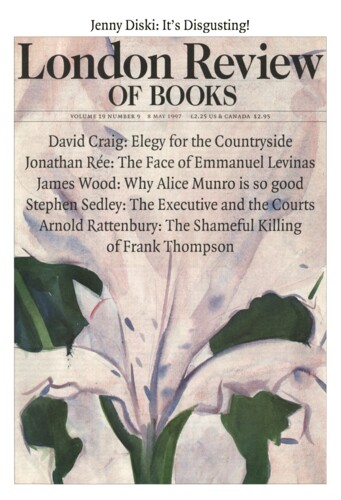
Dinah Birch, 8 May 1997

Anti-feminist women puzzle and infuriate their feminist sisters. How can a capable and rational woman persuade herself to oppose a cause from which she has gained so much? Is it self-hatred, or misguided self-interest? Craven subservience to men, or mean-minded jealousy of the success of other women? Understandably, feminist scholars have often preferred to focus on the onward march of liberation, rather than the perversities of female resistance to women’s advance. Yet the story of anti-feminism is a fascinating one, and we can scarcely understand the debates that have pushed feminist thinking forward without giving it some serious attention. Historians of Victorian women’s writing have found this a particularly unappealing task. George Eliot’s steady opposition to women’s suffrage is an embarrassment, and it is not encouraging to find Charlotte Brontë and Elizabeth Gaskell united in their distaste for the robust feminist arguments of John Stuart Mill. ‘In short, J.S. Mill’s head is, I dare say, very good, but I feel disposed to scorn his heart,’ sniffed Charlotte in a letter to Elizabeth Gaskell. ‘Woman must obey,’ Christina Rossetti wrote in 1879. ‘Her office is to be man’s helpmeet.’ These are not popular sentiments in the 1990s. Yet no one would wish to deny the intelligence, courage or reforming imagination of these women.

Defence of the Housefly

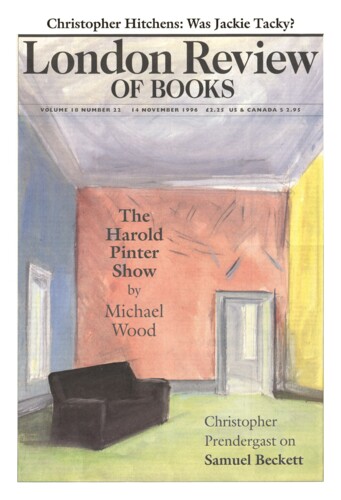
Dinah Birch, 14 November 1996

Hardy’s wives were not inclined to be reticent about the trials of life at Max Gate. Florence was struck with uneasiness after one particularly edgy bout of discontent: ‘I hope you burn my letters. Some are, I fear, most horribly indiscreet.’ But her husband was by then the most famous literary man of his age, and Florence’s letters were not for burning. They might, after all, be worth something. Neither Emma nor Florence could come to terms with having the value of their lives measured by that of their husband. It is hard to know whether the first or second Mrs Hardy had the more doleful time. Emma is more mysterious. Already 33 when she married Hardy in 1874, she was a mature woman with decided opinions and a strong sense of self-esteem committing herself to a shy but ambitious novelist. Oddly, not one of the letters she wrote before her marriage, or for many years after it, has survived. She would have been far from pleased with Michael Millgate’s speculations on their disappearance. ‘In her later years she was often regarded as a faintly ludicrous figure, and in her earlier years her status as Miss Emma Gifford or even as Mrs Thomas Hardy might well have been insufficient to ensure that her letters would be kept and treasured.’ It was Emma herself who seems to have destroyed her early letters to her husband. Just two poignant scraps remain, transcribed by Hardy. In 1870, only months after they met, she wrote to him: ‘I take him (the reserved man) as I do the Bible; find out what I can, compare one text with another, & believe the rest in a lump of simple faith.’ Perhaps Emma was hurt to see such trusting intimacy transformed into grist for a literary mill. A revised version of what she had written appears in A Pair of Blue Eyes, published the year before her marriage to Hardy.

Getting to Tombstone

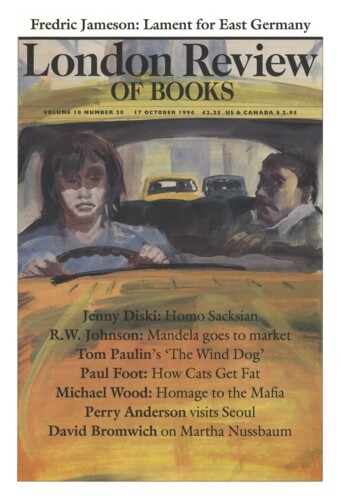
Dinah Birch, 17 October 1996

Volumes of short stories do not get into the bestseller lists, but Georgina Hammick’s first collection. People for Lunch (1987), did so at once. It can hardly have been the subject-matter: the stories are not especially violent or sexually inventive, nor do they offer revisionary analyses of late 20th-century culture. Anything quite exceptional, magic or grotesque is not their business. Nor is romantic reassurance. The voice is usually middle-class, the perspective often that of a harassed woman, struggling with wayward adolescent children, remembering youth and beginning to sense advancing age. Drinking, smoking and dogs get a sympathetic mention. Her next collection, Spoilt (1992), continued in like vein, contemplating loyalty and betrayal, maternal anxiety, family secrets and jokes, dreadful parties. Hammick has sharp eyes and even sharper ears, and a remarkable ability to write as people speak, to themselves and to others. This can make her a very funny writer, with a rare facility for reproducing the private comedies which keep families going. More often, it makes her unsettling. Her fiction insists on confrontations with discomfort, un-softened by glamour. She distrusts the consoling strategies of fantasy. To read her account of a dentist’s poisoned erotic fancies (‘Bad Taste’), or a bank clerk picturing the death of his wife (‘Deathcap’) is to be brought up hard against the clamorous needs of the imagination, and its power to corrupt. In ‘The Wheelchair Tennis Match’, a fearful mother (‘Bald tyres and a drunken or sleepy coach driver, an overweight coach driver all set to have a heart attack at the wheel … Driving too fast, falling asleep’) paralyses her relations with her family with her excessive fretting. Not, the story bleakly suggests, that she worries without reason. No one in these stories is wholly right or entirely wrong; no one is blamed, elevated to heroism or granted the charisma of villainy. ‘Noble Rot’, a story about English social class, undermines preconceptions with unobtrusive relish. Cicely, a modern lady of the manor, impulsively rescues an elderly couple having a miserable picnic on a busy lay-by, and sweeps them away for an afternoon’s entertainment in her very sophisticated garden. Cicely is generous and cultivated: so is her family. Arnold and Gladys behave with the awkwardness that might be expected under such circumstances. The satire seems to be of a recognisable type. But complications and questions are deftly accumulated. Cicely’s teenage children reveal themselves to be polished incompetents. Arnold and Gladys are capable, solidly aware of their worth, unfazed by this sudden glimpse of wealth and style. Their grandchildren are creative, doing well; the heirs to the manor are going nowhere. Yet the writing acknowledges and admires the charity and grace that led to Cicely’s eccentric invitation.

Baby Brothers

Dinah Birch, 18 April 1996

How does someone of Doris Lessing’s uncompromising intelligence turn into a little old lady? Not easily, especially if body conspires with mind in refusing to retire gracefully. ‘Most men and more women – young women afraid for themselves – punish older women with derision, punish them with cruelty, when they show inappropriate signs of sexuality.’ Having scorned maiden timidities sixty years ago. Lessing finds the discretions of age just as constraining. Love, Again is a novel about feelings – irrepressible love and paralysing grief – but it is still more about the analysis of feeling.’

Seeing through Fuller

Nicholas Penny, 30 March 1989

It has been respectable for some while now to admit to being bored by the huge, flat, ‘pure’ abstracts on the white walls of the museums of modern art. And yet non-representational...

Read more reviews

Read anywhere with the London Review of Books app, available now from the App Store for Apple devices, Google Play for Android devices and Amazon for your Kindle Fire.

Sign up to our newsletter

For highlights from the latest issue, our archive and the blog, as well as news, events and exclusive promotions.

Newsletter Preferences