Dinah Birch

Dinah Birch is Emeritus Professor of English at the University of Liverpool. She has written extensively on John Ruskin, as well as Dickens, Tennyson and the Brontës, and is the general editor of the Oxford Companion to English LiteratureAnthony Trollope: A Very Short Introduction is available now.

Fear among the Teacups: Ellen Wood

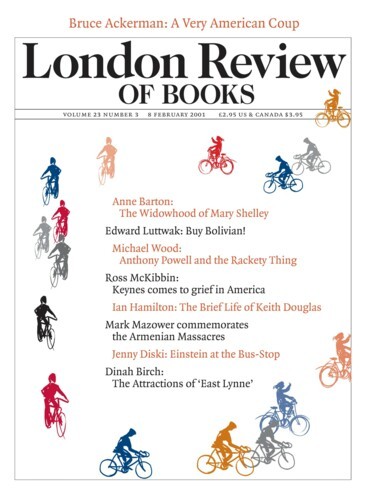
Dinah Birch, 8 February 2001

Andrew Maunder’s introduction to his new edition of Ellen Wood’s chronicle of scandalous goings-on among the Victorian middle classes claims that East Lynne may be ‘one of the most famous unread works in the English language’. Very possibly. Yet it was spectacularly successful in its day, and its popularity has turned out to be more durable than that of most publishing...

Tim Hilton’s foreword to the concluding volume of his biography of Ruskin is intimate and magisterial in a way that would seem presumptuous in anyone else. But Hilton has worked with Ruskin since the early 1960s and no one has a deeper understanding of either him or his writing. In the first volume, published in 1985, Hilton made it clear that the later life was to be the real focus of his biography: ‘I believe that Ruskin was a finer writer and, if I dare say so, a better man, in the years after 1860 and especially in the years after 1870.’ Still bolder was the claim that Fors Clavigera (1871-84), then little valued and rarely read, was Ruskin’s masterpiece. Both claims are made good in this book, which ought to reshape Ruskin studies.‘

No wonder it ached: George Eliot

Dinah Birch, 13 May 1999

It is odd that the pseudonym ‘George Eliot’ has proved so durable. It persisted long after the identity of Adam Bede’s author had become public knowledge, and there has been no serious attempt to dislodge it since. Why has George Eliot never been known by her own name? One reason is that it has never been quite clear what it was. She began life as Mary Anne Evans, daughter of Robert Evans, a sturdy and prosperous land agent in Warwickshire. But Mary Anne sounds rather like a servant’s name (the White Rabbit’s housemaid is called Mary Ann). As the rising fortunes of the family gave her a lady’s education, she began to experiment and adapt – trying out Marianne, losing the final ‘e’, and later settling on Marian. Throughout her life, she accumulated nicknames: Minie, Polly, Pollian, together with more dignified and maternal tags in middle age – Madre, Mutter or Madonna.’‘

Grubbling: Anne Lister

Dinah Birch, 21 January 1999

Anne Lister was undoubtedly one of the most unorthodox women of the early 19th century. She was an active and entirely unashamed lesbian, a scholar, a dauntless traveller and a resourceful businesswoman. As an example of what female tenacity could achieve in the pre-Victorian period, she might be seen as a fortifying ideal. But she was also manipulative and snobbish, often careless of the welfare of her tenants and labourers, and a belligerent ultra-Tory. Not only was she quite without interest in women’s political advancement, she was clearly not at all nice. One of the most engaging features of this selection from her writings is Jill Liddington’s refusal to make either a heroine or a witch out of this resolutely selfish woman. Nor does she allow Lister’s sexuality to dominate her account, as earlier editors have tended to do. Though Lister’s clandestine homosexual marriage with her fellow heiress Ann Walker is the most extraordinary event of the years covered here, its dynastic and economic repercussions figure as prominently as its personal significance in Liddington’s commentary. Nothing can make Anne Lister anything other than sensational, but Liddington is determined to show that she was something more substantial than a sexual curiosity.

One of the Cracked: Barbara Bodichon

Dinah Birch, 1 October 1998

Like Many forceful Victorian women, Barbara Leigh Smith Bodichon had a strong father and an obscure mother. Benjamin Smith, known in the family as ‘the Pater’, came from a formidable line of radical activists who had campaigned vigorously against the slave trade, and fostered projects for educational and political reform. Capable and self-assured, he combined progressive liberalism with a sharp eye for business. His interest in social betterment evidently did not extend to an involvement with the temperance movement, and he saw no difficulty in making his fortune out of distilling spirits. Nor did he see any difficulty in arranging his private life according to his own convenience. Visiting his married sister Fanny Nightingale (mother of Florence, who inherited a full share of the Smith resolve), he met a young milliner, Anne Longden. She was the daughter of a local miller, far beneath him in fortune and rank. He made her his mistress, and Barbara Leigh Smith was the first of the five children she bore him. He did not marry Anne. The more fastidious Smiths including Florence Nightingale’s well-to-do parents, were never reconciled to this ‘tabooed family’, and refused to acknowledge them. Anne, like most of her numerous counterparts in fiction, did not live long, dying of tuberculosis when Barbara was seven. Ben called her ‘the least selfish being I ever saw’, a description which certainly could not have been applied to him. He soon found himself another mistress, still further down the social scale (the daughter of an agricultural labourer), with whom he had a second covert family, never acknowledged.‘

Seeing through Fuller

Nicholas Penny, 30 March 1989

It has been respectable for some while now to admit to being bored by the huge, flat, ‘pure’ abstracts on the white walls of the museums of modern art. And yet non-representational...

Read more reviews

Read anywhere with the London Review of Books app, available now from the App Store for Apple devices, Google Play for Android devices and Amazon for your Kindle Fire.

Sign up to our newsletter

For highlights from the latest issue, our archive and the blog, as well as news, events and exclusive promotions.

Newsletter Preferences