David Runciman

David Runciman is an honorary professor of politics at Cambridge. His books include Political Hypocrisy: The Mask of Power, from Hobbes to Orwell and Beyond, How Democracy Ends and Confronting Leviathan: A History of Ideas. He has written more than a hundred pieces for the LRB on subjects including Lance Armstrong, gambling, all three volumes of Charles Moore’s biography of Thatcher, Donald Trump’s election and his defeat. He is the host of the podcast Past Present Future.

I was one of those Olympics gloomsters who, as Boris Johnson gleefully pointed out when the Games had finished, were scattered and routed by the rip-roaring success of London 2012. I assumed something would go wrong; everything went right. I thought people would complain about the cost; no one seems to have begrudged a penny. It was a triumph: I accept that now. But in one respect I still refuse to buy it. Before the Olympics began there were fears that the event would be overshadowed by a drugs scandal or by the steady drip-drip of multiple failed drugs tests.

Stiffed: Occupy

David Runciman, 25 October 2012

There is some competition to be the person who inspired the slogan of Occupy Wall Street: ‘We are the 99 per cent.’ Joseph Stiglitz thinks it might be him, on the back of an article he wrote for Vanity Fair in 2011 entitled: ‘Of the 1 per cent, by the 1 per cent, for the 1 per cent.’ Others think it was the economist Emmanuel Saez, who helped popularise the idea that 99 per cent of American households have been watching their incomes stagnate or fall while the top 1 per cent pulled away. As Saez reported back in 2007, since the 1970s half of all income growth has been captured by just 1 per cent of the population.

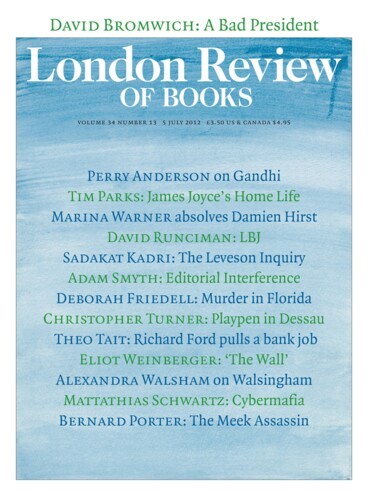
What if he’d made it earlier? LBJ

David Runciman, 5 July 2012

Lyndon Johnson always believed he would be president. As a boy in Texas, growing up in poor and sometimes desperate circumstances, he told anyone who would listen that he was headed for the White House. He mapped out a plan to get there from which, as Robert Caro writes, ‘he refused to be diverted.’ It meant first establishing himself in state politics, then winning a seat in the House of Representatives, then moving up to the Senate and finally to the highest office. He was undaunted by the fact that no Southerner had been president for the best part of a century.

You can tell Russia is not a real democracy because there is no great mystery about its politics. Democracies are slightly baffling in how they work: just look at America; just look at Europe; just look at us. In Russia the basics are easy to understand: people use money to get power and power to get money. The country is ruled by a narrow, self-serving elite who go through the motions of...

The recent Brussels summit to save the euro was a strange affair, and not just because of the quixotic behaviour of the British delegation. It was presided over by two politicians who were giving out a very mixed message. Nicolas Sarkozy told the world in the run-up to the meeting that this was the moment of truth not just for the currency but for the future of democracy. Europe only had a few days to save itself: ‘Never has Europe been in so much danger,’ he announced. Get this wrong and ‘there will be no second chance.’ It was salvation or the abyss.

In a Frozen Crouch: Democracy’s Ends

Colin Kidd, 13 September 2018

A historian​ ought to know better, I suppose. But for the last decade – ever since I passed a long queue of anxious depositors outside a branch of Northern Rock in September 2007...

Read more reviews

When American politicians are caught having illicit sex – like Eliot Spitzer, who resigned as governor of New York in 2008 after it was revealed that he was using a call-girl when he went...

Read more reviews

Throughout the history of political thought, attempts to imagine, classify and explain possible modes of political life have been characterised by starkly polarised and stylised antinomies. Among...

Read more reviews

Read anywhere with the London Review of Books app, available now from the App Store for Apple devices, Google Play for Android devices and Amazon for your Kindle Fire.

Sign up to our newsletter

For highlights from the latest issue, our archive and the blog, as well as news, events and exclusive promotions.

Newsletter Preferences