Colm Tóibín

Colm Tóibín’s novels include The Blackwater Lightship, Brooklyn, Nora Webster, The Master, The Magician and Long Island. He has written for the LRB on subjects including Thomas Mann and the Mann family, the Irish Famine, Mary Queen of Scots, Elton John, gay priests, Venice during lockdown and being diagnosed with cancer.

Looking at the list of poets was like having one’s Irish nose pushed up against the polished glass of a posh window in some imaginary Big House. But it was clear to me that there was one poet included in both these anthologies who really meant business. His name, like his poems, had a wilful, manufactured look. (He had, in fact, changed it by deed poll from William Guinneach Gunn to Thompson William Gunn.) It was clear, too, that he enjoyed his own style, his wit, his urge to dismiss what was dull and cautious, to celebrate what was dangerous and alive. This was a poetry that spoke as loudly to provincial teenagers as it did to thoughtful anthology-makers.
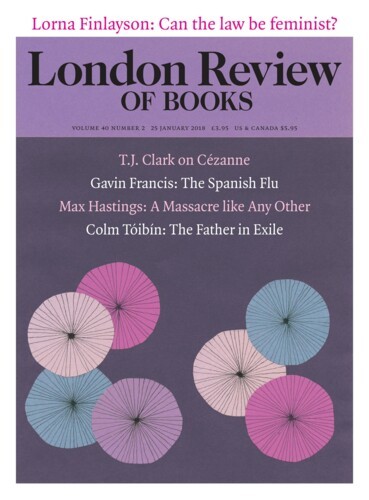
His Spittin’ Image: John Stanislaus Joyce

Colm Tóibín, 22 February 2018

‘A father​ is a necessary evil,’ Stephen Dedalus says in Ulysses. In Yeats: The Man and the Masks, Richard Ellmann quoted Ivan Karamazov: ‘Who doesn’t desire his father’s death?’ ‘From the Urals to Donegal,’ Ellmann writes,

the theme recurs, in Turgenev, in Samuel Butler, in Gosse. It is especially prominent in Ireland. George Moore, in his...

It was​ June 2004 and I was in the Special Collections section of the Union College Library in Schenectady in upstate New York. About an hour earlier, I had heard one of the librarians telling someone on the phone in a half-whisper that someone called Colm Tóibín was in the library looking at the correspondence of John Butler Yeats, which had been transcribed, then typed, then...

The Road to Reading Gaol

Colm Tóibín, 30 November 2017

In October​ 2016, three years after it was closed, I went to Reading Gaol. The prison had been laid out in 1844, each floor cruciform, so that all four corridors could be seen from a single, central vantage point. In cell after cell where, most recently, young offenders had been held, there was a set of metal bunk beds riveted to the wall, with a small table and two stools opposite, and a...

Short Cuts: In Barcelona

Colm Tóibín, 7 September 2017

On the route the van had taken, shrines were placed where people had been killed. The first one, opposite Bar Núria, marks the spot where the van had come onto the pedestrian boulevard. Among the candles and the flowers and the handwritten messages was a brand new edition of the collected poems of Federico García Lorca. Lorca, who came to Barcelona first in 1925, said that the Ramblas was a street he hoped would go on for ever.

So much in Long Island goes unsaid. It’s a world in which people speak knowledgeably (and sometimes bitchily) about others but reveal little of themselves. As well as secrets, there are problems of...

Read more reviews

Closet Virtuoso: Magic Mann

Seamus Perry, 24 February 2022

Colm Tóibín is not the first person to advance an interpretation of Thomas Mann as a virtuoso of life in the closet, and he generously lists in an appendix the numerous works of scholarship he has consulted....

Read more reviews

At the start​ of Aeschylus’ Oresteia a watchman sees a flaming beacon. This is supposed to be the sign that Troy has fallen and that Agamemnon is coming home from the Trojan war. The...

Read more reviews

‘Nobody knows​ … nobody knows.’ Elizabeth Bishop said her grandmother’s remark was the chorus of her childhood. ‘I often wondered what my grandmother knew that...

Read more reviews

Eilis Lacey is a young Enniscorthy woman who has never dreamed of leaving Ireland. Friary Street and Castle Street, the square and the cathedral: the grey co-ordinates of her small County Wexford...

Read more reviews

‘It’s, on the whole, I think,’ Henry James wrote to Edmund Gosse, ‘a queer place to plant the standard of duty.’ The letter is dated 7 January 1893, 29 years before...

Read more reviews

The Sacred Cause of Idiom: Lady Gregory

Frank Kermode, 22 January 2004

The possession and use of a toothbrush was a mark of the difference between us and them, gentry and peasant, or so Lady Gregory suggested when she made the remark – jocular, perhaps, and...

Read more reviews

‘You know, in my family,’ remarks a gay Irish architect in Colm Tóibín’s The Blackwater Lightship, ‘my brothers and sisters – even the married ones...

Read more reviews

His Socks, His Silences

Adam Mars-Jones, 3 October 1996

Colm Tóibín’s frustrating new novel starts from a pleasingly skewed perspective: its narrator Richard Garay (less often, Ricardo) was brought up in Buenos Aires, child of an...

Read more reviews

Poped

Hugo Young, 24 November 1994

In Kiev in 1992, Colm Tóibín met the Bishop of Zhytomir, who was dressed in his full regalia. ‘He had that wonderful, well-fed, lived-in look that reminded me of several Irish...

Read more reviews

Thick Description

Nicholas Spice, 24 June 1993

To write simply is always to seem to write well. Bad writing is usually identified with over-writing: too many adjectives and adverbs, flowery figures of speech, verbosity. No one is ever accused...

Read more reviews

Motiveless Malignity

D.A.N. Jones, 11 October 1990

Ever since 1958, when his play The Birthday Party opened in London, Harold Pinter has been admired by the judicious for the witty realism of his dialogue and the engrossing mystery of his...

Read more reviews

Read anywhere with the London Review of Books app, available now from the App Store for Apple devices, Google Play for Android devices and Amazon for your Kindle Fire.

Sign up to our newsletter

For highlights from the latest issue, our archive and the blog, as well as news, events and exclusive promotions.

Newsletter Preferences