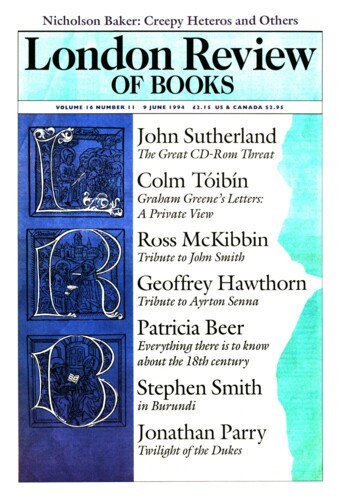
Colm Tóibín

Colm Tóibín’s novels include The Blackwater Lightship, Brooklyn, Nora Webster, The Master, The Magician and Long Island. He has written for the LRB on subjects including Thomas Mann and the Mann family, the Irish Famine, Mary Queen of Scots, Elton John, gay priests, Venice during lockdown and being diagnosed with cancer.

How many nipples had Graham Greene?

Colm Tóibín, 9 June 1994

He received one hundred and eighty letters a month, he told one of his correspondents. Some of them were fan letters; others came from journalists who kept him informed about the places in the world which he cared about; academics wrote with lists of questions; publishers wrote looking for quotes for books they were about to publish. Authors wrote. In 1973 Greene wrote to Josef Skvorecky: ‘Your letters reach the length of a book by this time … I feel sad that you are wasting such good material on me, but if you ever come to write about these events I can always send you the letters back.’…


Insiderish

Colm Tóibín, 26 May 1994

One of the early chapters in Harold Brodkey’s first novel The Runaway Soul is entitled ‘The River’. The narrator, after his father’s death, returns to a landscape which he had known in early childhood. Some of the prose is plain and clear: ‘At the mouth of the stream, where it emptied into the inlet, under willows, lay a very large, ungainly river dinghy. It was greenish and heavy, made of thick and heavy pieces of wood, scarred and scratched, peeling and warped, moored to a ring in the trunk of a willow.’ But Brodkey sets out in this book to find another language, broken and fast-flowing, to slow down experience as it is rendered in fiction, to make it more exact and true, to establish, if he can, the way in which several things happen in the mind at once, the way in which sensations come not single spies but in battalions.

Diary: In the Pyrenees

Colm Tóibín, 6 January 1994

Towards the end of November 1975 I was doing my shopping in the Boquería market off the Ramblas in Barcelona when I bumped into Bernard Loughlin, with whom I worked in an institution called the Dublin School of English. To mourn the passing of Generalissimo Franco on 20 November we had all been given ten days off. I had spent them in the city, wandering around in search of riots, old bars and potential sleeping partners. Bernard, on the other hand, had been in the Pyrenees: I listened to him carefully because his tone was full of wonder. He had been in a village full of enormous stone houses with slate roofs, most of them abandoned. They all faced south, each one a different height and shape, and the view was of a fertile valley, with rolling fields and poplar trees in the foreground, and masses of snowcapped peaks in the distance. It was spectacular, he said, awesome. It must once have been rich; but now nobody went there – it took five or six hours to get there from Barcelona. It was more than five thousand feet above sea-level – and you could rent a house there for next to nothing.

New Ways of Killing Your Father

Colm Tóibín, 18 November 1993

In 1969, two years after my father died, my mother, my sisters and I went to Wexford for the launch of a new history of the 1798 Rising, The Year of Liberty by Thomas Pakenham. The Rising was important for us: from our housing estate we could see Vinegar Hill where ‘our side’, the rebels, had made their last stand. From early childhood I knew certain things (I hesitate to say ‘facts’) about the Rising: how the English had muskets whereas we just had pikes, how the English poured boiling tar on the scalps of the Irish and then, when the tar had dried, peeled it off. The names of the towns and villages around us were in all the songs about 1798 – the places where battles had been fought, or atrocities committed. But there was one place that I did not know had a connection with 1798 until I was in my twenties. It was Scullabogue. Even now, as I write the name, it has a strange resonance. In 1798 it was where ‘our side’ took a large number of Protestant men, women and children, put them in a barn and burned them to death.’

So much for shame

Colm Tóibín, 10 June 1993

My father was a supporter of the Fianna Fail Party. ‘You could salute Fine Gael people,’ he once told my sister – Fine Gael was the main opposition party – ‘but if you ever actually voted Fine Gael, your right hand would wither off.’ Throughout my childhood I believed that you could recognise a Fine Gael person merely by looking at him or her. They looked stern and serious, as befitted a group who had run the state in the decade after independence while our side wondered whether to hand in their guns or not.’

So much in Long Island goes unsaid. It’s a world in which people speak knowledgeably (and sometimes bitchily) about others but reveal little of themselves. As well as secrets, there are problems of...

Read more reviews

Closet Virtuoso: Magic Mann

Seamus Perry, 24 February 2022

Colm Tóibín is not the first person to advance an interpretation of Thomas Mann as a virtuoso of life in the closet, and he generously lists in an appendix the numerous works of scholarship he has consulted....

Read more reviews

At the start​ of Aeschylus’ Oresteia a watchman sees a flaming beacon. This is supposed to be the sign that Troy has fallen and that Agamemnon is coming home from the Trojan war. The...

Read more reviews

‘Nobody knows​ … nobody knows.’ Elizabeth Bishop said her grandmother’s remark was the chorus of her childhood. ‘I often wondered what my grandmother knew that...

Read more reviews

Eilis Lacey is a young Enniscorthy woman who has never dreamed of leaving Ireland. Friary Street and Castle Street, the square and the cathedral: the grey co-ordinates of her small County Wexford...

Read more reviews

‘It’s, on the whole, I think,’ Henry James wrote to Edmund Gosse, ‘a queer place to plant the standard of duty.’ The letter is dated 7 January 1893, 29 years before...

Read more reviews

The Sacred Cause of Idiom: Lady Gregory

Frank Kermode, 22 January 2004

The possession and use of a toothbrush was a mark of the difference between us and them, gentry and peasant, or so Lady Gregory suggested when she made the remark – jocular, perhaps, and...

Read more reviews

‘You know, in my family,’ remarks a gay Irish architect in Colm Tóibín’s The Blackwater Lightship, ‘my brothers and sisters – even the married ones...

Read more reviews

His Socks, His Silences

Adam Mars-Jones, 3 October 1996

Colm Tóibín’s frustrating new novel starts from a pleasingly skewed perspective: its narrator Richard Garay (less often, Ricardo) was brought up in Buenos Aires, child of an...

Read more reviews

Poped

Hugo Young, 24 November 1994

In Kiev in 1992, Colm Tóibín met the Bishop of Zhytomir, who was dressed in his full regalia. ‘He had that wonderful, well-fed, lived-in look that reminded me of several Irish...

Read more reviews

Thick Description

Nicholas Spice, 24 June 1993

To write simply is always to seem to write well. Bad writing is usually identified with over-writing: too many adjectives and adverbs, flowery figures of speech, verbosity. No one is ever accused...

Read more reviews

Motiveless Malignity

D.A.N. Jones, 11 October 1990

Ever since 1958, when his play The Birthday Party opened in London, Harold Pinter has been admired by the judicious for the witty realism of his dialogue and the engrossing mystery of his...

Read more reviews

Read anywhere with the London Review of Books app, available now from the App Store for Apple devices, Google Play for Android devices and Amazon for your Kindle Fire.

Sign up to our newsletter

For highlights from the latest issue, our archive and the blog, as well as news, events and exclusive promotions.

Newsletter Preferences