Colin Burrow

Colin Burrow is a fellow of All Souls College, Oxford. His books include Shakespeare and Classical Antiquity and Imitating Authors: Plato to Futurity, as well as editions of Ben Jonson, Shakespeare and the metaphysical poets. His first contribution to the LRB, in 1999, was on British and Irish poetry of the Civil War; he has since written more than seventy pieces for the paper, on subjects from Catullus and Virgil to Hilary Mantel and Ursula Le Guin. He presented ‘On Satire’, an LRB Close Readings podcast series, with Clare Bucknell.

Recribrations: John Donne in Performance

Colin Burrow, 5 October 2006

Literary biography is one of the background noises of our age. It’s a decent, friendly sort of hum, like the Sunday papers or chatter on a train. It gives the punters a bit of history and a bit of literature, and perhaps a bit of gossip, and what’s more it saves them the trouble of reading history. And poems too, for that matter. Not to mention the ordeal of ploughing through a load of literary criticism. But there are two respects in which literary biography is intrinsically pernicious, however well it’s done. The first is that literary biographies need a thesis in order to catch the headlines. This can turn what ought to be a delicate art into a piece of problem-solving or a search for a key to a life. Wordsworth? Well, that stuff about Lucy is really all about his affair with Annette Vallon. Byron? Just remember he loved his sister.
Not Quite Nasty: Anthony Burgess

Colin Burrow, 9 February 2006

Anthony Burgess is a 1960s sideboard of a writer. His range was improbable. He published 32 novels, composed symphonies, wrote two books on Joyce, a biography of Shakespeare and a study of the English language, as well as a large number of film scripts, most of which never entered production. He died in 1993, and is at the moment passing through the droop in reputation which most dead writers endure before they can become history. Four years ago he was the victim of what was generally regarded as a loathsome biography by Roger Lewis, who presented him as a pompous, psychologically damaged second-rater. Lewis’s biography was no fun to read, but it was interesting for what it revealed about responses to the unfashionable. It was written by a lapsed admirer, and showed exactly what happens when a reader realises that he no longer likes what he thought he liked, but hasn’t yet worked out how to detach himself from his former feeling. The result is rage and loathing, which is chiefly a warped form of embarrassment about one’s former admiration.

No Way Out: John McGahern

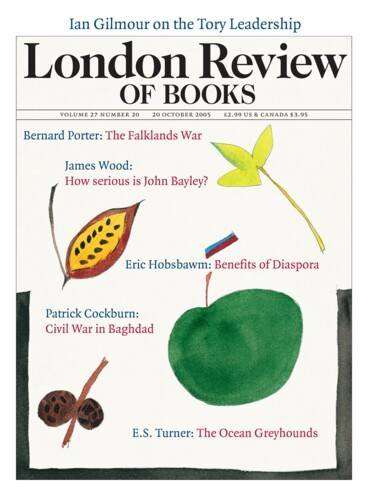
Colin Burrow, 20 October 2005

John McGahern is an extraordinary writer of charm and violence. His most recent novel, That They May Face the Rising Sun (2002), has a looseness and a gaiety which it took him nearly seventy years to allow himself. His earlier work marked him as one of the great writers of claustrophobia. His novels tend to evoke small places – single houses or tiny communities – and to crush into...

Why do we want to read about murder? Most of us do not want to kill people, and most of us would feel a little squeamish if we discovered that one of our friends had done somebody in. Part of the reason must be simple ghoulishness, if it can ever be entirely simple to take pleasure in imagining how people kill each other. In most murder fictions these dark pleasures are overlaid by other,...

“Literary biography is often written for people who don’t much fancy reading plays and who want to be reassured that some of the superstitions they have about the relationship between human activities and social causality have some descriptive force. The explanations of literary activity which are required by the market for literary biography tend to be made up from a dash of Freud, a handful of social aspiration, a scratching from Foucault’s armpit, and a willingness to entertain simple one-to-one correspondences between fiction and life.”

Don’t break that fiddle: Eclectic Imitators

Tobias Gregory, 19 November 2020

The boundary between the broader and narrower senses has never been firm, and the history of literary imitation has always been bound up with the histories of philosophy, rhetoric and education. Plato,...

Read more reviews

I must needs acknowledge, that the Greeke and Latine tongues, are great ornaments in a Gentleman, but they are purchased at over-high rate. Montaigne, Essays I grew up​ in postwar...

Read more reviews

Mr Who He? Shakespeare’s Poems

Stephen Orgel, 8 August 2002

In his own time, Shakespeare was much better known to the reading public as a poet than as a playwright. Venus and Adonis went through ten editions before his death in 1616, and another six...

Read more reviews

Read anywhere with the London Review of Books app, available now from the App Store for Apple devices, Google Play for Android devices and Amazon for your Kindle Fire.

Sign up to our newsletter

For highlights from the latest issue, our archive and the blog, as well as news, events and exclusive promotions.

Newsletter Preferences