Andrew O’Hagan

Andrew O’Hagan is the LRB’s editor at large. He is the author of seven novels – Our Fathers, Personality, Be Near Me, The Life and Opinions of Maf the Dog, The Illuminations, Mayflies and Caledonian Road – and four books of non-fiction: The Missing, The Atlantic Ocean: Essays on Britain and America, The Secret Life: Three True Stories (which contains his LRB pieces on Julian Assange, creating a fake identity online and the search for Satoshi Nakamoto) and On Friendship.

His first piece for the LRB, a Diary about James Bulger’s murder and the cruelty of children to other children, appeared in 1993, when he was working as an editor at the paper (in 2010 he wrote about Jon Venables’s rearrest). He has written more than a hundred and fifty pieces for the LRB since then, on subjects including begging, the sinking of his grandfather’s ship, the murder of the Irish solicitor Rosemary Nelson, Marilyn Monroe and Arthur Miller, the end of British farming, Jonathan Franzen, hating football, Scotland’s sense of grievance, the Democratic and Republican National Conventions of 2004 and the Republican one of 2024, poetry anthologies, the 7/7 bombing outside the LRB’s old offices, the aftermath of Hurricane Katrina, what happens to our rubbish, a driving holiday with Seamus Heaney and the LRB’s first editor, Karl Miller, Jimmy Savile and the BBC, Norman Mailer, the Daily Mail, the Grenfell disaster, Robert Louis Stevenson in Bournemouth and in Edinburgh, old Soho, the New Romantics and Prince Harry.

Me First

Andrew O’Hagan, 7 March 1996

In the mid-Eighties, my family felt everything would be fine if I could just get something with a shirt and tie. My three elder brothers wore nailbags, overalls and aprons – the respective black robes of time-served apprenticeship – but even that world was going by the time it got to be my turn, and it was hoped that I might be found fit for the crisp shirt and tie of the clerical elect. I had stayed on at school, bringing home the first family O-Level, and after the celebrations were over – a bottle of Merrydown cider in the garage of an epileptic pal ready for the dole – I thought about what it might mean to start thinking about the future. We sat on blue Calor-gas bottles, not quite ourselves, doing our thinking about the future as we looked out through the garage mouth. There wasn’t a great deal to look at: cars without tyres in the car park, a load of council fencing stretching up and away. My pal Tam made a joke about the state we were in, slugged the last of the cider, then fell to the floor and started wriggling about.’
Oswaldworld

Andrew O’Hagan, 14 December 1995

When Gary Gilmore faced his executioners one cold morning in 1977, there was a serious, anxious, bearded reporter-type standing only a few feet away. Before the hood was placed over Gilmore’s head, the man walked over to the chair, and took both of the killer’s hands into his own. ‘I don’t know why I’m here,’ he said. Gilmore looked up, and replied sweetly: ‘You’re going to help me escape.’

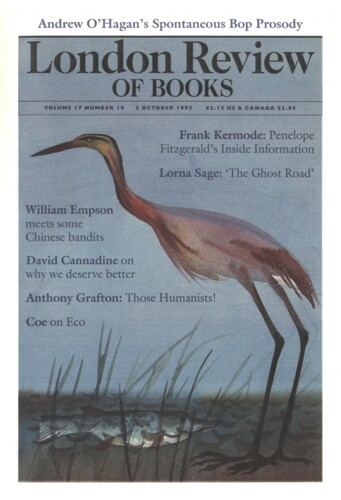
Bebop

Andrew O’Hagan, 5 October 1995

New York in August, and inside is the only place to be. The people around me, each at his own console, were watching their chosen moments in the history of American airtime. Elvis Presley’s top half on the Ed Sullivan Show; John F. Kennedy’s live debate with a melting Richard Nixon; an early episode of I Love Lucy; a dinner-table scene from The Waltons; Neil Armstrong’s One Small Step; the shooting of Lee Harvey Oswald; the pilot show of Roseanne. Each viewer wore headphones; all you could hear was the giggles and gasps. On my little TV, where the picture was jumpy at first, was Jack Kerouac. He was sitting up at a white piano, and Steve Allen tinkled away at the keys. Kerouac is very clean, very neat, but he looks nervous. Allen is smug. He’s a polyester-clad uncle sitting at the piano.

Lost Boys

Andrew O’Hagan, 8 June 1995

It was a Sunday morning, and a minister strode past me with a labrador. ‘That looks like a contented spot,’ he said, dog and dog-collar glistening. I sat in the middle of a little wood, just to the side of Kenilworth Chapel in East London, on 9 October 1994. The church looked closed and unattended. All around me, in tangles of ivy and nettles and scrub, lay hundreds of dilapidated grave-stones. They sloped every which way, and off into the distance, across a wide open ground beneath the Beckton flyover. The graveyards in English cities, especiaily in the east of those cities, are nearly always wasted and terrible. In Scotland, the tombstones are made to stand up; and the grass is most often cut and weeded. I was fairly shocked the first time I saw a London graveyard – in Walthamstow, I remember. It had nothing to do with the decorous, landscaped dead-parks of recent memory: it was a place where riot and decay ruled. It looked like a spot where time was having its way.

Thin Ayrshire

Andrew O’Hagan, 25 May 1995

David Gibson was a man stiff and parsonical; by all accounts the sort of man who got things done. You could say he was obsessed with ridding Glasgow of its slums, with turning them into something bright and high and unquestionably modern. That’s what he wanted, and he’d already made vast advances towards getting it when he became convener of Glasgow Corporation’s housing committee in 1964. We’re fond of hating his ideas nowadays, of seeing the horror of those damp flats and pointing up the stupidity of the planning. But Gibson and his allies were visionaries of a sort. They thought they could obliterate the past with new production, and they had reason to think a project like that might turn out to be for the good of everybody. It may be obvious now how wrong they were, but Gibson’s urge to remake, to deliver his own people out of the slums and into a pure, new, shock world, has plenty of wrong-headed nobility in it, and no shortage of high-mindedness.

About a third of the way through his first book, The Missing, Andrew O’Hagan pauses over a perception he thinks his readers may find ‘a bit surprising’. It’s an intricate...

Read more reviews

Read anywhere with the London Review of Books app, available now from the App Store for Apple devices, Google Play for Android devices and Amazon for your Kindle Fire.

Sign up to our newsletters

For highlights from the latest issue, our archive and the blog, as well as news, events and exclusive promotions.

Newsletter Preferences