Andrew O’Hagan

Andrew O’Hagan is the LRB’s editor at large. He is the author of seven novels – Our FathersPersonalityBe Near MeThe Life and Opinions of Maf the Dog, The Illuminations, Mayflies and Caledonian Road – and four books of non-fiction: The MissingThe Atlantic Ocean: Essays on Britain and AmericaThe Secret Life: Three True Stories (which contains his LRB pieces on Julian Assange, creating a fake identity online and the search for Satoshi Nakamoto) and On Friendship.

His first piece for the LRB, a Diary about James Bulger’s murder and the cruelty of children to other children, appeared in 1993, when he was working as an editor at the paper (in 2010 he wrote about Jon Venables’s rearrest). He has written more than a hundred and fifty pieces for the LRB since then, on subjects including begging, the sinking of his grandfather’s ship, the murder of the Irish solicitor Rosemary NelsonMarilyn Monroe and Arthur Miller, the end of British farmingJonathan Franzen, hating footballScotland’s sense of grievance, the Democratic and Republican National Conventions of 2004 and the Republican one of 2024, poetry anthologies, the 7/7 bombing outside the LRB’s old offices, the aftermath of Hurricane Katrina, what happens to our rubbish, a driving holiday with Seamus Heaney and the LRB’s first editor, Karl Miller, Jimmy Savile and the BBC, Norman Mailer, the Daily Mail, the Grenfell disaster, Robert Louis Stevenson in Bournemouth and in Edinburgh, old Soho, the New Romantics and Prince Harry.

Notes on a Notebook

Andrew O’Hagan, 30 September 1999

You set out believing in a world of possible truths; you finish up in an eternity of corridors waiting for clarification. Sometimes the only truth you find is the truth of your own hunger to find. You see in a flash that nothing will come of further questions or second trips. Between the lines of your unyielding story another narrative may awaken and begin to stand up. And that will be the story you take home: the unending story of the story itself.
Story: ‘Three Women’: work in progress

Andrew O’Hagan, 10 December 1998

It was the evictions that created the Effie Bawn people still remember. She was never political before that. She had never listened to politicians. She had only listened to saints. But the Rent Strikes brought her out to the world with her small fists clenched in a white-knuckle fury.

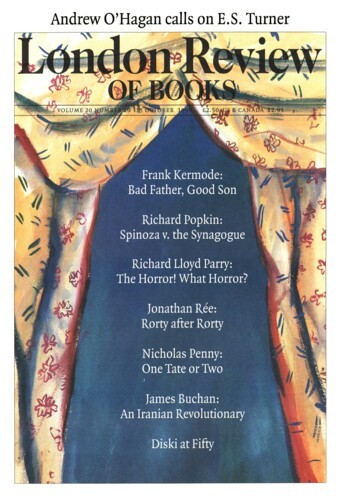
Seventy Years in a Filthy Trade: E.S. Turner

Andrew O’Hagan, 15 October 1998

Mr Turner is my favourite Edwardian. He sits in a chair under the window. He doesn’t waste a lot of words. And when he laughs he rocks a little. The sky is busy and blue over Richmond. Every few minutes a plane goes by. They seem to enter the window-frame just about head height; each one passes through the ears of E.S. Turner, and on from there to some Spain or America. He isn’t bothered. He’s nearly ninety. He’s thinking of things to say about his life. And when he speaks he speaks in a small way. His voice seems aware of the danger it’s in.

Good Fibs: Truman Capote

Andrew O’Hagan, 2 April 1998

Never give a writer a key to your apartment. Or your office. Never let him talk to your children. If he says he wants to take a bath tell him the plumbing’s knackered. If he makes for the fridge say everybody just died of food poisoning. Don’t encourage him in any way. Never give him your mother’s phone number. Keep him back from anything sharp. Tell him nothing you wouldn’t tell your worst enemy. Hide from him in the supermarket. Avoid eye contact. Never go out to war with one; never share his drugs. And never, never kiss a writer. Never kiss one no matter what. At the hard core of American writing this century, these would appear to be the big lessons. And they all crumble down to one thing in the end: never trust a genius who even thinks he might be American.

Many Andies

Andrew O’Hagan, 16 October 1997

All his life Andy Warhol looked like death. He came into the world that way: blank, rheumy-eyed, sick as the day was long. An unmerry child with St Vitus’ Dance, the young Warhol lay twitching in his bed under a blanket of fan magazines, the source of all his imaginary friendships – with Errol Flynn and Louella Parsons, Hedda Hopper and Gary Cooper – and the only thing he craved in those Pittsburgh days was the chance to be as lovable as Shirley Temple. The adult Warhol looked as much like death and lived as much by desire. A mobile presentation of 20th-century estrangement. A man in a wig in a season in hell. ‘A sphinx without a secret,’ said Truman Capote; ‘the Ecce Homo of modern exhibitionism,’ said Stephen Spender. For his own part, Warhol was intensely reasonable: ‘I just want to be a machine,’ he said.’

About a third of the way through his first book, The Missing, Andrew O’Hagan pauses over a perception he thinks his readers may find ‘a bit surprising’. It’s an intricate...

Read more reviews

Read anywhere with the London Review of Books app, available now from the App Store for Apple devices, Google Play for Android devices and Amazon for your Kindle Fire.

Sign up to our newsletter

For highlights from the latest issue, our archive and the blog, as well as news, events and exclusive promotions.

Newsletter Preferences