Andrew O’Hagan

Andrew O’Hagan is the LRB’s editor at large. He is the author of seven novels – Our Fathers, Personality, Be Near Me, The Life and Opinions of Maf the Dog, The Illuminations, Mayflies and Caledonian Road – and four books of non-fiction: The Missing, The Atlantic Ocean: Essays on Britain and America, The Secret Life: Three True Stories (which contains his LRB pieces on Julian Assange, creating a fake identity online and the search for Satoshi Nakamoto) and On Friendship.

His first piece for the LRB, a Diary about James Bulger’s murder and the cruelty of children to other children, appeared in 1993, when he was working as an editor at the paper (in 2010 he wrote about Jon Venables’s rearrest). He has written more than a hundred and fifty pieces for the LRB since then, on subjects including begging, the sinking of his grandfather’s ship, the murder of the Irish solicitor Rosemary Nelson, Marilyn Monroe and Arthur Miller, the end of British farming, Jonathan Franzen, hating football, Scotland’s sense of grievance, the Democratic and Republican National Conventions of 2004 and the Republican one of 2024, poetry anthologies, the 7/7 bombing outside the LRB’s old offices, the aftermath of Hurricane Katrina, what happens to our rubbish, a driving holiday with Seamus Heaney and the LRB’s first editor, Karl Miller, Jimmy Savile and the BBC, Norman Mailer, the Daily Mail, the Grenfell disaster, Robert Louis Stevenson in Bournemouth and in Edinburgh, old Soho, the New Romantics and Prince Harry.

Short Cuts: Dinner at the Digs

Andrew O’Hagan, 20 March 2008

If you are an Inuit or a hummingbird, you are very unlikely to die of heart disease, suffer from diabetes, or be extremely fat. You are also unlikely to drive a Bentley down the Brompton Road, but that’s not what interests the world’s top foodies, who look to ruddy Eskimos and buzz-winged birds to explain the success of a diet rich in Omega-3. Foodies are responsible for thousands...
Iraq, 2 May 2005: Two Soldiers

Andrew O’Hagan, 6 March 2008

In southern Iraq, just south of Amara, the main city of Maysan province, the British military base at Camp Abu Naji was preparing for the night. Set at the northern end of the marshlands between the Tigris and the Euphrates, the camp is now abandoned and looted, but in May 2005 it was a busy centre of military operations. Amara has seen many reversals of fortune and opinion: it was once a hideout for anti-Saddam insurgents, whom he punished by draining the marshes. He also killed many of them, and buried their bodies in mass graves around the city. But by the time the 1st Battalion of the Coldstream Guards were operating out of Camp Abu Naji, it was the British army that had become the enemy of the people. Mortar attacks on the base were just part of the general grief, a handful of dust to be thrown regularly in the face of the occupying forces.

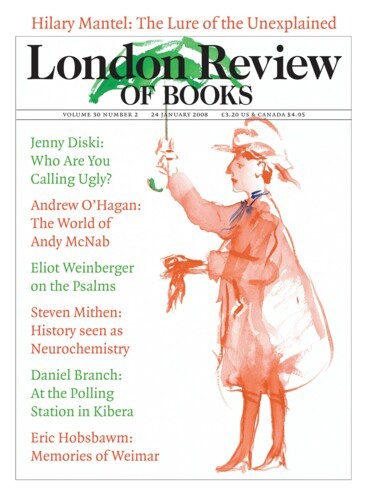
Living It: The World of Andy McNab

Andrew O’Hagan, 24 January 2008

If you want to know what is happening in the mind of the average teenage boy you must follow the action of his thumbs

Short Cuts: Don’t panic

Andrew O’Hagan, 13 December 2007

Some years ago I went to see the coroner at St Pancras. It was a bright afternoon, and daylight poured in from the old graveyard, a place that, in those days, had no very profound connection with the mainland of Europe, unless you consider the graves of Mary Shelley’s parents (now removed) to summon the connection between France and England more congenially than the Eurotunnel. The...

Poor Hitler: Toff Humour

Andrew O’Hagan, 15 November 2007

People who are serious about the business of not taking themselves seriously can have enormous fun as writers. The world of posh writing is full of minor writers getting away with murder, as in this passage from Julian Fellowes’s recent novel Snobs:

They lived in a large flat in Elm Park Gardens, which was almost at the wrong end of Chelsea and not quite to Mrs Lavery’s taste....

About a third of the way through his first book, The Missing, Andrew O’Hagan pauses over a perception he thinks his readers may find ‘a bit surprising’. It’s an intricate...

Read more reviews

Read anywhere with the London Review of Books app, available now from the App Store for Apple devices, Google Play for Android devices and Amazon for your Kindle Fire.

Sign up to our newsletters

For highlights from the latest issue, our archive and the blog, as well as news, events and exclusive promotions.

Newsletter Preferences